


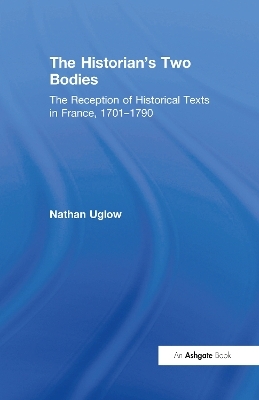
The Historian's Two Bodies
The Reception of Historical Texts in France, 1701–1790
Seiten
2000
Routledge (Verlag)
978-0-7546-0223-1 (ISBN)
Routledge (Verlag)
978-0-7546-0223-1 (ISBN)
This text describes certain paradoxical factors in the way that 18th century French writers and readers of historical texts were able to discuss the nature of history and to formulate their activities accordingly.
The discipline of history defines itself in terms of proof not trust. However, in the eighteenth century it became embarrassingly clear that the capacity of the past to appear as a totality under the critical control of the present eluded historical practice at every stage from research to judgement and to the critical reception of that judgement. Was history a practical but uncritical resource (the ’Temple of Fame’), or a self-enclosed critical project ever shy of ultimate truth? Technical manuals and journal reviews repeatedly reasserted fundamental criteria for acceptable historical practice, but failed to eradicate confusion between coping with and exploiting the information differentials between historical actors, historians, and readers of historical texts. The Historian’s Two Bodies offers a detailed analysis of this basic problem and its various repercussions for the competing perceptions of the historical task in eighteenth-century France while, importantly, denying itself any historical position free from such difficulties.
The discipline of history defines itself in terms of proof not trust. However, in the eighteenth century it became embarrassingly clear that the capacity of the past to appear as a totality under the critical control of the present eluded historical practice at every stage from research to judgement and to the critical reception of that judgement. Was history a practical but uncritical resource (the ’Temple of Fame’), or a self-enclosed critical project ever shy of ultimate truth? Technical manuals and journal reviews repeatedly reasserted fundamental criteria for acceptable historical practice, but failed to eradicate confusion between coping with and exploiting the information differentials between historical actors, historians, and readers of historical texts. The Historian’s Two Bodies offers a detailed analysis of this basic problem and its various repercussions for the competing perceptions of the historical task in eighteenth-century France while, importantly, denying itself any historical position free from such difficulties.
Nathan Uglow, University of Reading, UK
Contents: The discourse of history in eighteenth-century France; What is history?; A practical discipline; Homo Scriptans and Mastery; Homo Scriptus: Ethical criticism; Conclusion; Appendix I. ’Portrait de Juste Lipse’; Bibliography; Index.
| Erscheint lt. Verlag | 28.12.2000 |
|---|---|
| Verlagsort | London |
| Sprache | englisch |
| Maße | 152 x 229 mm |
| Gewicht | 453 g |
| Themenwelt | Geschichte ► Allgemeine Geschichte ► Neuzeit (bis 1918) |
| Geisteswissenschaften ► Geschichte ► Regional- / Ländergeschichte | |
| Geisteswissenschaften ► Sprach- / Literaturwissenschaft ► Anglistik / Amerikanistik | |
| ISBN-10 | 0-7546-0223-0 / 0754602230 |
| ISBN-13 | 978-0-7546-0223-1 / 9780754602231 |
| Zustand | Neuware |
| Informationen gemäß Produktsicherheitsverordnung (GPSR) | |
| Haben Sie eine Frage zum Produkt? |
Mehr entdecken
aus dem Bereich


aus dem Bereich
Geschichte einer wilden Handlung
Buch | Hardcover (2024)
C.H.Beck (Verlag)
CHF 47,60


