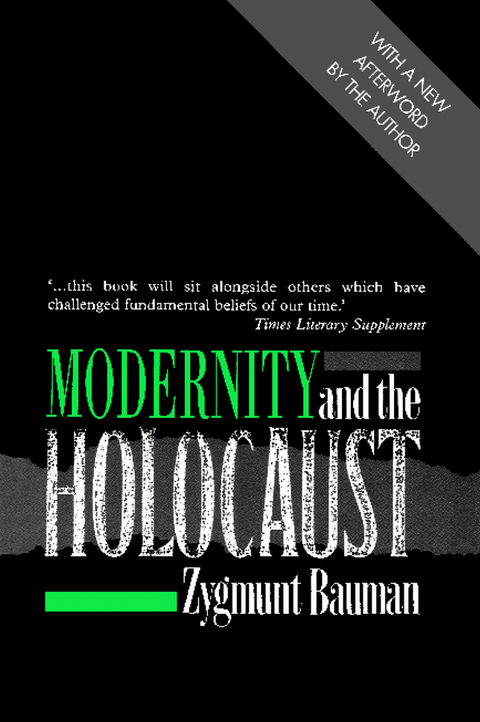
The book examines what sociology can teach us about the Holocaust, but more particularly concentrates upon the lessons which the Holocaust has for sociology. Bauman's work demonstrates that the Holocaust has to be understood as deeply involved with the nature of modernity. There is nothing comparable to this work available in the sociological literature.
Zygmunt Bauman is the author of many works including Legislators and Interpreters (Polity Press) and Modernity and Ambivalence (Polity Press). He was also awarded the Theodor W. Adorno Prize in 1998.
Sociology is concerned with modern society, but has never come to terms with one of the most distinctive and horrific aspects of modernity - the Holocaust. The book examines what sociology can teach us about the Holocaust, but more particularly concentrates upon the lessons which the Holocaust has for sociology. Bauman's work demonstrates that the Holocaust has to be understood as deeply involved with the nature of modernity. There is nothing comparable to this work available in the sociological literature.
Zygmunt Bauman (1925-2017) was Professor Emeritus of Sociology at the Universities of Leeds and Warsaw. He is the author of many works including Legislators and Interpreters (Polity Press) and Modernity and Ambivalence (Polity Press). He was also awarded the Theodor W. Adorno Prize in 1998.
Foreword.
1. Introduction: Sociology after the Holocaust.
2. Modernity, Racism, Extermination - I.
3. Modernity, Racism, Extermination - II.
4. On the Uniqueness and Normality of the Holocaust.
5. Soliciting Cooperation of the Victims.
6. The Ethics of Obedience (reading Milgram).
7. Towards a Sociological Theory of Morality Rationality and
Shame.
Index.
'Modernity and the Holocaust is a very fine book. Broad in
scope and penetrating in analysis, it is disturbing as its subject
matter demands, yet never fails to preserve the crucial element of
reflective distance out of which new or more acute knowledge is
able to emerge.' Times Higher Education Supplement
'Such is the concentrated brilliance of this study that it is
sure to find an appreciative audience in every field of research
which touches on the Holocaust.' Times Literary
Supplement
'This is a profound book, brilliant in its insights ... It
demands wide readership.' Political Studies
'The book should be widely read by students of the social
sciences, since it is, apart from a provocative analysis of
explanations of genocide, a critique of sociology, which Bauman
claims has neglected the ethical dilemmas posed by the destruction
of the Jews.' Sociology
1
Introduction: Sociology after the Holocaust
Civilization now includes death camps and Muselmänner among its material and spiritual products
Richard Rubenstein and John Roth, Approaches to Auschwitz
There are two ways to belittle, misjudge, or shrug off the significance of the Holocaust for sociology as the theory of civilization, of modernity, of modern civilization.
One way is to present the Holocaust as something that happened to the Jews; as an event in Jewish history. This makes the Holocaust unique, comfortably uncharacteristic and sociologically inconsequential. The most common example of such a way is the presentation of the Holocaust as the culmination point of European-Christian antisemitism – in itself a unique phenomenon with nothing to compare it with in the large and dense inventory of ethnic or religious prejudices and aggressions. Among all other cases of collective antagonisms, antisemitism stands alone for its unprecedented systematicity, for its ideological intensity, for its supra-national and supra-territorial spread, for its unique mix of local and ecumenical sources and tributaries. In so far as it is defined as, so to speak, the continuation of antisemitism through other means, the Holocaust appears to be a ‘one item set’, a one-off episode, which perhaps sheds some light on the pathology of the society in which it occurred, but hardly adds anything to our understanding of this society’s normal state. Less still does it call for any significant revision of the orthodox understanding of the historical tendency of modernity, of the civilizing process, of the constitutive topics of sociological inquiry.
Another way – apparently pointing in an opposite direction, yet leading in practice to the same destination – is to present the Holocaust as an extreme case of a wide and familiar category of social phenomena; a category surely loathsome and repellent, yet one we can (and must) live with. We must live with it because of its resilience and ubiquity, but above all because modern society has been all along, is and will remain, an organization designed to roll it back, and perhaps even to stamp it out altogether. Thus the Holocaust is classified as another item (however prominent) in a wide class that embraces many ‘similar’ cases of conflict, or prejudice, or aggression. At worst, the Holocaust is referred to a primeval and culturally inextinguishable, ‘natural’ predisposition of the human species – Lorenz’s instinctual aggression or Arthur Koestler’s failure of the neo-cortex to control the ancient, emotion-ridden part of the brain.1 As pre-social and immune to cultural manipulation, factors responsible for the Holocaust are effectively removed from the area of sociological interest. At best, the Holocaust is cast inside the most awesome and sinister – yet still theoretically assimilable category – of genocide; or else simply dissolved in the broad, all-too-familiar class of ethnic, cultural or racial oppression and persecution.2
Whichever of the two ways is taken, the effects are very much the same. The Holocaust is shunted into the familiar stream of history:
When viewed in this fashion, and accompanied with the proper citation of other historical horrors (the religious crusades, the slaughter of Albigensian heretics, the Turkish decimation of the Armenians, and even the British invention of concentration camps during the Boer War), it becomes all too convenient to see the Holocaust as ‘unique’ – but normal, after all.3
Or the Holocaust is traced back to the only-too-familiar record of the hundreds of years of ghettos, legal discrimination, pogroms and persecutions of Jews in Christian Europe – and so revealed as a uniquely horrifying, yet fully logical consequence of ethnic and religious hatred. One way or the other, the bomb is defused; no major revision of our social theory is really necessary; our visions of modernity, of its unrevealed yet all-too-present potential, its historical tendency, do not require another hard look, as the methods and concepts accumulated by sociology are fully adequate to handle this challenge – to ‘explain it’, to ‘make sense of it’, to understand. The overall result is theoretical complacency. Nothing, really, happened to justify another critique of the model of modern society that has served so well as the theoretical framework and the pragmatic legitimation of sociological practice.
Thus far, significant dissent with this complacent, self-congratulating attitude has been voiced mostly by historians and theologians. Little attention has been paid to these voices by the sociologists. When compared with the awesome amount of work accomplished by the historians, and the volume of soul-searching among both Christian and Jewish theologians, the contributions of professional sociologists to Holocaust studies seems marginal and negligible. Such sociological studies as have been completed so far show beyond reasonable doubt that the Holocaust has more to say about the state of sociology than sociology in its present shape is able to add to our knowledge of the Holocaust. This alarming fact has not yet been faced (much less responded to) by the sociologists.
The way the sociological profession perceives its task regarding the event called ‘the Holocaust’ has been perhaps most pertinently expressed by one of the profession’s most eminent representatives, Everett C. Hughes:
The National Socialist Government of Germany carried out the most colossal piece of ‘dirty work’ in history on the Jews. The crucial problems concerning such an occurrence are (1) who are the people who actually carry out such work and (2) what are the circumstances in which other ‘good’ people allow them to do it? What we need is better knowledge of the signs of their rise to power and better ways of keeping them out of power.4
True to the well-established principles of sociological practice, Hughes defines the problem as one of disclosing the peculiar combination of psycho-social factors which could be sensibly connected (as the determinant) with peculiar behavioural tendencies displayed by the ‘dirty work’ perpetrators; of listing another set of factors which detract from the (expected, though not forthcoming) resistance to such tendencies on the part of other individuals; and of gaining in the result a certain amount of explanatory-predictive knowledge which in this rationally organized world of ours, ruled as it is by causal laws and statistical probabilities, will allow its holders to prevent the ‘dirty’ tendencies from coming into existence, from expressing themselves in actual behaviour and achieving their deleterious, ‘dirty’ effects. The latter task will be presumably attained through the application of the same model of action that has made our world rationally organized, manipulable and ‘controllable’. What we need is a better technology for the old – and in no way discredited – activity of social engineering.
In what has been so far the most notable among the distinctly sociological contributions to the study of the Holocaust, Helen Fein5 has faithfully followed Hughes’s advice. She defined her task as that of spelling out a number of psychological, ideological and structural variables which most strongly correlate with percentages of Jewish victims or survivors inside various state-national entities of Nazi-dominated Europe. By all orthodox standards, Fein produced a most impressive piece of research. Properties of national communities, intensity of local antisemitism, degrees of Jewish acculturation and assimilation, the resulting cross-communal solidarity have all been carefully and correctly indexed, so that correlations may be properly computed and checked for their relevance. Some hypothetical connections are shown to be non-existent or at least statistically invalid; some other regularities are statistically confirmed (like the correlation between the absence of solidarity and the likelihood that ‘people would become detached from moral constraints’). It is precisely because of the impeccable sociological skills of the author, and the competence with which they are put in operation, that the weaknesses of orthodox sociology have been inadvertently exposed in Fein’s book. Without revising some of the essential yet tacit assumptions of sociological discourse, one cannot do anything other than what Fein has done; conceive of the Holocaust as a unique yet fully determined product of a particular concatenation of social and psychological factors, which led to a temporary suspension of the civilizational grip in which human behaviour is normally held. On such a view (implicitly if not explicitly) one thing that emerges from the experience of the Holocaust intact and unscathed is the humanizing and/or rationalizing (the two concept are used synonymously) impact of social organization upon inhuman drives which rule the conduct of pre- or anti-social individuals. Whatever moral instinct is to be found in human conduct is socially produced. It dissolves once society malfunctions. ‘In an anomic condition – free from social regulation – people may respond without regard to the possibility of injuring others.’6 By implication, the presence of effective social regulation makes such disregard unlikely. The thrust of social regulation – and thus of modern civilization, prominent as it is for...
| Erscheint lt. Verlag | 28.5.2013 |
|---|---|
| Sprache | englisch |
| Themenwelt | Geschichte ► Allgemeine Geschichte ► 1918 bis 1945 |
| Geisteswissenschaften ► Geschichte ► Regional- / Ländergeschichte | |
| Sozialwissenschaften ► Politik / Verwaltung | |
| Sozialwissenschaften ► Soziologie ► Allgemeine Soziologie | |
| Sozialwissenschaften ► Soziologie ► Spezielle Soziologien | |
| Schlagworte | Aspects • baumans • Book • concentrates • concerned • deeply • demonstrates • distinctive • Gesellschaftstheorie • Holocaust • Horrific • lessons • Modernity • Modern society • Nature • particularly • Political Issues & Behavior • Political Philosophy & Theory • Political Science • Politikwissenschaft • Politische Fragen u. politisches Verhalten • Politische Philosophie u. Politiktheorie • Social Theory • Sociology • Soziologie • Terms • understood • US • Work |
| ISBN-13 | 9780745638096 / 9780745638096 |
| Informationen gemäß Produktsicherheitsverordnung (GPSR) | |
| Haben Sie eine Frage zum Produkt? |
 EPUB (Adobe DRM)
Kopierschutz: Adobe-DRM
Adobe-DRM ist ein Kopierschutz, der das eBook vor Mißbrauch schützen soll. Dabei wird das eBook bereits beim Download auf Ihre persönliche Adobe-ID autorisiert. Lesen können Sie das eBook dann nur auf den Geräten, welche ebenfalls auf Ihre Adobe-ID registriert sind.
Details zum Adobe-DRM
Dateiformat: EPUB (Electronic Publication)
EPUB ist ein offener Standard für eBooks und eignet sich besonders zur Darstellung von Belletristik und Sachbüchern. Der Fließtext wird dynamisch an die Display- und Schriftgröße angepasst. Auch für mobile Lesegeräte ist EPUB daher gut geeignet.
Systemvoraussetzungen:
PC/Mac: Mit einem PC oder Mac können Sie dieses eBook lesen. Sie benötigen eine
eReader: Dieses eBook kann mit (fast) allen eBook-Readern gelesen werden. Mit dem amazon-Kindle ist es aber nicht kompatibel.
Smartphone/Tablet: Egal ob Apple oder Android, dieses eBook können Sie lesen. Sie benötigen eine
Geräteliste und zusätzliche Hinweise
Buying eBooks from abroad
For tax law reasons we can sell eBooks just within Germany and Switzerland. Regrettably we cannot fulfill eBook-orders from other countries.
aus dem Bereich