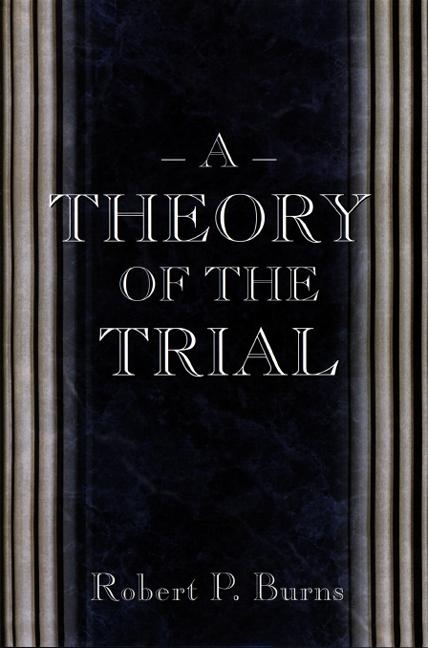
A Theory of the Trial (eBook)
Princeton University Press (Verlag)
978-1-4008-2337-6 (ISBN)
BurnsRobert P.:
Robert P. Burns is Professor of Law at Northwestern University School of Law, where he teaches evidence, legal ethics, and procedure. He has practiced law for twenty-five years and has published widely in law journals and reviews.
Anyone who has sat on a jury or followed a high-profile trial on television usually comes to the realization that a trial, particularly a criminal trial, is really a performance. Verdicts seem determined as much by which lawyer can best connect with the hearts and minds of the jurors as by what the evidence might suggest. In this celebration of the American trial as a great cultural achievement, Robert Burns, a trial lawyer and a trained philosopher, explores how these legal proceedings bring about justice. The trial, he reminds us, is not confined to the impartial application of legal rules to factual findings. Burns depicts the trial as an institution employing its own language and styles of performance that elevate the understanding of decision-makers, bringing them in contact with moral sources beyond the limits of law. Burns explores the rich narrative structure of the trial, beginning with the lawyers' opening statements, which establish opposing moral frameworks in which to interpret the evidence. In the succession of witnesses, stories compete and are held in tension. At some point during the performance, a sense of the right thing to do arises among the jurors. How this happens is at the core of Burns's investigation, which draws on careful descriptions of what trial lawyers do, the rules governing their actions, interpretations of actual trial material, social science findings, and a broad philosophical and political appreciation of the trial as a unique vehicle of American self-government.
Robert P. Burns is Professor of Law at Northwestern University School of Law, where he teaches evidence, legal ethics, and procedure. He has practiced law for twenty-five years and has published widely in law journals and reviews.
| Erscheint lt. Verlag | 1.1.2002 |
|---|---|
| Zusatzinfo | 2 line illus. |
| Verlagsort | Princeton |
| Sprache | englisch |
| Themenwelt | Geschichte ► Teilgebiete der Geschichte ► Militärgeschichte |
| Geisteswissenschaften ► Philosophie ► Allgemeines / Lexika | |
| Geisteswissenschaften ► Philosophie ► Ethik | |
| Recht / Steuern ► Allgemeines / Lexika | |
| Recht / Steuern ► EU / Internationales Recht | |
| Recht / Steuern ► Rechtsgeschichte | |
| Recht / Steuern ► Strafrecht | |
| Schlagworte | acquittal • Acting (law) • Adjudication • Allegation • appellate court • A Theory of Justice • attempt • Bench trial • Bicameralism (psychology) • Case study • Categorization • Cause of action • character evidence • Class action • Columbia Law Review • Common Law • Concept • Consideration • Coping (psychology) • counsel • Criminal Law • Critical Legal Studies • Decision-Making • defendant • Defense (legal) • Determination • Direct examination • Discharge (sentence) • Discovery (law) • Dispute Resolution • distributive justice • district attorney • Epistemology • Evidence (Law) • Experiment • Explanation • Federal Rules of Evidence • forensic rhetoric • Hannah Arendt • hierarchy of values • Historiography • Holism • Implicit invocation • indictment • inference • injunction • Judicial interpretation • Jury • jury instructions • jury trial • lawyer • Legal Doctrine • Legal Positivism • legal process • mandatory sentencing • Manifesto • Morality • narrative • Narrative Ethics • narrativity • National Institute for Trial Advocacy • Opening Statement • Persuasion • Philosophical investigations • Philosophy of Law • plaintiff • plea • Political Philosophy • Political statement • Precedent • Preliminary hearing • presumption • Prosecutor • questionnaire • Question of law • reason • Received view • Requirement • Research Program • rhetoric • Rule of inference • Rule of Law • self-evidence • show trial • State of affairs (philosophy) • Storytelling • Summary judgment • Suspect • The Juror • theory • The Various • Thought • tort reform • trial advocacy • trial court • Tribunal • University of California Press • Utilitarianism • Vocation • witness statement |
| ISBN-10 | 1-4008-2337-4 / 1400823374 |
| ISBN-13 | 978-1-4008-2337-6 / 9781400823376 |
| Informationen gemäß Produktsicherheitsverordnung (GPSR) | |
| Haben Sie eine Frage zum Produkt? |
 PDF (Wasserzeichen)
Größe: 954 KB
DRM: Digitales Wasserzeichen
Dieses eBook enthält ein digitales Wasserzeichen und ist damit für Sie personalisiert. Bei einer missbräuchlichen Weitergabe des eBooks an Dritte ist eine Rückverfolgung an die Quelle möglich.
Dateiformat: PDF (Portable Document Format)
Mit einem festen Seitenlayout eignet sich die PDF besonders für Fachbücher mit Spalten, Tabellen und Abbildungen. Eine PDF kann auf fast allen Geräten angezeigt werden, ist aber für kleine Displays (Smartphone, eReader) nur eingeschränkt geeignet.
Systemvoraussetzungen:
PC/Mac: Mit einem PC oder Mac können Sie dieses eBook lesen. Sie benötigen dafür einen PDF-Viewer - z.B. den Adobe Reader oder Adobe Digital Editions.
eReader: Dieses eBook kann mit (fast) allen eBook-Readern gelesen werden. Mit dem amazon-Kindle ist es aber nicht kompatibel.
Smartphone/Tablet: Egal ob Apple oder Android, dieses eBook können Sie lesen. Sie benötigen dafür einen PDF-Viewer - z.B. die kostenlose Adobe Digital Editions-App.
Buying eBooks from abroad
For tax law reasons we can sell eBooks just within Germany and Switzerland. Regrettably we cannot fulfill eBook-orders from other countries.
 EPUB (Adobe DRM)
Kopierschutz: Adobe-DRM
Adobe-DRM ist ein Kopierschutz, der das eBook vor Mißbrauch schützen soll. Dabei wird das eBook bereits beim Download auf Ihre persönliche Adobe-ID autorisiert. Lesen können Sie das eBook dann nur auf den Geräten, welche ebenfalls auf Ihre Adobe-ID registriert sind.
Details zum Adobe-DRM
Dateiformat: EPUB (Electronic Publication)
EPUB ist ein offener Standard für eBooks und eignet sich besonders zur Darstellung von Belletristik und Sachbüchern. Der Fließtext wird dynamisch an die Display- und Schriftgröße angepasst. Auch für mobile Lesegeräte ist EPUB daher gut geeignet.
Systemvoraussetzungen:
PC/Mac: Mit einem PC oder Mac können Sie dieses eBook lesen. Sie benötigen eine
eReader: Dieses eBook kann mit (fast) allen eBook-Readern gelesen werden. Mit dem amazon-Kindle ist es aber nicht kompatibel.
Smartphone/Tablet: Egal ob Apple oder Android, dieses eBook können Sie lesen. Sie benötigen eine
Geräteliste und zusätzliche Hinweise
Buying eBooks from abroad
For tax law reasons we can sell eBooks just within Germany and Switzerland. Regrettably we cannot fulfill eBook-orders from other countries.
aus dem Bereich