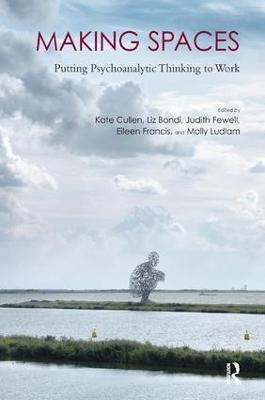
Making Spaces
Karnac Books (Verlag)
978-1-78049-165-3 (ISBN)
Liz Bondi is Professor of Social Geography at the University of Edinburgh, where she contributes to professional education in Counselling and Psychotherapy, primarily at doctoral level. She began her academic career in human geography, which she continued while training part-time in counselling. After completing her training she joined SIHR. Combining her academic background in human geography (and the social sciences more generally) with her interest in counselling and psychotherapy, she has lead or contributed to a series of research projects about the cultural shaping of counselling and psychotherapy in Scotland. She also applies ideas from counselling and psychotherapy to the developing field of "emotional geographies". She is founding editor of the journal 'Emotion, Space and Society' and author of numerous academic papers as well as co-editor or co-author of several books. She is a COSCA-accredited counsellor who maintains a small practise in the voluntary sector. Kate Cullen is a psychoanalytic psychotherapist in private practice. She trained initially as a teacher and worked in secondary schools in the UK and in West Africa. Her work as a pastoral care teacher led her to train as a counselling psychologist and later to train as a psychoanalytic psychotherapist at the London Centre for Psychotherapy. On returning to Scotland in 2006, she joined SIHR (the Scottish Institute of Human Relations) and worked in the Adult Psychoanalytic Psychotherapy Service. She has a private practice in Fife. Judith Fewell is a psychoanalytic psychotherapist in private practice in Edinburgh and Honorary Fellow at the University of Edinburgh. For many years she worked as a freelance trainer within the statutory and voluntary sectors in Scotland delivering workshops and courses based on psychodynamic thinking for professionals and volunteers whilst training as a psychoanalytic psychotherapist at the SIHR. She took up a post at the University of Edinburgh in Counselling and Psychotherapy during the course of which she contributed to the development and delivery of the postgraduate Diploma in Counselling, supervised masters and doctoral students and participated in the research programme. She has held a long term interest in, and commitment to, the single case study as a legitimate form of research into psychotherapeutic practices and understandings. This has led her to explore and write about how personal and professional narratives of the psychotherapist can help illustrate and illuminate psychoanalytic theory and practice. Eileen Francis worked as a speech and language therapist in health and education settings before becoming a lecturer in the Speech Unit at Moray House Institute of Education, Edinburgh. She later became a member of the department of professional and curriculum support studies and was appointed senior lecturer. She is a former President of the Scottish Educational Research Association and chaired the Board of SIHR from 2005-2010. Molly Ludlam is a psychoanalytic psychotherapist with couples, individuals, and parents in private practice and a Full Member of the British Society of Couple Psychotherapists and Counsellors, and Member of the International Council of Editors of Psychoanalytic Journals. She is author, editor and contributor to many books and journals.
ACKNOWLEDGEMENTSABOUT THE EDITORS AND CONTRIBUTORSFOREWORD by Monica LanyadoPART I OPENING UP SPACES FOR PSYCHOANALYTIC THINKING CHAPTER ONE The development of psychoanalytic spaces in Scotland: historical overview and introduction Liz Bondi and Molly Ludlam CHAPTER TWO Inner and outer worlds: then and now Jill Savege Scharff CHAPTER THREE A liminal practice? Making interdisciplinary spaces for psychoanalysis Liz BondiPART II MAKING SPACE TO LOVE CHAPTER FOUR The "Fort Da" game and other stories from infant observation Nicola Chadd CHAPTER FIVE Learning from experience: developing observation skills and reflective thinking in social work practice with children and families Debbie Hindle and Alexandra Scott CHAPTER SIX Scotland the brave: freedom to roam between individual, family, systemic, and social perspectives in psychoanalytic work with children and young people Joan Herrmann CHAPTER SEVEN The perinatally depressed couple and the work of mourning: a development imperative Molly LudlamPART III MAKING SPACE TO WORK CHAPTER EIGHT Temenos or ivory tower? Academic pedagogy through a psychodynamic lens Lindy Barbour CHAPTER NINE Precious gift or poisoned chalice: what does psychoanalysis offer to social research? Sue Jervis CHAPTER TEN The inner voice: building the institution in the mind Eileen Francis CHAPTER ELEVEN Knowing (and not knowing) one's place: organisational ranking and the operation of envy and shame in organisational life Marie KanePART IV MAKING SPACE TO GROW CHAPTER TWELVE The heart has its reasons: reflections on working with a relational supervision group Susan Lendrum CHAPTER THIRTEEN Thinking under fire: the experience of staff at the front line of mental health services Grant Wilkie CHAPTER FOURTEEN Ministers ministering to ministers: psychoanalytic reflections Murray Leishman CHAPTER FIFTEEN A plea to "see into the life of things": thinking psychoanalytically about later life Susan Maciver and Tom C. RussINDEX
| Erscheint lt. Verlag | 10.6.2014 |
|---|---|
| Verlagsort | London |
| Sprache | englisch |
| Maße | 147 x 230 mm |
| Themenwelt | Geisteswissenschaften ► Psychologie ► Arbeits- und Organisationspsychologie |
| Geisteswissenschaften ► Psychologie ► Psychoanalyse / Tiefenpsychologie | |
| ISBN-10 | 1-78049-165-4 / 1780491654 |
| ISBN-13 | 978-1-78049-165-3 / 9781780491653 |
| Zustand | Neuware |
| Informationen gemäß Produktsicherheitsverordnung (GPSR) | |
| Haben Sie eine Frage zum Produkt? |
aus dem Bereich