


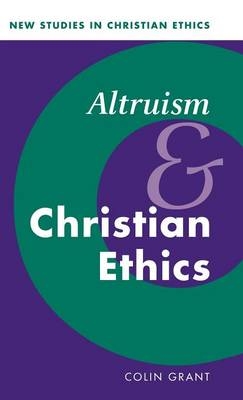
Altruism and Christian Ethics
Seiten
2000
Cambridge University Press (Verlag)
978-0-521-79144-1 (ISBN)
Cambridge University Press (Verlag)
978-0-521-79144-1 (ISBN)
This book contends that, as a modern secular concept, altruism is a parody on the self-giving love of Christianity, so that its dismissal represents a social levelling that loses the depths that theology makes intelligible and religion makes possible.
Separated from its anchorage in religion, ethics has followed the social sciences in seeing human beings as fundamentally characterised by self-interest, so that altruism is either naively idealistic or arrogantly self-sufficient. Colin Grant contends that, as a modern secular concept, altruism is a parody on the self-giving love of Christianity, so that its dismissal represents a social levelling that loses the depths that theology makes intelligible and religion makes possible. The Christian affirmation is that God is characterised by self-giving love (agape), then expected of Christians. Lacking this theological background, the focus on self-interest in sociobiology and economics, and on human realism in the political focus of John Rawls or the feminist sociability of Carol Gilligan, finds altruism naive or a dangerous distraction from real possibilities of mutual support. This book argues that to dispense with altruism is to dispense with God and with the divine transformation of human possibilities.
Separated from its anchorage in religion, ethics has followed the social sciences in seeing human beings as fundamentally characterised by self-interest, so that altruism is either naively idealistic or arrogantly self-sufficient. Colin Grant contends that, as a modern secular concept, altruism is a parody on the self-giving love of Christianity, so that its dismissal represents a social levelling that loses the depths that theology makes intelligible and religion makes possible. The Christian affirmation is that God is characterised by self-giving love (agape), then expected of Christians. Lacking this theological background, the focus on self-interest in sociobiology and economics, and on human realism in the political focus of John Rawls or the feminist sociability of Carol Gilligan, finds altruism naive or a dangerous distraction from real possibilities of mutual support. This book argues that to dispense with altruism is to dispense with God and with the divine transformation of human possibilities.
Part I. Alien Altruism: 1. Explanations for altruism; 2. Evidence of altruism; 3. The elusiveness of altruism; Part II. Ideal Altruism: 4. Contract altruism; 5. Constructed altruism; 6. Collegial altruism; Part III. Real Altruism: 7. Acute altruism: agape; 8. Absolute altruism; 9. Actual altruism.
| Erscheint lt. Verlag | 16.11.2000 |
|---|---|
| Reihe/Serie | New Studies in Christian Ethics |
| Verlagsort | Cambridge |
| Sprache | englisch |
| Maße | 140 x 216 mm |
| Gewicht | 456 g |
| Themenwelt | Religion / Theologie ► Christentum ► Kirchengeschichte |
| Religion / Theologie ► Christentum ► Moraltheologie / Sozialethik | |
| ISBN-10 | 0-521-79144-8 / 0521791448 |
| ISBN-13 | 978-0-521-79144-1 / 9780521791441 |
| Zustand | Neuware |
| Informationen gemäß Produktsicherheitsverordnung (GPSR) | |
| Haben Sie eine Frage zum Produkt? |
Mehr entdecken
aus dem Bereich


aus dem Bereich
eine andere Geschichte der Papststadt
Buch | Softcover (2024)
C.H.Beck (Verlag)
CHF 25,20
die Macht des Dunklen in unserer Zeit und wie wir ihr entgegentreten
Buch | Hardcover (2025)
Verlag Herder
CHF 27,90


