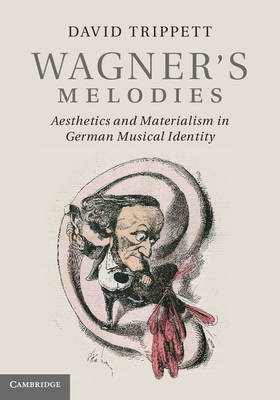
Wagner's Melodies (eBook)
Cambridge University Press (Verlag)
978-1-107-06943-5 (ISBN)
Since the 1840s, critics have lambasted Wagner for lacking the ability to compose melody. But for him, melody was fundamental—'music's only form.' This incongruity testifies to the surprising difficulties during the nineteenth century of conceptualizing melody. Despite its indispensable place in opera, contemporary theorists were unable even to agree on a definition for it. In Wagner's Melodies, David Trippett re-examines Wagner's central aesthetic claims, placing the composer's ideas about melody in the context of the scientific discourse of his age: from the emergence of the natural sciences and historical linguistics to sources about music's stimulation of the body and inventions for 'automatic' composition. Interweaving a rich variety of material from the history of science, music theory, music criticism, private correspondence and court reports, Trippett uncovers a new and controversial discourse that placed melody at the apex of artistic self-consciousness and generated problems of urgent dimensions for German music aesthetics.
Since the 1840s, critics have lambasted Wagner for lacking the ability to compose melody. But for him, melody was fundamental - ''music''s only form''. This incongruity testifies to the surprising difficulties during the nineteenth century of conceptualizing melody. Despite its indispensable place in opera, contemporary theorists were unable even to agree on a definition for it. In Wagner''s Melodies, David Trippett re-examines Wagner''s central aesthetic claims, placing the composer''s ideas about melody in the context of the scientific discourse of his age: from the emergence of the natural sciences and historical linguistics to sources about music''s stimulation of the body and inventions for ''automatic'' composition. Interweaving a rich variety of material from the history of science, music theory, music criticism, private correspondence and court reports, Trippett uncovers a new and controversial discourse that placed melody at the apex of artistic self-consciousness and generated problems of urgent dimensions for German music aesthetics.
| Erscheint lt. Verlag | 2.5.2013 |
|---|---|
| Sprache | englisch |
| Themenwelt | Kunst / Musik / Theater ► Musik ► Klassik / Oper / Musical |
| Geisteswissenschaften ► Geschichte | |
| ISBN-10 | 1-107-06943-2 / 1107069432 |
| ISBN-13 | 978-1-107-06943-5 / 9781107069435 |
| Informationen gemäß Produktsicherheitsverordnung (GPSR) | |
| Haben Sie eine Frage zum Produkt? |
 PDF (Adobe DRM)
Kopierschutz: Adobe-DRM
Adobe-DRM ist ein Kopierschutz, der das eBook vor Mißbrauch schützen soll. Dabei wird das eBook bereits beim Download auf Ihre persönliche Adobe-ID autorisiert. Lesen können Sie das eBook dann nur auf den Geräten, welche ebenfalls auf Ihre Adobe-ID registriert sind.
Details zum Adobe-DRM
Dateiformat: PDF (Portable Document Format)
Mit einem festen Seitenlayout eignet sich die PDF besonders für Fachbücher mit Spalten, Tabellen und Abbildungen. Eine PDF kann auf fast allen Geräten angezeigt werden, ist aber für kleine Displays (Smartphone, eReader) nur eingeschränkt geeignet.
Systemvoraussetzungen:
PC/Mac: Mit einem PC oder Mac können Sie dieses eBook lesen. Sie benötigen eine
eReader: Dieses eBook kann mit (fast) allen eBook-Readern gelesen werden. Mit dem amazon-Kindle ist es aber nicht kompatibel.
Smartphone/Tablet: Egal ob Apple oder Android, dieses eBook können Sie lesen. Sie benötigen eine
Geräteliste und zusätzliche Hinweise
Buying eBooks from abroad
For tax law reasons we can sell eBooks just within Germany and Switzerland. Regrettably we cannot fulfill eBook-orders from other countries.
aus dem Bereich