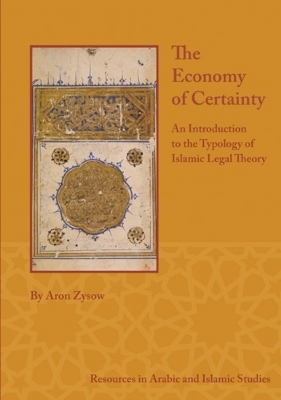
The Economy of Certainty
Lockwood Press (Verlag)
978-1-937040-09-3 (ISBN)
Aron Zysow's 1984 PhD dissertation, 'The Economy of Certainty,' remains the most important, compelling, and intellectually ambitious treatment of Islamic legal theory (usul al-fiqh) in Western scholarship to date. It continues to be widely read and cited, and remains unsurpassed in its incisive analysis of the fundamental assumptions of Islamic legal thought.
Zysow's important work is published here in full, for the first time, with updated references, further reflections by the author, and with the addition of a nine-page Foreword by Robert Gleave.
Zysow argues that the great dividing line in Islamic legal thought is between those legal theories that require certainty in every detail of the law and those that will admit probability. The latter were historically dominant and include the leading legal schools that have survived to our own day. Zahirism and, for much of its history, Twelver Shi'ism, are examples of the former.
The well-known dispute regarding the legitimacy of juridical analogy is only one feature of this fundamental epistemological division, since probability can enter the law in the process of authenticating prophetic traditions and in the interpretation of the revealed texts, as well as through analogy. The notion of consensus in Islamic legal theory functioned to reintroduce some measure of certainty into the law by identifying one of the competing probable solutions as correct. Consequently, consensus has only a reduced role in those systems that reject probability. Another, more radical, means of regaining certainty was the doctrine that regarded the legal reasoning of all qualified jurists on matters of probability as infallible. The development of legal theories of both types was to a large extent shaped by theology and, most significantly, by Mu'tazilism, and subsequently by Ash'arism and Maturidism.
Aron Zysow received his A.B. (Classics), Ph.D. (Islamic Studies), and J.D. from Harvard. From 2000 to 2005 he served as Research Associate for the Islamic Legal Studies Program at Harvard Law School. Before that he taught Arabic and Islamic Studies at the University of Washington in Seattle and Washington University in St. Louis and commercial law at Baruch College, City University of New York. Prior to his academic career he worked as an attorney in New York City. His main academic interests are Islamic law, particularly legal theory, and theology. He is a former fellow of The Institute for the Transregional Study of the Contemporary Middle East, North Africa and Central Asia (TRI) at Princeton University, where he also taught in the Department of Near Eastern Studies.
Series Editor's Preface
Foreword
Author's Preface
Acknowledgements
Abbreviations
Introduction
1. The Authentication of Prophetic Traditions
2. Interpretation
3. Consensus
4. Analogy
5. IJTIHÄD
Epilogue
Bibliography
Works Cited in the Addenda and Preface
Table of Page Correspondences
Index of Qur'än Citations
Index of Arabic Terms and Proper Names
| Erscheint lt. Verlag | 1.10.2013 |
|---|---|
| Reihe/Serie | Resources in Arabic and Islamic Studies |
| Verlagsort | Atlanta |
| Sprache | englisch |
| Maße | 178 x 254 mm |
| Gewicht | 626 g |
| Themenwelt | Geschichte ► Teilgebiete der Geschichte ► Militärgeschichte |
| Recht / Steuern ► Allgemeines / Lexika | |
| Recht / Steuern ► EU / Internationales Recht | |
| Recht / Steuern ► Rechtsgeschichte | |
| ISBN-10 | 1-937040-09-7 / 1937040097 |
| ISBN-13 | 978-1-937040-09-3 / 9781937040093 |
| Zustand | Neuware |
| Informationen gemäß Produktsicherheitsverordnung (GPSR) | |
| Haben Sie eine Frage zum Produkt? |
aus dem Bereich