


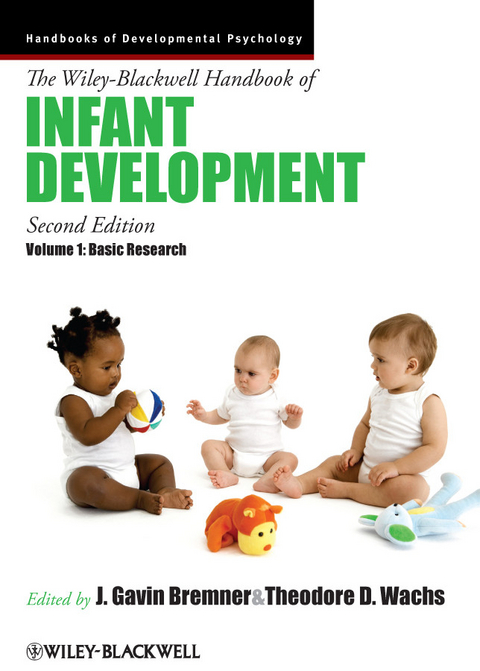
Wiley-Blackwell Handbook of Infant Development, Volume 1 (eBook)
696 Seiten
Wiley (Verlag)
9781444327571 (ISBN)
- Updated, fully-revised and expanded, this two-volume set presents in-depth and cutting edge coverage of both basic and applied developmental issues during infancy
- Features contributions by leading international researchers and practitioners in the field that reflect the most current theories and research findings
- Includes editor commentary and analysis to synthesize the material and provide further insight
- The most comprehensive work available in this dynamic and rapidly growing field
J. Gavin Bremner is Professor of Developmental Psychology at Lancaster University. He has investigated perception and cognition in infancy for more than 30 years, and has published numerous papers and books relating to this topic. His current research interests include infants’ perception of object trajectories and infants’ intersensory perception.
Theodore D. Wachs is Professor of Psychological Sciences at Purdue University. He is a member of the editorial boards of the International Journal of Behavioral Development and the Journal of Applied Developmental Psychology. His current research focuses on chaotic family environments and infant development; micro-nutrient deficiencies in infancy and cognitive and social-emotional development; and temperament in infancy and childhood.
Now part of a two-volume set, the fully revised and updated second edition of The Wiley-Blackwell Handbook of Infant Development, Volume 1: Basic Research provides comprehensive coverage of the basic research relating to infant development. Updated, fully-revised and expanded, this two-volume set presents in-depth and cutting edge coverage of both basic and applied developmental issues during infancy Features contributions by leading international researchers and practitioners in the field that reflect the most current theories and research findings Includes editor commentary and analysis to synthesize the material and provide further insight The most comprehensive work available in this dynamic and rapidly growing field
J. Gavin Bremner is Professor of Developmental Psychology at Lancaster University. He has investigated perception and cognition in infancy for more than 30 years, and has published numerous papers and books relating to this topic. His current research interests include infants' perception of object trajectories and infants' intersensory perception. Theodore D. Wachs is Professor of Psychological Sciences at Purdue University. He is a member of the editorial boards of the International Journal of Behavioral Development and the Journal of Applied Developmental Psychology. His current research focuses on chaotic family environments and infant development; micro-nutrient deficiencies in infancy and cognitive and social-emotional development; and temperament in infancy and childhood.
Preface (Gavin Bremner and Theodore D. Wachs).
Chapter 1: Historical Reflections on Intimacy (Alan Fogel, University of Utah).
Part I: Basic perceptual and cognitive development.
Chapter 2: Visual perception (Alan Slater, Washington Singer Laboratories, Patricia Riddell, University of Reading, Paul C. Quinn, University of Delaware, Olivier Pascalis, University of Sheffield, Kang Lee, University of Toronto, and David J. Kelly, University of Glasgow).
Chapter 3: Auditory Development (Denis Burnham, University of Western Sydney, and Karen Mattock, Lancaster University).
Chapter 4: Intermodal Perception and Selective Attention to Intersensory Redundancy: Implications for Typical Social Development and Autism (Lorraine E. Bahrick, Florida International University).
Chapter 5: Action in Infancy - Perspectives, Concepts, and Challenges (Ad Smitsman, Radboud University, and Daniela Corbetta, University of Tennessee).
Chapter 6: Cognitive Development: Knowledge of the physical world (Gavin Bremner, Lancaster University).
Chapter 7: Perceptual categorisation and concepts (David H. Rakison, Carnegie Mellon University).
Chapter 8: Infant learning and memory (Carolyn Rovee-Collier, Rutgers University, and Rachel Barr, Georgetown University).
Chapter 9: Functional brain development during infancy (Mark H. Johnson, Birkbeck College, University of London).
Part II: Social cognition, communication, and language.
Chapter 10: Emerging self-concept (Philippe Rochat, Emory University).
Chapter 11: The Importance of Imitation for Theories of Social-Cognitive Development (Andrew N. Meltzoff, University of Washington, and Rebecca A. Williamson, Georgia State University).
Chapter 12: Engaging Minds in the first year: The developing awareness of attention and intention (Vasudevi Reddy, Portsmouth University).
Chapter 13: Preverbal communication (Andrew Lock, Massey University, and Patricia Zukow-Goldring, University of California, Los Angeles).
Chapter 14: Early language (George Hollich, Purdue University).
Part III: Social-emotional development.
Chapter 15: Parent-infant interaction (Marc H. Bornstein, Eunice Kennedy Shriver National Institute of Child Health and Human Development, and Catherine S. Tamis-LeMonda, New York University).
Chapter 16: Attachment in infancy (Germán Posada and Garene Kaloustian, Purdue University).
Chapter 17: Early social cognitive skills at play in toddlers' peer interactions (Hildy Ross, University of Waterloo, Marcia Vickar, University of Waterloo, and Michal Perlman, University of Toronto).
Chapter 18: Touch and physical contact during infancy: Discovering the richness of the forgotten sense (Dale M. Stack, Concordia University).
Chapter 19: Emotion and its development in infancy (David C. Witherington, University of New Mexico, Joseph J. Campos, University of California, Berkeley, Jennifer A. Harriger, Cheryl Bryan, & Tessa E. Margett, University of New Mexico).
Chapter 20: Temperament (Theodore D. Wachs, Purdue University, and John E. Bates, Indiana University Bloomington).
Chapter 21: Culture and infancy (Charles M. Super and Sara Harkness, University of Connecticut).
Author Index.
Subject Index.
Contents of Volume 2: Applied and Policy Issues.
| Erscheint lt. Verlag | 29.6.2010 |
|---|---|
| Sprache | englisch |
| Themenwelt | Geisteswissenschaften ► Psychologie ► Entwicklungspsychologie |
| Schlagworte | Entwicklungspsychologie |
| ISBN-13 | 9781444327571 / 9781444327571 |
| Informationen gemäß Produktsicherheitsverordnung (GPSR) | |
| Haben Sie eine Frage zum Produkt? |
 PDF (Adobe DRM)
Größe: 5,1 MB
Kopierschutz: Adobe-DRM
Adobe-DRM ist ein Kopierschutz, der das eBook vor Mißbrauch schützen soll. Dabei wird das eBook bereits beim Download auf Ihre persönliche Adobe-ID autorisiert. Lesen können Sie das eBook dann nur auf den Geräten, welche ebenfalls auf Ihre Adobe-ID registriert sind.
Details zum Adobe-DRM
Dateiformat: PDF (Portable Document Format)
Mit einem festen Seitenlayout eignet sich die PDF besonders für Fachbücher mit Spalten, Tabellen und Abbildungen. Eine PDF kann auf fast allen Geräten angezeigt werden, ist aber für kleine Displays (Smartphone, eReader) nur eingeschränkt geeignet.
Systemvoraussetzungen:
PC/Mac: Mit einem PC oder Mac können Sie dieses eBook lesen. Sie benötigen eine
eReader: Dieses eBook kann mit (fast) allen eBook-Readern gelesen werden. Mit dem amazon-Kindle ist es aber nicht kompatibel.
Smartphone/Tablet: Egal ob Apple oder Android, dieses eBook können Sie lesen. Sie benötigen eine
Geräteliste und zusätzliche Hinweise
Buying eBooks from abroad
For tax law reasons we can sell eBooks just within Germany and Switzerland. Regrettably we cannot fulfill eBook-orders from other countries.
aus dem Bereich


