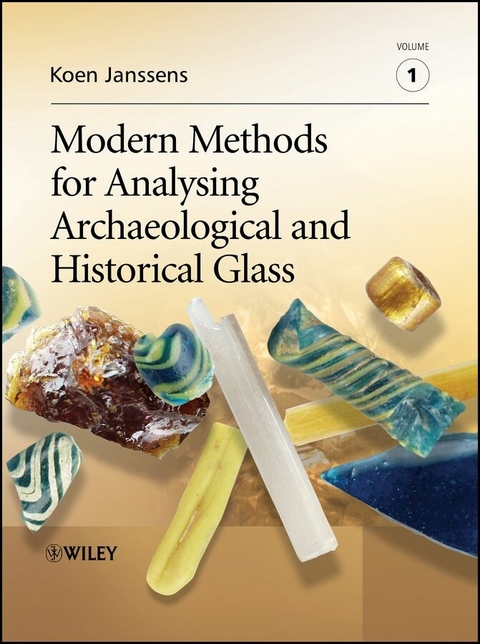
Modern Methods for Analysing Archaeological and Historical Glass (eBook)
John Wiley & Sons (Verlag)
978-1-118-31420-3 (ISBN)
The first scientific volume to compile the modern analytical techniques for glass analysis, Modern Methods for Analysing Archaeological and Historical Glass presents an up-to-date description of the physico-chemical methods suitable for determining the composition of glass and for speciation of specific components. This unique resource presents members of Association Internationale pour l'Histoire du Verre, as well as university scholars, with a number of case studies where the effective use of one or more of these methods for elucidating a particular culturo-historical or historo-technical aspect of glass manufacturing technology is documented.
Professor Koen Janssens is based in the Center for Micro- and Trace Analysis at the Department of Chemistry at the University of Antwerp in Belgium. He currently teaches undergraduates on General Chemistry -- Theory, Instrumental Analytical Chemistry, Radiochemistry, Micro- and Surface Analysis Methods and Practical Exercises in Analytical Chemistry. Since 1999 he has presented over 100 lectures and has published, since 1990, over 140 papers, book chapters/books. From 1999-2004 he served as an Associate Editor for Journal of Micro- and Trace Analysis, and since 2004 has served as an editorial board member of Spectrochimica Acta. His main area of research is as head of the x-ray microbeam analysis research group at the University of Antwerp which specializes in the use of X-ray microbeams for the non-destructive (trace) analysis and materials characterization.
Preface
Glass can be considered to be the first manmade polymeric material. Although relatively hard to make (since it requires a specific mixture of several ingredients and a sufficiently high working temperature to fuse them into an amorphous, homogeneous and transparent material), the earliest glass was already in use several thousands of years before Christ, e.g. in Egypt and other near-Eastern localities of advanced cultural development.
During its long and complex history, the technology and (resulting from that) the composition, and thus also the physico-chemical properties of glass and (resulting from that) the possible uses of glass in various societies (such as the Ancient Egyptians, the Iron age cultures, the Greeks, the Romans, the Byzantine and Ottoman civilizations, the European medieval and post-medieval states and also the Indian and Chinese cultures) have been subject to considerable evolution. The key to reading the rich history of the technology of glass making, glass colouring and glass shaping throughout the ages is the determination of the chemical composition of (sometimes minute) historic glass fragments, which in all the above-mentioned cultures are encountered in archaeological excavations.
Increasingly, next to the elemental composition, it is relevant to also extract information on the chemical speciation or the isotopic distribution of some major, minor or trace constituent(s) of historical glass fragments. Corrosion of glass, on the other hand, is a wide-spread phenomenon, for which a number of surface-specific methods are very useful.
This book attempts to bring together into one volume: (i) an up-to-date description of the physico-chemical methods suitable for determining the composition of glass and for speciation of specific components and (ii) a number of case studies where the effective use of one or more of these methods for elucidating a particular culturo-historical or historo-technical aspect of glass manufacturing technology is documented.
The book has been divided into several sections, each section being composed of 4–10 chapters. In the first section, the attention is devoted to describing glass as a material, including a discussion of its physico-chemical properties (Chapter 1.1). This chapter is followed by one (Chapter 1.2) that focuses on which raw materials have been used throughout the ages for glass making: with respect to both the silica and the ash/flux, a number of alternative sources have been used in different periods. Depending on the purity of these materials, glass can acquire different colours and tints. In Chapter 1.3, methods and materials employed in various periods for giving glass a particular colour, for obtaining colourless glass and/or for making opacified glass are treated. Also the various physical processes (such as absorption, scattering or interference of light) that can lead to a sensation of colour are discussed. The first section closes with Chapter 1.4 on how the composition of (European) glass has evolved throughout the centuries.
In the second section, several methods for determining the elemental composition and other properties of glass samples are described that employ energetic electromagnetic radiation. Chapter 2.1 treats the use of X-rays for elemental glass analysis at the major to the trace level, for speciation purposes and for 3D imaging of heterogeneous glass samples. Also methods that make use of synchrotron radiation are covered. This is followed by Chapter 2.2 on various forms of electron microscopy; in this chapter the exploration of the seemingly homogeneous glass material at the microscopic to the nanoscopic level by means of highly focused electron beams and related methods is discussed. In Chapter 2.3, the possibilities of analyzing minute glass fragments or entire glass vessels by means of ion beam methods are presented. As in the preceding chapters, next to elemental analysis per se, based on X-ray (or gamma) emission, via related methods such as Rutherford backscattering and elastic recoil detection analysis, certain forms of depth profiling are also possible. The fourth chapter in Section 2 deals with instrumental neutron activation analysis, a panoramic method of (trace) element analysis that has been frequently employed in glass provenancing studies.
To complement the methods described in the previous section, in Section 3 we find two chapters that deal with mass spectrometric methods that are now being increasingly used in glass provenancing studies; they are specifically oriented towards using patterns of (trace) elements or isotopic ratios of some geological tracers with the aim of making a more optimal distinction between the various sources of raw materials encountered in glass of different chronological and geographical origins.
In the fourth section of this book, methods are treated that go beyond elemental analysis: first, the use of different surface analysis methods for the characterization of (reactive) glass surfaces is treated in Chapter 4.1; this chapter describes methods such as secondary ion microscopy, atomic force microscopy and infrared reflection absorption spectroscopy. In Chapter 4.2, infrared and raman spectroscopy and microscopy as means of obtaining information on the different classes of Si−O bonds that are present in a silicate glass network, and how these are influenced by the composition and the state of corrosion of the glass are discussed. To conclude Section 4, Chapter 4.3 treats the use of X-ray absorption spectroscopy for the characterization of the chemical environment of metals present in silicate glass materials.
The remaining sections of the book comprise a series of studies in which one or a combination of the above-mentioned analytical methods are employed to characterize archaeological glass fragments, historic museum pieces in glass or other related materials. Studies of this kind can be performed having different objectives in mind.
A first and important objective is to reveal information on the provenance of (a series of mainly) archaeological glass fragments and/or to disclose information on the technology used to make and influence the colour of glass. Section 5 contains a number of chapters devoted to this endeavor. The first chapter of this section deals with provenance studies of glass that originates from various periods, ranging from obsidian, a natural glass used since Paleolithic times, through the first artificial glassy materials of the Neolithic period and the discovery of glass during the Bronze Age, to glass of the Iron Age, Antique, Medieval and Post-medieval periods. After this extensive chapter, a concise description of the glass found in the short-lived capital city of the Egyptian Pharao Akhenaten, Tell El-Amarna, in the delta of the Nile, is provided in Chapter 5.2. Since Amarna is the earliest scientifically excavated potential glass manufactory site known in either Egypt or the Near East, the finds from this location are crucial to understanding the earliest production of glass in the Antique period. In Chapter 5.3 the systematic characterization of Bronze Age Italian vitreous materials are reviewed in terms of their compositional, mineralogical, and textural variations in time. Chapter 5.4 is devoted to the analysis of black (appearing) glass from the Roman era, while Chapter 5.5 addresses Merovigian glass finds. In Chapters 5.6 to 5.8, Asian glass is given the focus of attention: in Chapter 5.6 an overview of the glass circulating through the Indian world is provided, while Chapter 5.7 discusses glass is South-East Asia. A description is provided of how the glass manufacturing industry was organized in ancient times in South Asia and what routes were used to exchange glass as a raw material or as finished objects. Chapter 5.8 deals with the trade in glass between the Near and the Far East, perhaps along the silk road or via the sea, and how portable X-ray-based analysis methods may be profitably used in this context. Finally Chapter 5.8 discusses the unravelling of sixteenth century trade patterns in Northern America between the aboriginal peoples of north-eastern North America and the increasing numbers of Europeans, via trace element analysis of glass beads.
Section 6 is composed of four chapters dealing with various types of (post) medieval glass. Chapter 6.1 focuses on medieval glass making and working in Tuscany and Liguria, while Chapter 6.2 addresses the evolution of the Venetian glass compositions. As a result of technology transfer, the practice of making clear, colourless glass gradually spread from Italy to Northern Europe in the sixteenth and seventeenth centuries. Chapter 6.3 discusses the compositional similarities and differences between genuine Venetian glass pieces and vessels made à-la-façon-de-Venise in north European urban centres such as Antwerp, Amsterdam and London. Glass produced on the basis of kelp ash for the Galerie des Glaçes of the Châteaux de Versailles is discussed in Chapter 6.4. Another clear type of glass that was invented in the last quarter of the seventeenth century is lead glass, the topic of Chapter 6.5.
The final section of the book (Section 7) includes a Chapter 7.1 on the characterization of nanoparticles that, when present in a glassy matrix, can give rise to glazes of different colours with surprising metallic reflections and dichroic effects. It was a frequently employed decoration technique for medieval and Renaissance pottery of the Mediterranean basin. The other chapters in this section deal with various aspects of glass weathering, a phenomenon frequently encountered in stained glass windows. In Chapter 7.2, the degradation of glass by liquids and atmospheric agents is discussed, while Chapter 7.3 focuses on the corrosion of...
| Erscheint lt. Verlag | 29.1.2013 |
|---|---|
| Sprache | englisch |
| Themenwelt | Geisteswissenschaften ► Archäologie |
| Geschichte ► Allgemeine Geschichte ► Vor- und Frühgeschichte | |
| Naturwissenschaften ► Chemie | |
| Technik ► Maschinenbau | |
| Schlagworte | advanced • already • Analytical Chemistry • Analytische Chemie • Archäologie • archaeology • Archäologie • BC • Ceramics • Chemie • Chemistry • Composition • Cultural • Earliest • Egypt • First • Glass • glassmaking • Historical Archaeology • Historische Archäologie • Historische Archäologie • History • keramische Werkstoffe • Localities • manmade • Material • Materials Science • Materialwissenschaften • physicochemical • Polymer • possible • Properties • Several • Societies • Subject • thousands • use • various • Werkstoffprüfung • Werkstoffprüfung • years |
| ISBN-10 | 1-118-31420-4 / 1118314204 |
| ISBN-13 | 978-1-118-31420-3 / 9781118314203 |
| Informationen gemäß Produktsicherheitsverordnung (GPSR) | |
| Haben Sie eine Frage zum Produkt? |
 EPUB (Adobe DRM)
Kopierschutz: Adobe-DRM
Adobe-DRM ist ein Kopierschutz, der das eBook vor Mißbrauch schützen soll. Dabei wird das eBook bereits beim Download auf Ihre persönliche Adobe-ID autorisiert. Lesen können Sie das eBook dann nur auf den Geräten, welche ebenfalls auf Ihre Adobe-ID registriert sind.
Details zum Adobe-DRM
Dateiformat: EPUB (Electronic Publication)
EPUB ist ein offener Standard für eBooks und eignet sich besonders zur Darstellung von Belletristik und Sachbüchern. Der Fließtext wird dynamisch an die Display- und Schriftgröße angepasst. Auch für mobile Lesegeräte ist EPUB daher gut geeignet.
Systemvoraussetzungen:
PC/Mac: Mit einem PC oder Mac können Sie dieses eBook lesen. Sie benötigen eine
eReader: Dieses eBook kann mit (fast) allen eBook-Readern gelesen werden. Mit dem amazon-Kindle ist es aber nicht kompatibel.
Smartphone/Tablet: Egal ob Apple oder Android, dieses eBook können Sie lesen. Sie benötigen eine
Geräteliste und zusätzliche Hinweise
Buying eBooks from abroad
For tax law reasons we can sell eBooks just within Germany and Switzerland. Regrettably we cannot fulfill eBook-orders from other countries.
aus dem Bereich