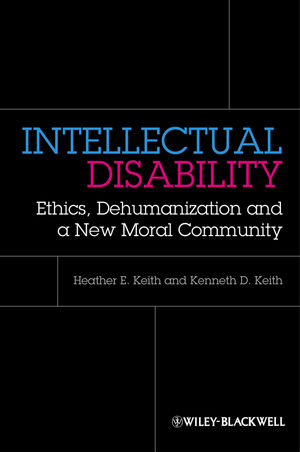
Intellectual Disability (eBook)
248 Seiten
John Wiley & Sons (Verlag)
978-1-118-58644-0 (ISBN)
* Examines the roots of disability ethics from a psychological, philosophical, and educational perspective
* Presents a coherent, sustained moral perspective in examining the historical dehumanization of people with diminished cognitive abilities
* Includes a series of narratives and case descriptions to illustrate arguments
* Reveals the importance of an interdisciplinary understanding of the social construction of intellectual disability
Heather E. Keith is Associate Professor of Philosophy at Green Mountain College, Vermont. Her work has appeared in such publications as The Transactions of the Charles S. Peirce Society, The Journal of Chinese Philosophy, Streams of William James, and the Encyclopedia of American Philosophy. Kenneth D. Keith is Professor Emeritus of Psychological Sciences at the University of San Diego. The author, co-author, or editor of more than 100 scientific and professional publications including The Wiley-Blackwell Encyclopedia of Cross-Cultural Psychology, Keith is also a Fellow of the American Psychological Association in the divisions on teaching and on international psychology, and a Fellow of the Western Psychological Association and the Association for Psychological Science.
Acknowledgements vii
Prologue:Why Study Disability? ix
Part I The Roots of Dehumanization 1
1 Intellectual Disability: History and Evolution of Definitions 3
2 The Social Construction of Purgatory: Ideas and Institutions 19
3 A Failure of Intelligence 37
4 The Consequences of Reason: Moral Philosophy and Intelligence 53
Part II Out of the Darkness 77
5 Defining the Person: The Moral and Social Consequences of Philosophies of Selfhood 79
6 Alternative Views of Moral Engagement: Relationality and Rationality 95
7 Culture and Intellectual Disability 116
Part III Disability Ethics for a New Age 131
8 Quality of Life and Perception of Self 133
9 Application and Best Practices: Rights, Education, and Ethics 151
10 Epilogue: Visions of the Future 170
References 177
Name Index 215
Subject Index 225
"The best use of this valuable contribution may be to
disseminate it to the decision makers, legislators, and health care
providers and, most importantly, to the educators and trainers who
can extract the gems from this treasure chest to increase the
wealth of knowledge and improve the awareness of direct workers,
families, medical/behavioral health students, and community members
about people with intellectual disabilities. In addition,
this book could be used to correct a significant concern regarding
the professionals who provide services to this
population." (PsycCRITIQUES, 28 April 2014)
"This well-thought-out reference is grounded in thorough
research with an engaging narrative. Summing Up: Highly
recommended. Lower-level undergraduates and above; general
readers." (Choice, 1 March 2014)
"It is entirely refreshing to read about intellectual disability
from a philosophical and social perspective. I would recommend this
book to anyone with an interest in intellectual disability (be it
clinical, academic or personal). It is a useful piece of literature
that will aid anyone involved in this field to more readily
appreciate the social, moral and historical context of intellectual
disability, while providing a useful framework to consider for the
future." The International Journal of Developmental
Disabilities
One of the greatest challenges facing the field of intellectual
disability in today's transformational era is that we will
forget from where we have come. The inclusion of people with
intellectual disability into the mainstream of life is based on the
principles of inclusion, empowerment, equity, and
self-determination. This well-written and conceptually solid
book contributes significantly to both our understanding of
the past attitudes towards people who are now coming out of the
darkness, and the ethical and moral challenges we continue to face
to enhance their quality of life.
--Bob Schalock, Professor Emeritus, Hastings
College.
Intellectual Disability: Ethics, Dehumanization, and a New
Moral Community is a welcome piece of scholarship that draws on
philosophy and several other fields to provide a thoughtful account
of what shapes our thinking about intellectual disability. Filled
with stories and historical facts presented in a highly interesting
way, all from a captivating assortment of approaches, this book is
hard to set down.
--Professor Ivan Brown, Centre for Disability Studies,
Brock University, Canada and Associate Director, IASSIDD Academy
for Teaching, Learning, and Research.
Marshaling a broad command of the relevant literature from
psychology and philosophy, the authors open new vistas of
understanding on a subject of great importance for the future of
human society. They succeed in bringing moral issues
concerned with intellectual disability from the margins of
understanding to a bright new sympathetic intelligibility.
--Larry A. Hickman, Professor of Philosophy and Director of
the Center for Dewey Studies, Southern Illinois University
Carbondale.
This concise and thoughtful book skillfully guides the reader to
consider recent changes for good in the lives of many people with
intellectual disabilities. A rich trove of published
references spanning many disciplines will gladden the hearts of
many scholars. This book invites us to shape, to seize and to
benefit from the changes yet in store.
--Patricia Noonan Walsh PhD, Professor Emerita of
Disability Studies, University College Dublin.
| Erscheint lt. Verlag | 15.3.2013 |
|---|---|
| Sprache | englisch |
| Themenwelt | Geisteswissenschaften ► Psychologie ► Pädagogische Psychologie |
| Sozialwissenschaften ► Pädagogik ► Sonder-, Heil- und Förderpädagogik | |
| Schlagworte | Bildungswesen • Education • Learning Disabilities • learning disability • Lernstörungen • Lernstörungen, Lernschwächen • Lernstörungen • Lernstörungen, Lernschwächen • Psychologie • Psychology |
| ISBN-10 | 1-118-58644-1 / 1118586441 |
| ISBN-13 | 978-1-118-58644-0 / 9781118586440 |
| Informationen gemäß Produktsicherheitsverordnung (GPSR) | |
| Haben Sie eine Frage zum Produkt? |
 PDF (Adobe DRM)
Größe: 4,5 MB
Kopierschutz: Adobe-DRM
Adobe-DRM ist ein Kopierschutz, der das eBook vor Mißbrauch schützen soll. Dabei wird das eBook bereits beim Download auf Ihre persönliche Adobe-ID autorisiert. Lesen können Sie das eBook dann nur auf den Geräten, welche ebenfalls auf Ihre Adobe-ID registriert sind.
Details zum Adobe-DRM
Dateiformat: PDF (Portable Document Format)
Mit einem festen Seitenlayout eignet sich die PDF besonders für Fachbücher mit Spalten, Tabellen und Abbildungen. Eine PDF kann auf fast allen Geräten angezeigt werden, ist aber für kleine Displays (Smartphone, eReader) nur eingeschränkt geeignet.
Systemvoraussetzungen:
PC/Mac: Mit einem PC oder Mac können Sie dieses eBook lesen. Sie benötigen eine
eReader: Dieses eBook kann mit (fast) allen eBook-Readern gelesen werden. Mit dem amazon-Kindle ist es aber nicht kompatibel.
Smartphone/Tablet: Egal ob Apple oder Android, dieses eBook können Sie lesen. Sie benötigen eine
Geräteliste und zusätzliche Hinweise
Buying eBooks from abroad
For tax law reasons we can sell eBooks just within Germany and Switzerland. Regrettably we cannot fulfill eBook-orders from other countries.
 EPUB (Adobe DRM)
Kopierschutz: Adobe-DRM
Adobe-DRM ist ein Kopierschutz, der das eBook vor Mißbrauch schützen soll. Dabei wird das eBook bereits beim Download auf Ihre persönliche Adobe-ID autorisiert. Lesen können Sie das eBook dann nur auf den Geräten, welche ebenfalls auf Ihre Adobe-ID registriert sind.
Details zum Adobe-DRM
Dateiformat: EPUB (Electronic Publication)
EPUB ist ein offener Standard für eBooks und eignet sich besonders zur Darstellung von Belletristik und Sachbüchern. Der Fließtext wird dynamisch an die Display- und Schriftgröße angepasst. Auch für mobile Lesegeräte ist EPUB daher gut geeignet.
Systemvoraussetzungen:
PC/Mac: Mit einem PC oder Mac können Sie dieses eBook lesen. Sie benötigen eine
eReader: Dieses eBook kann mit (fast) allen eBook-Readern gelesen werden. Mit dem amazon-Kindle ist es aber nicht kompatibel.
Smartphone/Tablet: Egal ob Apple oder Android, dieses eBook können Sie lesen. Sie benötigen eine
Geräteliste und zusätzliche Hinweise
Buying eBooks from abroad
For tax law reasons we can sell eBooks just within Germany and Switzerland. Regrettably we cannot fulfill eBook-orders from other countries.
aus dem Bereich