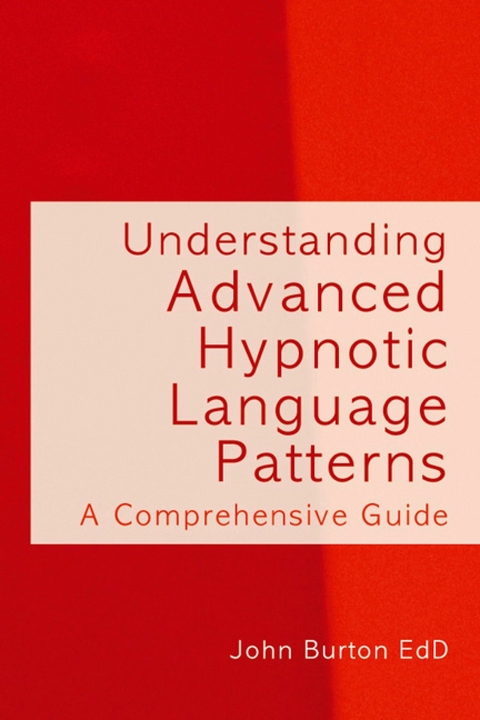
Understanding Advanced Hypnotic Language Patterns (eBook)
232 Seiten
Crown House Publishing (Verlag)
978-1-84590-667-2 (ISBN)
John Burton, EdD LPC holds a Doctorate in Human Development Counseling from Vanderbilt University as well as a Masters in Clinical Psychology. He is licensed as a Professional Counselor, Counselor Supervisor and holds certificates as a NLP Master, Clinical Hypnotherapist, and Reiki Master. He currently maintains his own counseling practice with over 30 years of professional experience. He also conducts regular workshops in the U.S. for The Sacred Sequence and Clinical Hypnotherapy. Dr. Burton co-authored one book and was sole author for two other books published by Crown House.
This book dissects and describes the conceptual ingredients that construct hypnotic language. Clinical case examples and dozens of hypnotic language scripts are provided to illustrate the identified principles.
This chapter concerns how we categorize information in our lives and will serve as a more general template through which to view hypnotic language and cognitive processes. The continuum of awareness, as referenced here, represents the first of the four tiers within the information-processing system. Whether we receive information from the environment through our senses or we just experience from within, we naturally categorize the information we notice. When categorizing information, we seem to draw from a pre-existing category based on similarities between the new information and the existing category. We then place the “new” experience within the closest matching category.
Categorizing is all about comparing pieces of information and their details. We compare the information on which we focus to other known information in order to determine in which category the information belongs. This begs the question of what will we do with truly new or unique information that does not relate to other already known information. Here we may delete, distort, or generalize to force fit an item into an old category or seize the opportunity for a unique experience.
I suggest that fear limits anyone’s openness to truly new experiences. By doing what Gestalt psychology calls simplifying, we think we better protect ourselves by deleting, distorting, and generalizing new experiences so that they resemble familiar ones. But excluding the uniqueness of experiences actually endangers us more instead of protecting us. By noticing uniqueness we find more possibilities and opportunities for solutions and effective self-directing. In other words, fear may lead us to a closed-minded style of thinking that limits awareness of choice, making our fears come true. Part of the challenge to overcoming this limiting fear is bypassing conscious efforts at categorizing.
In some sense, hypnotic language attempts to defy conscious mind categorizing, giving the information within the hypnotic language uniqueness, and thus promoting new awareness and new responses to life. Focusing further on language, there seems to be some interesting parallels between language and other concepts. First, language appears to be the result of a deductive process. We begin with a general concept or idea about something. We then find and use words that we hope describe this idea, just as I am doing here.
When attempting to communicate, I reduce my ideas to a sequence of words that attempt to convey these ideas as well as my abilities permit. Yet these words come from a larger pool of words, a dictionary of sorts. We use words to describe other words, involved in a rather circular process so long as we use words. When we just think, feel, and then experience, we can leave words behind and simply experience. But to describe what we experience, we resort to words, actually reducing the experience by categorizing through words. Essentially, words can become a vehicle transporting us to a place of unmediated experience, which can allow more creative, resourceful living.
At the same time that all words stem from a common, all-inclusive word pool, words also resemble numbers in some ways. Years ago, I used to think of the number zero as actually being the circle, O. Later I came to realize that the circle is not zero; the line is a circle. The zero is the content of the circle, the nothing. (Bear with me, as there is a method to this apparent madness.) All numbers, then, are essentially units away from this zero, this nothing. A positive 12 is 12 units away from zero. A negative 424 is this many units away from zero in the other direction. Just as words use other words to describe them, numbers use a common reference, zero. Words and numbers both come from a common pool.
Words use other words to describe a concept. We use a part of the whole of all words to describe another part of the whole of all words. We may also then use a part, words, to describe a larger concept, a metaphor, for example. We may also use words to refer to the entirety of all concepts, the one or the whole, in some philosophical sense. This highest level of awareness perhaps consists of all resources in their yet to be activated or utilized forms. These concepts or resources reside in the whole and resemble the entire raw number system that can be utilized as we most resourcefully desire. Let us not get bogged down in this philosophical discussion.
My point is that numbers and language have a common structure. Each derives from a common source, and this common source is both nothing and everything at the same time: It contains all possibilities and resources. By utilizing hypnotic language, a person can access this unstructured whole, which then permits creation of a more beneficial structure for living. Generally, hypnotic language represents just one of many vehicles through which one can increase awareness and reap the benefits this brings to life.
This introduction to words, numbers, and the concept of a sliding scale, from singular awareness to awareness of a whole, now leads us to what I refer to as the continuum of awareness. The process of change that can occur through hypnotic language will then be demonstrated within this awareness continuum. As previously stated, how we categorize data will serve as this book’s larger framework or template through which to view an individual’s thinking process and to assess their potential well-being. I suggest that these ways of categorizing data comprise general levels of perception and that the level of perception from which we experience life actually determines our experience of life.
The ideas presented here about perception are reminiscent of Victor Frankl’s (1973) existentially based Logotherapy. It is my belief that what we experience in life results from our perceptual position along an ever-increasing awareness scale. Experience inside our self stems from what we are able to perceive, either within or outside the self. This perception then determines the proportion of the whole of which we are aware and largely dictates response options. We often make the mistake of believing the level of perception from which we live is the only one in existence. This leads to emotional, behavioral, and physical problems.
I also suggest that problems stem from and are a byproduct of our level of perception, not the result of an event that “happens” to us. We may say that we experience emotional hurt as the result of some event. I will offer a process definition of emotional hurt. I propose that emotional hurt is a process whereby one withholds from oneself a beneficial resource-state in response to an event. This state could be joy, assertiveness, determination, or some state that permits effective, satisfying living. It is the withholding of the resource that brings the sense of hurt rather than the actual event. For example, we experience emotional hurt in response to withholding of joy from the self. This accidental self-denial of a resource stems from the belief formed at a particular perceptual position (Burton, 2003). Therefore, emotional hurt results from one’s perceptual position, occurring solely within the individual. Ultimately therapy—whether hypnotherapy or any effective therapy—aims to elevate the perceptual position of the client and allow recategorizing of information from a hurtful category to a benign or resourceful category.
Since categorizing information involves comparing at least two pieces of information, the size of the comparison chunk—quality—and the number of chunks—quantity—play a significant role in determining how we categorize data. The quality of a comparison determines its significance, whether it is minor or major and just how many instances of this experience exist in this category. The more emotionally charged the category and/or the more examples of the category, the more power it exerts in categorizing new information. The quantity of information chunks determines how many different pieces of information we use when comparing new to existing information. When we just look at similarities, we limit the effectiveness of our categorizing. In looking at differences and parts of the whole, we find their independent uniqueness and perhaps more effective uses in new experiences.
This categorizing process largely determines our emotional states and the noticed response options. I emphasize “noticed response options”. All response options exist simultaneously; we just notice the ones corresponding to our level of awareness. You can equate level of awareness with the term perception, since our level of awareness determines what and how we perceive. In cognitive psychology, the premise is that our thoughts determine our emotions. I would modify this by stating that our perceptual position determines our thoughts. Therefore, our perceptual position determines our emotions.
Here is a simple example of perceptual position or perceptual level and its influence on our thoughts and emotions. If we see the color red and then just compare it to blue, we may say that red is not blue and blue is not red. But we leave out the roughly seven million colors that our eyes can perceive. If I want to paint my living room, I may only notice two options, blue and red. Maybe I’m frustrated because I feel restricted. Maybe later I notice the color yellow and expand my options, but remain unaware of the wide range resulting from these primary colors. When I finally become aware of the full spectrum of colors, and thus of...
| Erscheint lt. Verlag | 24.5.2007 |
|---|---|
| Verlagsort | London |
| Sprache | englisch |
| Themenwelt | Geisteswissenschaften ► Psychologie ► Allgemeine Psychologie |
| Geisteswissenschaften ► Psychologie ► Biopsychologie / Neurowissenschaften | |
| Geisteswissenschaften ► Psychologie ► Humanistische Psychotherapien | |
| Medizin / Pharmazie ► Gesundheitsfachberufe | |
| Medizin / Pharmazie ► Medizinische Fachgebiete ► Psychiatrie / Psychotherapie | |
| Medizin / Pharmazie ► Naturheilkunde | |
| ISBN-10 | 1-84590-667-5 / 1845906675 |
| ISBN-13 | 978-1-84590-667-2 / 9781845906672 |
| Informationen gemäß Produktsicherheitsverordnung (GPSR) | |
| Haben Sie eine Frage zum Produkt? |
 EPUB (Wasserzeichen)
DRM: Digitales Wasserzeichen
Dieses eBook enthält ein digitales Wasserzeichen und ist damit für Sie personalisiert. Bei einer missbräuchlichen Weitergabe des eBooks an Dritte ist eine Rückverfolgung an die Quelle möglich.
Dateiformat: EPUB (Electronic Publication)
EPUB ist ein offener Standard für eBooks und eignet sich besonders zur Darstellung von Belletristik und Sachbüchern. Der Fließtext wird dynamisch an die Display- und Schriftgröße angepasst. Auch für mobile Lesegeräte ist EPUB daher gut geeignet.
Systemvoraussetzungen:
PC/Mac: Mit einem PC oder Mac können Sie dieses eBook lesen. Sie benötigen dafür die kostenlose Software Adobe Digital Editions.
eReader: Dieses eBook kann mit (fast) allen eBook-Readern gelesen werden. Mit dem amazon-Kindle ist es aber nicht kompatibel.
Smartphone/Tablet: Egal ob Apple oder Android, dieses eBook können Sie lesen. Sie benötigen dafür eine kostenlose App.
Geräteliste und zusätzliche Hinweise
Buying eBooks from abroad
For tax law reasons we can sell eBooks just within Germany and Switzerland. Regrettably we cannot fulfill eBook-orders from other countries.
aus dem Bereich