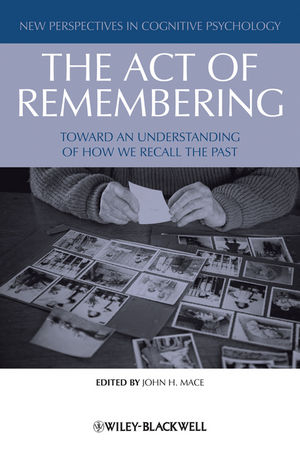
The Act of Remembering (eBook)
416 Seiten
John Wiley & Sons (Verlag)
978-1-4443-5171-2 (ISBN)
retrieval, The Act of Remembering serves as a primer of
ideas, methodology, and central topics, and lays the groundwork for
future research in the field.
* Contains new, forward-looking theories from leading
international scholars
* Answers questions such as: Do we retrieve memories according to
when and where we need them? How much conscious control do we have
over what we remember? Why are some people more likely than others
to have intrusive 'flashbacks' following a stressful
event?
* Pays particular attention to voluntary and involuntary
recall
John H. Mace is a cognitive psychologist who specializes in the study of memory. He is Professor and Chair of Psychology at Eastern Illinois University, and author of Involuntary Memory (Wiley-Blackwell, 2007).
Preface.
Contributors.
Part I: Introduction.
1. The act of remembering the past: An overview (John H.
Mace, Eastern Illinois University).
2. From diaries to brain scans: Methodological developments in
the investigation of autobiographical memory (Christopher Ball,
College of William & Mary).
Part II: Theories and Reviews of Involuntary and Voluntary
Remembering.
3. Involuntary remembering and voluntary remembering: How
different are they? (John H. Mace, Eastern Illinois
University).
4. Accessing autobiographical memories (Martin Conway,
University of Leeds, and Catherine Loveday, University of
Westminster).
5. Involuntary and voluntary memory sequencing phenomena: An
interesting puzzle for the study of autobiographical memory
organization and retrieval (Jennifer Talarico, Lafayette
College, and John H. Mace, Eastern Illinois University).
6. Spontaneous retrieval is the norm: What integrative models
tell us about human consciousness and memory (Stan Franklin,
University of Memphis, and Bernard J. Baars, The Neurosciences
Institute).
7. Priming, automatic recollection, and control of retrieval:
Toward an integrative retrieval architecture (Alan
Richardson-Klavehn, Otto von Guericke University).
Part III: Broader Issues in the Science of
Remembering.
8. Understanding autobiographical remembering from a spreading
activation perspective (John H. Mace, Eastern Illinois
University)
9. Retrieval Inhibition in Autobiographical Memory (Bernhard
Pastötter and Karl-Heinz Bäuml).
10. The role of visual perspective in autobiographical memory
retrieval (Heather J. Rice, Washington University in St.
Louis).
11. The emergence of recollection: How we learn to recall
ourselves in the past (Robyn Fivush and Patricia J. Bauer, Emory
University).
12. You get what you need: The psychosocial functions of
remembering (Susan Bluck, University of Florida, Nicole Alea,
University of the West Indies, and Burcu Demiray, University of
Florida).
Part IV: Theories of Abnormal Remembering.
13. Exploring pathological recall in involuntary retrieval in
Post-traumatic Stress Disorder from an information processing
perspective: Intrusive images of trauma (Julie Krans, Radboud
University, Marcella L. Woud, Radboud University, Gérard
Näring, Radboud University, Eni S. Becker, Radboud University,
and Emily A. Holmes, Warneford Hospital).
14. Unwanted traumatic intrusions: The role of pre-trauma
individual differences in executive control (Johan Verwoerd and
Ineke Wessel, University of Groningen).
15. The content, nature and persistence of intrusive memories in
depression (Alishia D. Williams and Michelle L. Moulds,
University of New South Wales).
"All in all, this is a serious book about a most fascinating subject. What do you wish you could remember or forget?." (PsychologyToday.com , 1 March 2011)
The Act of Remembering provides a comprehensive treatment of
autobiographical memory retrieval, which has emerged as a key topic
in both psychology and neuroscience. Ranging broadly across
cognitive, developmental, clinical, and neuropsychological
approaches, leading researchers provide a state-of-the-art overview
of where the field has been and where it is going. This volume is
essential reading for anyone involved in memory research.
--Daniel L. Schacter, Harvard University
This volume is composed of chapters by experts on how memories
are retrieved from autobiographical memory. Although several books
on autobiographical memory exist, this is the first exclusively
focused on processes of retrieval (the act of remembering). The
book is wide ranging, including chapters on both involuntary and
voluntary memories and even on the topic of intrusive memories that
sometimes occur after traumatic events (and in depression). I can
recommend it with enthusiasm to all researchers interested in
remembering.
--Henry L. Roediger, III, Washington University at St.
Louis
| Erscheint lt. Verlag | 7.7.2011 |
|---|---|
| Reihe/Serie | New Perspectives in Cognitive Psychology | New Perspectives in Cognitive Psychology |
| Sprache | englisch |
| Themenwelt | Geisteswissenschaften ► Psychologie ► Allgemeine Psychologie |
| Geisteswissenschaften ► Psychologie ► Biopsychologie / Neurowissenschaften | |
| Geisteswissenschaften ► Psychologie ► Verhaltenstherapie | |
| Schlagworte | Gedächtnis • Gedächtnis • Kognitive Psychologie • Memory • Psychologie • Psychology |
| ISBN-10 | 1-4443-5171-0 / 1444351710 |
| ISBN-13 | 978-1-4443-5171-2 / 9781444351712 |
| Informationen gemäß Produktsicherheitsverordnung (GPSR) | |
| Haben Sie eine Frage zum Produkt? |
 EPUB (Adobe DRM)
Kopierschutz: Adobe-DRM
Adobe-DRM ist ein Kopierschutz, der das eBook vor Mißbrauch schützen soll. Dabei wird das eBook bereits beim Download auf Ihre persönliche Adobe-ID autorisiert. Lesen können Sie das eBook dann nur auf den Geräten, welche ebenfalls auf Ihre Adobe-ID registriert sind.
Details zum Adobe-DRM
Dateiformat: EPUB (Electronic Publication)
EPUB ist ein offener Standard für eBooks und eignet sich besonders zur Darstellung von Belletristik und Sachbüchern. Der Fließtext wird dynamisch an die Display- und Schriftgröße angepasst. Auch für mobile Lesegeräte ist EPUB daher gut geeignet.
Systemvoraussetzungen:
PC/Mac: Mit einem PC oder Mac können Sie dieses eBook lesen. Sie benötigen eine
eReader: Dieses eBook kann mit (fast) allen eBook-Readern gelesen werden. Mit dem amazon-Kindle ist es aber nicht kompatibel.
Smartphone/Tablet: Egal ob Apple oder Android, dieses eBook können Sie lesen. Sie benötigen eine
Geräteliste und zusätzliche Hinweise
Buying eBooks from abroad
For tax law reasons we can sell eBooks just within Germany and Switzerland. Regrettably we cannot fulfill eBook-orders from other countries.
aus dem Bereich