


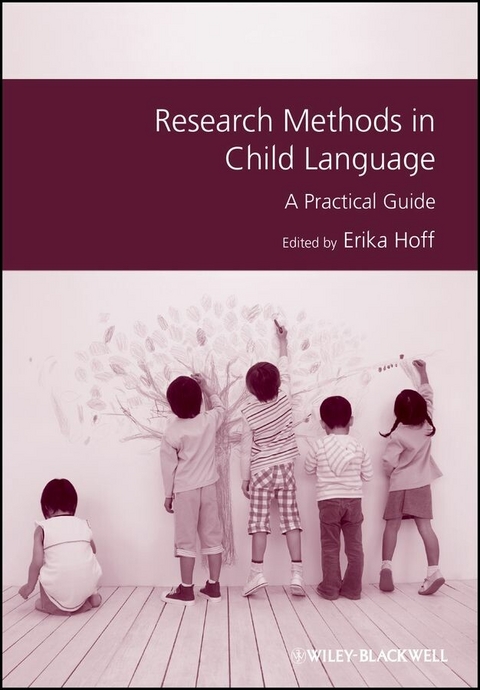
- Presents a comprehensive survey of laboratory and naturalistic techniques used in the study of different domains of language, age ranges, and populations, and explains the questions addressed by each technique
- Presents new research methods, such as the use of functional Near Infrared Spectroscopy (fNIRS) to study the activity of the brain
- Expands on more traditional research methods such as collection, transcription, and coding of speech samples that have been transformed by new hardware and software
Erika Hoff is Professor of Psychology at Florida Atlantic University. She is the author of Language Development, 4th Edition (2009), and co-editor of The Blackwell Handbook of Language Development (Wiley-Blackwell, 2007), and Childhood Bilingualism: Research on Infancy Through School Age (2006).
This is a comprehensive and accessible guide to the methods researchers use to study child language, written by experienced scholars in the study of language development. Presents a comprehensive survey of laboratory and naturalistic techniques used in the study of different domains of language, age ranges, and populations, and explains the questions addressed by each technique Presents new research methods, such as the use of functional Near Infrared Spectroscopy (fNIRS) to study the activity of the brain Expands on more traditional research methods such as collection, transcription, and coding of speech samples that have been transformed by new hardware and software
Erika Hoff is Professor of Psychology at Florida Atlantic University. She is the author of Language Development, 4th Edition (2009), and co-editor of The Blackwell Handbook of Language Development (Wiley-Blackwell, 2007), and Childhood Bilingualism: Research on Infancy Through School Age (2006).
List of Figures vii
List of Plates viii
Notes on Contributors ix
Acknowledgments xv
Preface xvi
Part I Studying Infants and Others Using Nonverbal Methods
1
1 Habituation Procedures 3
Christopher T. Fennell
2 Intermodal Preferential Looking 17
Janina Piotroski and Letitia R. Naigles
3 The Looking-While-Listening Procedure 29
Daniel Swingley
4 Neuroimaging Methods 43
Ioulia Kovelman
5 Methods for Studying Language in Infants: Back to the Future
60
Roberta Michnick Golinkoff and Kathryn Hirsh-Pasek
Part II Assessing Language Knowledge and Processes in
Children Who Talk 77
6 Assessing Phonological Knowledge 79
Cynthia Core
7 Assessing Vocabulary Skills 100
Barbara Alexander Pan
8 Assessing Grammatical Knowledge (with Special Reference to the
Graded Grammaticality Judgment Paradigm) 113
Ben Ambridge
9 Assessing Children's Narratives 133
Elaine Reese, Alison Sparks, and Sebastian Suggate
10 Using Judgment Tasks to Study Language Knowledge 149
David A. McKercher and Vikram K. Jaswal
11 Using Priming Procedures with Children 162
Marina Vasilyeva, Heidi Waterfall, and Ligia Gómez
12 Studying Language Processing Using Eye Movements 177
John C. Trueswell
Part III Capturing Children's Language Experience and
Language Production 191
13 Recording, Transcribing, and Coding Interaction 193
Meredith L. Rowe
14 Studying Gesture 208
Erica A. Cartmill, Özlem Ece Demir, and Susan
Goldin-Meadow
15 Dense Sampling 226
Elena Lieven and Heike Behrens
16 Not Sampling, Getting It All 240
Letitia R. Naigles
17 Approaches to Studying Language in Preschool Classrooms
254
David K. Dickinson
18 Using the CHILDES Database 271
Roberta Corrigan
Part IV Studying Multiple Languages and Special Populations
285
19 Crosslinguistic Research 287
Aylin C. Küntay
20 Studying Children in Bilingual Environments 300
Erika Hoff and Rosario Luz Rumiche
21 Studying Children with Language Impairment 317
Karla K. McGregor
22 Studying the Language Development of Children with
Intellectual Disabilities 330
Leonard Abbeduto, Sara T. Kover, and Andrea McDuffie
Index 347
"Furthermore, the information presented throughout the
book will be of immense benefits to an institution's library
or to a lecturer or supervisor to provide for their students and
researchers. Hence, Research Methods in Child Language is an
essential tool for all in the field of child language."
(Infant & Child Development, 1 January 2014)
"This book, though perhaps of limited use to individuals
interested to learn more about a single method of research, since
much of the book would therefore be irrelevant, will undoubtedly
prove to be an invaluable resource for an institution's
library or for a lecturer or supervisor to provide for their
students and researchers." (Linguist, 2 July
2012)
| Erscheint lt. Verlag | 28.7.2011 |
|---|---|
| Reihe/Serie | GMLZ - Guides to Research Methods in Language and Linguistics |
| GMLZ - Guides to Research Methods in Language and Linguistics | Guides to Research Methods in Language and Linguistics |
| Sprache | englisch |
| Themenwelt | Geisteswissenschaften ► Psychologie ► Entwicklungspsychologie |
| Geisteswissenschaften ► Sprach- / Literaturwissenschaft ► Sprachwissenschaft | |
| Schlagworte | Child Language • Kindersprache • language acquisition, language development, child development, child language, research methodology • Linguistics • Sprachwissenschaften |
| ISBN-13 | 9781444344011 / 9781444344011 |
| Informationen gemäß Produktsicherheitsverordnung (GPSR) | |
| Haben Sie eine Frage zum Produkt? |
 EPUB (Adobe DRM)
Kopierschutz: Adobe-DRM
Adobe-DRM ist ein Kopierschutz, der das eBook vor Mißbrauch schützen soll. Dabei wird das eBook bereits beim Download auf Ihre persönliche Adobe-ID autorisiert. Lesen können Sie das eBook dann nur auf den Geräten, welche ebenfalls auf Ihre Adobe-ID registriert sind.
Details zum Adobe-DRM
Dateiformat: EPUB (Electronic Publication)
EPUB ist ein offener Standard für eBooks und eignet sich besonders zur Darstellung von Belletristik und Sachbüchern. Der Fließtext wird dynamisch an die Display- und Schriftgröße angepasst. Auch für mobile Lesegeräte ist EPUB daher gut geeignet.
Systemvoraussetzungen:
PC/Mac: Mit einem PC oder Mac können Sie dieses eBook lesen. Sie benötigen eine
eReader: Dieses eBook kann mit (fast) allen eBook-Readern gelesen werden. Mit dem amazon-Kindle ist es aber nicht kompatibel.
Smartphone/Tablet: Egal ob Apple oder Android, dieses eBook können Sie lesen. Sie benötigen eine
Geräteliste und zusätzliche Hinweise
Buying eBooks from abroad
For tax law reasons we can sell eBooks just within Germany and Switzerland. Regrettably we cannot fulfill eBook-orders from other countries.
aus dem Bereich


