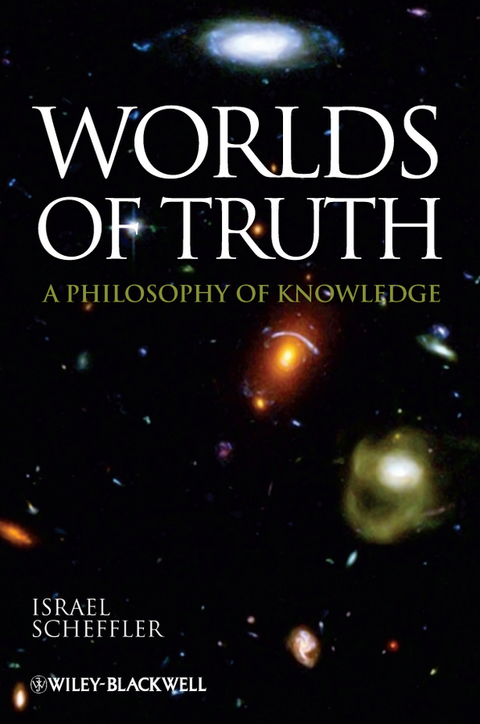
Worlds of Truth (eBook)
John Wiley & Sons (Verlag)
978-1-4443-1093-1 (ISBN)
Israel Scheffler is Victor S. Thomas Professor of Education and Philosophy Emeritus at Harvard University and serves as Scholar-in-Residence at the Mandel Center at Brandeis University. He is a Fellow of the American Academy of Arts and Sciences, a founding member of the National Academy of Education and a past president of both the Philosophy of Science Association and the Charles S. Peirce Society. Among his various books are The Anatomy of Inquiry (1963), Science and Subjectivity (1967), Four Pragmatists (1974), Beyond the Letter (1979), and Symbolic Worlds: Art, Science, Language, Ritual (1997).
Preface viii
Acknowledgments x
Introduction 1
Part I: Inquiry 5
Chapter 1: Justification 7
1. Beliefs 7
2. Access to truth 8
3. Cogito ergo sum 9
4. Mathematical certainty 11
5. Classical logic 12
6. C. I. Lewis' empiricism 14
7. Access as a metaphor 17
8. J. F. Fries and K. Popper 18
9. Voluntarism and linearity 19
10. One-way justification 20
11. Beginning in the middle 21
12. Justification, contextual and comparative 22
13. Justification in the empirical sciences 23
14. Circularity versus linearity 25
15. Democratic controls 25
16. Interactionism 27
Chapter 2: Truth 30
1. Allergy to absolute truth 31
2. Provisionality and truth 32
3. Truth versus verification 34
4. Truth and fixity 36
5. Transparency, Tarski, and Carnap 38
6. Truth and certainty 42
7. Sentences as truth candidates 44
8. Theoretical terms 44
9. Varieties of instrumentalism 45
10. Pragmatism and instrumentalism 45
11. Systems, simplicity, reduction 46
12. Crises in science 51
13. Reduction and expansion 52
Chapter 3: Worlds 55
1. Philosophies of truth 55
2. Operationism and truth 57
3. Version-dependence 59
4. Differences among scientifically oriented philosophers 61
5. Monism, pluralism, plurealism 62
6. Realism versus irrealism 66
7. A theory of everything 72
8. The status of ethics 75
9. Emotive theories; Ayer and Stevenson 75
10. Moore's ethical intuitionism 77
11. Dewey and ethical naturalism 79
12. Symbol, reference, and ritual 81
Part II: Related Pragmatic Themes 93
Chapter 4: Belief and Method 95
Introduction 95
1. Problems of pragmatism and pragmatic responses 98
2. Peirce's theory of belief, doubt, and inquiry 102
3. Peirce's comparison of methods 104
4. Difficulties in Peirce's treatment 106
5. An epistemological interpretation 108
6. The primacy of method 109
Chapter 5: Action and Commitment 114
Chapter 6: Emotion and Cognition 125
1. Emotions in the service of cognition 126
2. Cognitive emotions 132
Index 143
"The book will be of interest to philosophers working on
pragmatism, pluralism, relativism, and justification".
(International Studies In The Philosophy Of Science, 1 December
2010)
"This volume will be useful for specialists in pragmatism, but
perhaps not sufficiently original for all collections."
(CHOICE, October 2009)
"Worlds of Truth develops an epistemology that accommodates
science. It construes knowledge as advancing holistically. Because
justification accrues through systematization, it is a property of
theories, not primarily of individual sentences. Drawing on and
contributing to the pragmatic tradition, Scheffler shows how a
commitment to fallibilism is not a concession to epistemic
inadequacy but an asset to understanding."
-Catherine Z. Elgin, Harvard University
"Israel Scheffler's Worlds of Truth is a book that
can be read with profit and enjoyment by the general reader as well
as by the philosophical expert. In recent years both general
readers and professional philosophers have tended to think of
"pragmatism" as a fuzzy philosophy closely allied to postmodernism,
and as in deep opposition to analytic philosophy, which is often
seen as anti-humanistic. In this important book, and in clear and
elegant prose, Scheffler performs a great service by showing in
detail how to combine the antifoundationalism, the holism, and the
deep fallibilism of the pragmatists with the respect for the notion
of absolute truth, and the sharp distinction between being true and
being warranted at a given moment characteristic of the analytic
philosophers. The result is both an attractive and I believe
largely right epistemological picture, and a portrait of the
philosophical thinking of a significant philosopher, whose work
deserves to be more widely known."
-Hilary Putnam, Harvard University
"Many things pass for 'pragmatism' these days that the original
pragmatists would not recognize. It might well be said that the
pragmatist tradition has lost its way. It is the perfect time for
this book, which builds upon the groundbreaking work of the
original figures, but does not hesitate to criticize their earlier
discussions where appropriate and improve on them in the service of
the development of a philosophically adequate pragmatic
epistemology and metaphysics."
-Harvey Siegel, University of Miami
| Erscheint lt. Verlag | 30.3.2009 |
|---|---|
| Sprache | englisch |
| Themenwelt | Geisteswissenschaften ► Philosophie ► Allgemeines / Lexika |
| Geisteswissenschaften ► Philosophie ► Erkenntnistheorie / Wissenschaftstheorie | |
| Schlagworte | Epistemology • Erkenntnistheorie • Philosophie • Philosophy • philosophy, epistemology, philosophy of science, symbolism, metaphysics, theory of knowledge, systematic relativity, objectivity, fallibilism, cognition, emotion, ethics, ritual, culture, art, plurealism, pragmatism, truth |
| ISBN-10 | 1-4443-1093-3 / 1444310933 |
| ISBN-13 | 978-1-4443-1093-1 / 9781444310931 |
| Informationen gemäß Produktsicherheitsverordnung (GPSR) | |
| Haben Sie eine Frage zum Produkt? |
 PDF (Adobe DRM)
Kopierschutz: Adobe-DRM
Adobe-DRM ist ein Kopierschutz, der das eBook vor Mißbrauch schützen soll. Dabei wird das eBook bereits beim Download auf Ihre persönliche Adobe-ID autorisiert. Lesen können Sie das eBook dann nur auf den Geräten, welche ebenfalls auf Ihre Adobe-ID registriert sind.
Details zum Adobe-DRM
Dateiformat: PDF (Portable Document Format)
Mit einem festen Seitenlayout eignet sich die PDF besonders für Fachbücher mit Spalten, Tabellen und Abbildungen. Eine PDF kann auf fast allen Geräten angezeigt werden, ist aber für kleine Displays (Smartphone, eReader) nur eingeschränkt geeignet.
Systemvoraussetzungen:
PC/Mac: Mit einem PC oder Mac können Sie dieses eBook lesen. Sie benötigen eine
eReader: Dieses eBook kann mit (fast) allen eBook-Readern gelesen werden. Mit dem amazon-Kindle ist es aber nicht kompatibel.
Smartphone/Tablet: Egal ob Apple oder Android, dieses eBook können Sie lesen. Sie benötigen eine
Geräteliste und zusätzliche Hinweise
Buying eBooks from abroad
For tax law reasons we can sell eBooks just within Germany and Switzerland. Regrettably we cannot fulfill eBook-orders from other countries.
aus dem Bereich