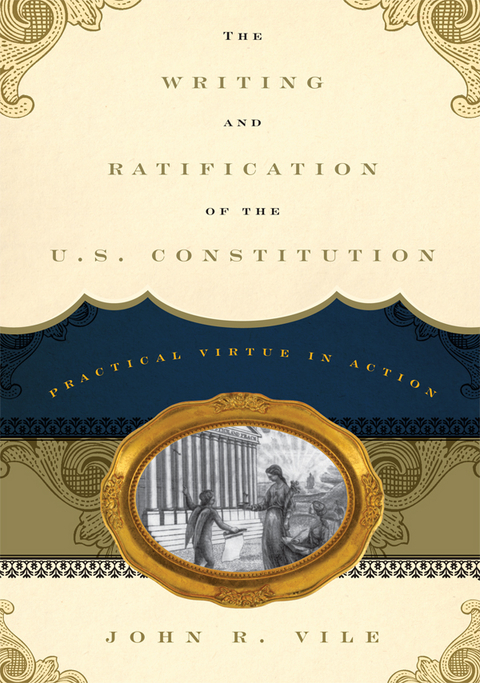
Writing and Ratification of the U.S. Constitution (eBook)
292 Seiten
Rowman & Littlefield Publishers (Verlag)
978-1-4422-1770-6 (ISBN)
The Writing and Ratification of the U.S. Constitution: Practical Virtue in Action examines the events surrounding the development of the U.S. Constitution. Setting these events within the context of the colonial conflict with Britain and the experience with state constitutions under the Articles of Confederation, John R. Vile discusses the delegates who attended the Constitutional Convention of 1787, the major plans and proposals that delegates offered, and the arguments that delegates made both in the Convention and in subsequent state ratifying debates that ultimately led to the adoption of the U.S. Bill of Rights. Vile contends that the Convention and subsequent ratifying conventions were not mere exercises in political theory but practical attempts to formulate a workable government that all the states would ratify. Focusing chiefly on records of debates at the Convention, the book is a legal brief, identifying key facts, issues, arguments, and compromises, and providing a unique window into the contestation surrounding this keystone American political moment. This book is perfect for scholars and students in the field of American political history and development.
John R. Vile is professor of political science and dean of the University Honors College at Middle Tennessee State University at Murfreesboro. He is the author and coeditor of numerous books, including Encyclopedia of the First Amendment as well as Encyclopedia of Constitutional Amendments, Proposed Amendments, and Amending Issues, 1789-1995; The Constitutional Convention of 1787; Great American Lawyers; Great American Judges, and Essential Supreme Court Decisions among others.
PrefaceTimelineChapter 1: The Revolution and the Articles of Confederation Set the StageThe Colonial Background • The Developing Split with England • The Declaration of Independence • Developments in the States • The Articles of Confederation • The Confluence of State and National Influences • The Annapolis Convention • Shay’s Rebellion • The Stage is SetChapter 2: The Convention Begins and Randolph Introduces the Virginia PlanDelegates Assemble • A Collective Portrait of the Delegates • Delegations from the Eastern (Northern, or New England) States • Delegations from the Middle States • Delegations from the Southern States • Selecting Officers and Recording Debates • Rules of the Convention • Randolph Introduces the Virginia Plan • Clarifying What the Virginia Plan Was Proposing to do • Discussion of the Proposed Congress • Discussion of the Proposed Executive • Discussions of the Proposed Judiciary and Related Matters • Further Discussions of the Proposed Legislature Wax Philosophical • Discussion of the Proposed Council of Revision • Discussion of the Proposed Second House • Discussion of the Proposed Congressional Negative of State Laws • Choosing the Executive • Apportioning Congress: A Preview of Things to Come • The End of the Beginning • Report of the Committee of the WholeChapter 3: Paterson and Hamilton Offer Alternative PlansIntroduction of the New Jersey Plan • The Initial Defense of the New Jersey Plan • Further Discussion of the New Jersey Plan • Alexander Hamilton Speaks • Hamilton’s Plan • Reception of Hamilton’s Proposals • Madison’s SpeechChapter 4: Delegates Debate the Report of the Committee of the WholeRenewed Discussion of the Report of the Committee of the Whole • Bicameralism and Federalism • Terms of the First House • Congressional Pay • Minimum Age for Members of the First House • Concerns Over a Revolving Door • Charles Pinckney’s Speech • Discussion of the Second House • Terms of Senators • Franklin Suggest Prayer • Further Discussion of State Representation in Congress • Gunning Bedford’s Bombshell • A Committee Tries Its Hand at Compromise • Discussion of Committee Proposals • Creation of a Committee on Original Apportionment of Congress • Further Discussion of Congress • Report of the Committee on Original Apportionment of Congress • The Convention Creates Another Committee to Reconsider Original Apportionment • Counting Slaves by Fractions • The Great CompromiseChapter 5: From the Great Compromise to the Committee of DetailThe Convention Rejects the Proposed Congressional Negative of State Laws • Selection of the Executive • Executive Term Lengths • Discussion of the Judiciary • Guaranteeing State Governments • Renewed Discussion of the Executive • Impeachment • The Council of Revision • Judicial Selection • Oaths • Ratification of the Constitution • Representation in the Senate • Legislative Selection of the Executive Reconsidered • Executive Re-eligibility and Term Lengths • Property and Anti-Debtor Qualifications for Legislators • Location of the CapitalChapter 6: Debates Over Report of the Committee of DetailPrinciples Applied by the Committee of Detail • An Outline of the Report from the Committee of Detail • Provisions Relative to Congress • Congressional Meeting Times • Voting Qualifications • Qualifications for the House of Representatives • Slavery and Related Issues • Filling Senatorial Vacancies • Durational Citizenship Requirements • Congressional Oversight of Federal Elections • Property Qualifications for Members of Congress • Quorums and Other Congressional Matters • Years of Citizenship for Members of the First House • The Origination of Money Bills • Eligibility of Members of Congress to Other Jobs • Pay for Members of Congress • Council of Revision and Veto Powers • Congressional Powers • First Report from the Committee on State Debts and Militia • Importation and Taxation of Slaves • Protections for Civil Liberties • Governing the Militia and Negating State Laws • Treaties • The Executive Branch • Importation and Taxation of Slaves Reconsidered • Treaties Reconsidered • Pardons and Militia • Judicial Powers • Prohibitions on the States • Supermajorities and Commercial Regulations • The Admission of New States •State Ratification of the Constitution • More Committees • Report by the Committee on Postponed Matters • Further Proposals and Debates Relative to the Committee on Postponed Matters • Constitutional Amendments and Their RatificationChapter 7: Wrapping Up Business, Signing, and RatifyingCongressional Majorities Needed to Override an Executive Veto • Proposals for a Bill of Rights • Tinkering with the Constitution from the Committee of Style and Arrangement • Reservations About the Document • The Signing of the Constitution • Outline of the Constitution • Ratification of the Constitution • Federalists and Antifederalists • State Conventions Meet • Adoption of the Bill of Rights • The Post-Civil War Amendments • The Importance of the Convention and Its AftermathSelected Bibliography Selected DocumentsThe Declaration of Independence • The Articles of Confederation • The Constitution of the United States • The Virginia Plan • The New Jersey Plan • Federalist No. 10 Index
| Erscheint lt. Verlag | 13.7.2012 |
|---|---|
| Sprache | englisch |
| Themenwelt | Geschichte ► Teilgebiete der Geschichte ► Militärgeschichte |
| Recht / Steuern ► Allgemeines / Lexika | |
| Recht / Steuern ► EU / Internationales Recht | |
| Recht / Steuern ► Öffentliches Recht | |
| Recht / Steuern ► Rechtsgeschichte | |
| ISBN-10 | 1-4422-1770-7 / 1442217707 |
| ISBN-13 | 978-1-4422-1770-6 / 9781442217706 |
| Informationen gemäß Produktsicherheitsverordnung (GPSR) | |
| Haben Sie eine Frage zum Produkt? |
 EPUB (Adobe DRM)
Kopierschutz: Adobe-DRM
Adobe-DRM ist ein Kopierschutz, der das eBook vor Mißbrauch schützen soll. Dabei wird das eBook bereits beim Download auf Ihre persönliche Adobe-ID autorisiert. Lesen können Sie das eBook dann nur auf den Geräten, welche ebenfalls auf Ihre Adobe-ID registriert sind.
Details zum Adobe-DRM
Dateiformat: EPUB (Electronic Publication)
EPUB ist ein offener Standard für eBooks und eignet sich besonders zur Darstellung von Belletristik und Sachbüchern. Der Fließtext wird dynamisch an die Display- und Schriftgröße angepasst. Auch für mobile Lesegeräte ist EPUB daher gut geeignet.
Systemvoraussetzungen:
PC/Mac: Mit einem PC oder Mac können Sie dieses eBook lesen. Sie benötigen eine
eReader: Dieses eBook kann mit (fast) allen eBook-Readern gelesen werden. Mit dem amazon-Kindle ist es aber nicht kompatibel.
Smartphone/Tablet: Egal ob Apple oder Android, dieses eBook können Sie lesen. Sie benötigen eine
Geräteliste und zusätzliche Hinweise
Buying eBooks from abroad
For tax law reasons we can sell eBooks just within Germany and Switzerland. Regrettably we cannot fulfill eBook-orders from other countries.
aus dem Bereich