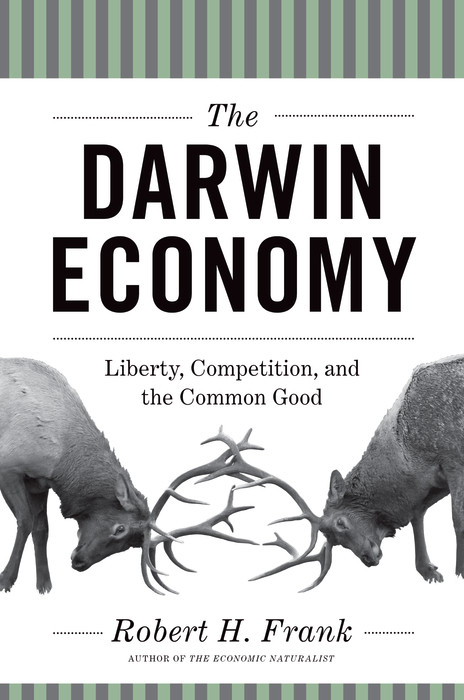
The Darwin Economy (eBook)
Princeton University Press (Verlag)
978-1-4008-4498-2 (ISBN)
Robert H. Frank is an economics professor at Cornell's Johnson Graduate School of Management, a regular 'Economic View' columnist for the New York Times, and a Distinguished Senior Fellow at Demos. His books, which have been translated into twenty-two languages, include The Winner-Take-All Society (with Philip Cook), The Economic Naturalist, Luxury Fever, What Price the Moral High Ground?, and Principles of Economics (with Ben Bernanke).
What Charles Darwin can teach us about building a fairer societyWho was the greater economist-Adam Smith or Charles Darwin? The question seems absurd. Darwin, after all, was a naturalist, not an economist. But Robert Frank, New York Times economics columnist and best-selling author of The Economic Naturalist, predicts that within the next century Darwin will unseat Smith as the intellectual founder of economics. The reason, Frank argues, is that Darwin's understanding of competition describes economic reality far more accurately than Smith's. And the consequences of this fact are profound. Indeed, the failure to recognize that we live in Darwin's world rather than Smith's is putting us all at risk by preventing us from seeing that competition alone will not solve our problems.Smith's theory of the invisible hand, which says that competition channels self-interest for the common good, is probably the most widely cited argument today in favor of unbridled competition-and against regulation, taxation, and even government itself. But what if Smith's idea was almost an exception to the general rule of competition? That's what Frank argues, resting his case on Darwin's insight that individual and group interests often diverge sharply. Far from creating a perfect world, economic competition often leads to "e;arms races,"e; encouraging behaviors that not only cause enormous harm to the group but also provide no lasting advantages for individuals, since any gains tend to be relative and mutually offsetting.The good news is that we have the ability to tame the Darwin economy. The best solution is not to prohibit harmful behaviors but to tax them. By doing so, we could make the economic pie larger, eliminate government debt, and provide better public services, all without requiring painful sacrifices from anyone. That's a bold claim, Frank concedes, but it follows directly from logic and evidence that most people already accept.In a new afterword, Frank further explores how the themes of inequality and competition are driving today's public debate on how much government we need.
Robert H. Frank is an economics professor at Cornell's Johnson Graduate School of Management, a regular "Economic View" columnist for the New York Times, and a Distinguished Senior Fellow at Demos. His books, which have been translated into twenty-two languages, include The Winner-Take-All Society (with Philip Cook), The Economic Naturalist, Luxury Fever, What Price the Moral High Ground?, and Principles of Economics (with Ben Bernanke).
| Erscheint lt. Verlag | 16.9.2012 |
|---|---|
| Zusatzinfo | 1 table. |
| Verlagsort | Princeton |
| Sprache | englisch |
| Themenwelt | Geschichte ► Teilgebiete der Geschichte ► Wirtschaftsgeschichte |
| Sozialwissenschaften ► Politik / Verwaltung | |
| Wirtschaft ► Allgemeines / Lexika | |
| Wirtschaft ► Volkswirtschaftslehre ► Makroökonomie | |
| Wirtschaft ► Volkswirtschaftslehre ► Wirtschaftspolitik | |
| Schlagworte | after-tax income • Austerity • Behavioral Economics • bidding • Budget • bureaucrat • Charles Darwin • Citizens United v. FEC • Competition • Competitive advantage • consumer • Consumption (Economics) • Consumption Tax • Corruption • Cost–benefit analysis • cronyism • Customer • debt • Division of Labour • Economic Growth • Economic Inequality • Economics • economic surplus • economist • economy • Effective competition • Employment • Entrepreneurship • Expenditure • Expense • Externality • Financial crisis of 2007–08 • free rider problem • Government Debt • government spending • government waste • Harm Principle • Incentive • income • Income Tax • Infrastructure • institutional investor • Interest • invisible Hand • Market Failure • Microsoft • Milton Friedman • narrative • Negotiation • Nudge (book) • Occupational Safety and Health • Payment • Payroll tax • perfect competition • pollution • Positional good • Poverty • Prediction • private sector • Productivity • progressive tax • Provision (accounting) • Public Policy • Rational Choice Theory • Recession • Regulation • Reputation • Retirement • Ronald Coase • salary • saving • Self-Interest • shortage • skepticism • Slogan • Social engineering (political science) • Social engineering (security) • Supervisor • Tax • Tax Cut • Taxpayer • Tax Policy • Tax Rate • tax revenue • Theft • The Wealth of Nations • Thomas Robert Malthus • Thought experiment • Trade-off • Tragedy of the commons • transaction cost • trickle-down economics • Unemployment • Value (economics) • wage • Wealth • welfare • Willingness to pay • year • Your Money |
| ISBN-10 | 1-4008-4498-3 / 1400844983 |
| ISBN-13 | 978-1-4008-4498-2 / 9781400844982 |
| Informationen gemäß Produktsicherheitsverordnung (GPSR) | |
| Haben Sie eine Frage zum Produkt? |
 PDF (Wasserzeichen)
Größe: 942 KB
DRM: Digitales Wasserzeichen
Dieses eBook enthält ein digitales Wasserzeichen und ist damit für Sie personalisiert. Bei einer missbräuchlichen Weitergabe des eBooks an Dritte ist eine Rückverfolgung an die Quelle möglich.
Dateiformat: PDF (Portable Document Format)
Mit einem festen Seitenlayout eignet sich die PDF besonders für Fachbücher mit Spalten, Tabellen und Abbildungen. Eine PDF kann auf fast allen Geräten angezeigt werden, ist aber für kleine Displays (Smartphone, eReader) nur eingeschränkt geeignet.
Systemvoraussetzungen:
PC/Mac: Mit einem PC oder Mac können Sie dieses eBook lesen. Sie benötigen dafür einen PDF-Viewer - z.B. den Adobe Reader oder Adobe Digital Editions.
eReader: Dieses eBook kann mit (fast) allen eBook-Readern gelesen werden. Mit dem amazon-Kindle ist es aber nicht kompatibel.
Smartphone/Tablet: Egal ob Apple oder Android, dieses eBook können Sie lesen. Sie benötigen dafür einen PDF-Viewer - z.B. die kostenlose Adobe Digital Editions-App.
Buying eBooks from abroad
For tax law reasons we can sell eBooks just within Germany and Switzerland. Regrettably we cannot fulfill eBook-orders from other countries.
 EPUB (Adobe DRM)
Kopierschutz: Adobe-DRM
Adobe-DRM ist ein Kopierschutz, der das eBook vor Mißbrauch schützen soll. Dabei wird das eBook bereits beim Download auf Ihre persönliche Adobe-ID autorisiert. Lesen können Sie das eBook dann nur auf den Geräten, welche ebenfalls auf Ihre Adobe-ID registriert sind.
Details zum Adobe-DRM
Dateiformat: EPUB (Electronic Publication)
EPUB ist ein offener Standard für eBooks und eignet sich besonders zur Darstellung von Belletristik und Sachbüchern. Der Fließtext wird dynamisch an die Display- und Schriftgröße angepasst. Auch für mobile Lesegeräte ist EPUB daher gut geeignet.
Systemvoraussetzungen:
PC/Mac: Mit einem PC oder Mac können Sie dieses eBook lesen. Sie benötigen eine
eReader: Dieses eBook kann mit (fast) allen eBook-Readern gelesen werden. Mit dem amazon-Kindle ist es aber nicht kompatibel.
Smartphone/Tablet: Egal ob Apple oder Android, dieses eBook können Sie lesen. Sie benötigen eine
Geräteliste und zusätzliche Hinweise
Buying eBooks from abroad
For tax law reasons we can sell eBooks just within Germany and Switzerland. Regrettably we cannot fulfill eBook-orders from other countries.
aus dem Bereich