


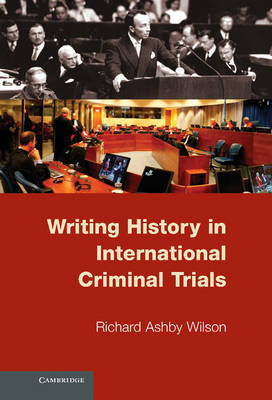
Writing History in International Criminal Trials (eBook)
Cambridge University Press (Verlag)
978-1-139-06527-6 (ISBN)
Why do international criminal tribunals write histories of the origins and causes of armed conflicts? Richard Ashby Wilson conducted research with judges, prosecutors, defense attorneys and expert witnesses in three international criminal tribunals to understand how law and history are combined in the courtroom. Historical testimony is now an integral part of international trials, with prosecutors and defense teams using background testimony to pursue decidedly legal objectives. In the Slobodan Milo evi trial, the prosecution sought to demonstrate special intent to commit genocide by reference to a long-standing animus, nurtured within a nationalist mindset. For their part, the defense called historical witnesses to undermine charges of superior responsibility, and to mitigate the sentence by representing crimes as reprisals. Although legal ways of knowing are distinct from those of history, the two are effectively combined in international trials in a way that challenges us to rethink the relationship between law and history.
Why do international criminal tribunals write histories of the origins and causes of armed conflicts? Richard Ashby Wilson conducted research with judges, prosecutors, defense attorneys and expert witnesses in three international criminal tribunals to understand how law and history are combined in the courtroom. Historical testimony is now an integral part of international trials, with prosecutors and defense teams using background testimony to pursue decidedly legal objectives. In the Slobodan Milošević trial, the prosecution sought to demonstrate special intent to commit genocide by reference to a long-standing animus, nurtured within a nationalist mindset. For their part, the defense called historical witnesses to undermine charges of superior responsibility, and to mitigate the sentence by representing crimes as reprisals. Although legal ways of knowing are distinct from those of history, the two are effectively combined in international trials in a way that challenges us to rethink the relationship between law and history.
| Erscheint lt. Verlag | 17.5.2011 |
|---|---|
| Sprache | englisch |
| Themenwelt | Sachbuch/Ratgeber |
| Geisteswissenschaften ► Geschichte | |
| Recht / Steuern ► EU / Internationales Recht | |
| Recht / Steuern ► Öffentliches Recht ► Völkerrecht | |
| ISBN-10 | 1-139-06527-0 / 1139065270 |
| ISBN-13 | 978-1-139-06527-6 / 9781139065276 |
| Informationen gemäß Produktsicherheitsverordnung (GPSR) | |
| Haben Sie eine Frage zum Produkt? |
 PDF (Adobe DRM)
Kopierschutz: Adobe-DRM
Adobe-DRM ist ein Kopierschutz, der das eBook vor Mißbrauch schützen soll. Dabei wird das eBook bereits beim Download auf Ihre persönliche Adobe-ID autorisiert. Lesen können Sie das eBook dann nur auf den Geräten, welche ebenfalls auf Ihre Adobe-ID registriert sind.
Details zum Adobe-DRM
Dateiformat: PDF (Portable Document Format)
Mit einem festen Seitenlayout eignet sich die PDF besonders für Fachbücher mit Spalten, Tabellen und Abbildungen. Eine PDF kann auf fast allen Geräten angezeigt werden, ist aber für kleine Displays (Smartphone, eReader) nur eingeschränkt geeignet.
Systemvoraussetzungen:
PC/Mac: Mit einem PC oder Mac können Sie dieses eBook lesen. Sie benötigen eine
eReader: Dieses eBook kann mit (fast) allen eBook-Readern gelesen werden. Mit dem amazon-Kindle ist es aber nicht kompatibel.
Smartphone/Tablet: Egal ob Apple oder Android, dieses eBook können Sie lesen. Sie benötigen eine
Geräteliste und zusätzliche Hinweise
Buying eBooks from abroad
For tax law reasons we can sell eBooks just within Germany and Switzerland. Regrettably we cannot fulfill eBook-orders from other countries.


