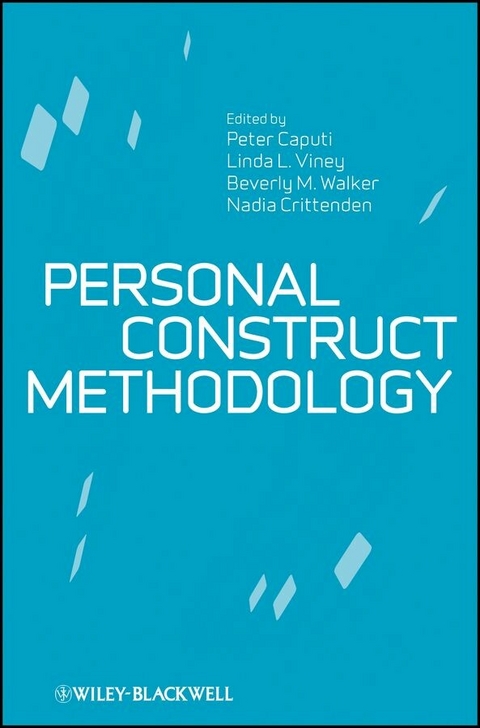
Personal Construct Methodology (eBook)
John Wiley & Sons (Verlag)
978-1-119-95362-3 (ISBN)
- Covers methods such as content analysis scales, repertory grid methodology, narrative assessments and drawings, the laddering and ABC techniques, and discusses how and why they are used
- Explores both qualitative and quantitative methods, as well as methods used in clinical and counselling settings
- Includes 13 contributions from leading international scholars
Peter Caputi is Associate Professor of Psychology at the University of Wollongong, Australia. He is the author of Personal Construct Psychology: New Ideas (edited with Foster & Viney, Wiley, 2006).
Linda L. Viney is Professorial Fellow at the University of Wollongong, Australia and her most recent publication is Personal Construct Psychotherapy: Advances in Theory, Practice and Research (2005).
Beverley M. Walker is Honorary Associate Professor of Psychology at the University of Wollongong, Australia. Her publications include The Construction of Group Realities: Culture, Society and Personal Construct Theory (edited with Kalekin-Fishman & Walker, 1996) and The Internet Encyclopaedia of Personal Construct Psychology (edited with Scheer & Walker).
Nadia Crittenden is Senior Lecturer in Psychology at the University of Wollongong, Australia, where she has she has taught for many years, conducted training workshops, and presented and published research
Written by an international team of experts, this collection provides a comprehensive account of established and emerging methods of collecting and analysing data within the framework of personal construct theory. Covers methods such as content analysis scales, repertory grid methodology, narrative assessments and drawings, the laddering and ABC techniques, and discusses how and why they are used Explores both qualitative and quantitative methods, as well as methods used in clinical and counselling settings Includes 13 contributions from leading international scholars
Peter Caputi is Associate Professor of Psychology at the University of Wollongong, Australia. He is the author of Personal Construct Psychology: New Ideas (edited with Foster & Viney, Wiley, 2006). Linda L. Viney is Professorial Fellow at the University of Wollongong, Australia and her most recent publication is Personal Construct Psychotherapy: Advances in Theory, Practice and Research (2005). Beverley M. Walker is Honorary Associate Professor of Psychology at the University of Wollongong, Australia. Her publications include The Construction of Group Realities: Culture, Society and Personal Construct Theory (edited with Kalekin-Fishman & Walker, 1996) and The Internet Encyclopaedia of Personal Construct Psychology (edited with Scheer & Walker). Nadia Crittenden is Senior Lecturer in Psychology at the University of Wollongong, Australia, where she has she has taught for many years, conducted training workshops, and presented and published research
About the Editors ix
List of Contributors xi
Preface xv
Acknowledgments xvii
PART I: SETTING THE SCENE
1 Assessment of Personal Constructs: Features and Functions of
Constructivist Techniques 3
Heather Gaines Hardison and Robert A. Neimeyer
2 Qualitative Methods in Personal Construct Research: A Set of
Possible Criteria 53
Linda L. Viney and Sue Nagy
PART II: QUALITATIVE APPROACHES: EXPLORING PROCESS
3 The Use of Laddering: Techniques, Applications and Problems
71
Beverly M. Walker and Nadia Crittenden
4 The ABC Model Revisited 89
Finn Tschudi and David Winter
5 The Self-Characterization Technique: Uses, Analysis and
Elaboration 109
Nadia Crittenden and Chantel Ashkar
6 Experience Cycle Methodology: A Method for Understanding the
Construct Revision Pathway 129
Lindsay G. Oades and Linda L. Viney
PART III: QUANTITATIVE APPROACHES: EXPLORING PROCESS
7 An Introduction to Grid-based Methods 149
Peter Caputi
8 Analyzing Grids: New and Traditional Approaches 159
Peter Caputi, Richard Bell and Desley Hennessy
9 Computer-aided Constructivism 183
Brian R. Gaines and Mildred L.G. Shaw
10 Using Constructivist-oriented Content Analysis Scales
223
Linda L. Viney and Peter Caputi
PART IV: METHODS IN COUNSELING AND CLINICAL SETTINGS
11 Narrative Assessment in Psychotherapy: A Constructivist
Approach 247
Luis Botella and Maria Gamiz
12 Using Contrasting Drawings or Pictures as an Assessment Tool
within a Personal Construct Framework 269
Heather Foster and Linda L. Viney
13 Personal Construct Psychotherapy Techniques with Adolescents:
An Integrated Model 287
Miriam Stein, Elaine Atkinson, and Anne Fraser
Index 319
| Erscheint lt. Verlag | 17.11.2011 |
|---|---|
| Sprache | englisch |
| Themenwelt | Geisteswissenschaften ► Psychologie ► Klinische Psychologie |
| Schlagworte | Chapters • Clinical • Clinical psychology • Collection • comprehensive overview • construct • Data • established • Field • Framework • Innovative Approach • International experts • Klinische Psychologie • leading • Methodology • Methods • Personal • Psychologie • Psychology • qualitative • Range • sections • Settings • techniques |
| ISBN-10 | 1-119-95362-6 / 1119953626 |
| ISBN-13 | 978-1-119-95362-3 / 9781119953623 |
| Informationen gemäß Produktsicherheitsverordnung (GPSR) | |
| Haben Sie eine Frage zum Produkt? |
 PDF (Adobe DRM)
Kopierschutz: Adobe-DRM
Adobe-DRM ist ein Kopierschutz, der das eBook vor Mißbrauch schützen soll. Dabei wird das eBook bereits beim Download auf Ihre persönliche Adobe-ID autorisiert. Lesen können Sie das eBook dann nur auf den Geräten, welche ebenfalls auf Ihre Adobe-ID registriert sind.
Details zum Adobe-DRM
Dateiformat: PDF (Portable Document Format)
Mit einem festen Seitenlayout eignet sich die PDF besonders für Fachbücher mit Spalten, Tabellen und Abbildungen. Eine PDF kann auf fast allen Geräten angezeigt werden, ist aber für kleine Displays (Smartphone, eReader) nur eingeschränkt geeignet.
Systemvoraussetzungen:
PC/Mac: Mit einem PC oder Mac können Sie dieses eBook lesen. Sie benötigen eine
eReader: Dieses eBook kann mit (fast) allen eBook-Readern gelesen werden. Mit dem amazon-Kindle ist es aber nicht kompatibel.
Smartphone/Tablet: Egal ob Apple oder Android, dieses eBook können Sie lesen. Sie benötigen eine
Geräteliste und zusätzliche Hinweise
Buying eBooks from abroad
For tax law reasons we can sell eBooks just within Germany and Switzerland. Regrettably we cannot fulfill eBook-orders from other countries.
aus dem Bereich