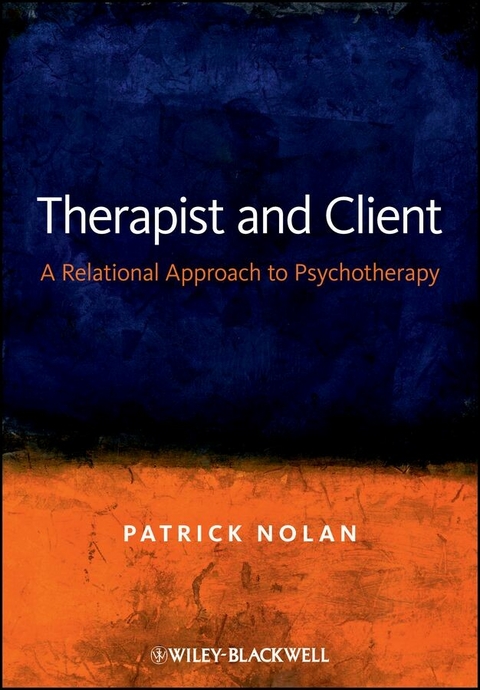
Therapist and Client (eBook)
John Wiley & Sons (Verlag)
978-1-119-94223-8 (ISBN)

- Presents the fundamental interpersonal elements that make the therapeutic relationship the most effective factor in psychotherapy
- Explores and integrates a range of approaches from various schools, from psychoanalysis to body-oriented psychotherapy and humanistic psychotherapies
- Offers clear and practical explanations of the intersubjective aspects of therapy
- Demonstrates the pivotal need to work in the present moment in order to effect change and tailor therapy to the client
- Provides detailed case studies and numerous practical applications of infant research and the unified body-mind perspective increasingly revealed by neuroscience
Patrick Nolan is a Psychotherapist and the Director of the Irish Institute for Integrated Psychotherapy. He is co-author of Object Relations and Integrative Psychotherapy: Tradition and Innovation in Theory and Practice (2002) and has written about integrative, psychoanalytic and body psychotherapy in numerous publications.
Therapist and Client: A Relational Approach to Psychotherapy provides a guide to the fundamental interpersonal elements of the therapeutic relationship that make it the most effective factor in therapy. Presents the fundamental interpersonal elements that make the therapeutic relationship the most effective factor in psychotherapy Explores and integrates a range of approaches from various schools, from psychoanalysis to body-oriented psychotherapy and humanistic psychotherapies Offers clear and practical explanations of the intersubjective aspects of therapy Demonstrates the pivotal need to work in the present moment in order to effect change and tailor therapy to the client Provides detailed case studies and numerous practical applications of infant research and the unified body-mind perspective increasingly revealed by neuroscience
Patrick Nolan is a Psychotherapist and the Director of the Irish Institute for Integrated Psychotherapy. He is co-author of Object Relations and Integrative Psychotherapy: Tradition and Innovation in Theory and Practice (2002) and has written about integrative, psychoanalytic and body psychotherapy in numerous publications.
Foreword ix
Preface xiii
Acknowledgements xv
Introduction xvii
1 Applying Findings from Infant Research 1
Introduction 1
Intersubjectivity 3
References 24
2 The Interpersonal Relationship 27
Introduction 27
The Evolution of a Relational Approach 28
The Therapist: Self with Other 30
Reflecting on Self and Other 42
Repairing the Relationship 45
References 51
3 Potential Space, Creativity and Play 54
Introduction 54
Intersubjectivity - the Realm of Potential Space
55
The Therapeutic Space 56
Creativity and Play 65
References 84
4 The Intersubjective Experience 86
Introduction 86
Defining and Exploring the Intersubjective Experience
90
References 104
5 The Relational Body-Mind 106
Introduction 106
The Nature of the Relational Body-Mind 109
A Relational Body-Mind Perspective 112
Five Modes of Experience, Function and Expression 114
Taking a Body-Mind Stance 119
Relational Body-Mind Therapy 121
Transference-Countertransference and the Body-Mind
131
'Fragile' Clients 132
References 134
6 Working with Trauma and Fragile Clients 137
Introduction 137
Therapy for the Traumatized Body-Mind 138
Working with Fragile Clients 149
References 157
7 Adapting Therapy to the Client: A Relational Approach
159
Introduction 159
Assessment 163
Creating the Therapeutic Frame 171
Tailoring the Therapist's Stance 174
Choosing a Level 184
Staying Adaptable and Relational 189
Arriving at an Individual Style 192
References 194
Index 197
"The real richness in this book is how Nolan illustrates his ideas through his own reflections on his client work and the presentation throughout the book of case vignettes that explicitly demonstrate how the concepts outlined are manifested in his work with clients. Each chapter begins with a presentation of theoretical ideas, supported by theory and research from diverse disciplines including developmental psychology and neuroscience, followed by a demonstration of how these ideas apply in the therapy setting. We are invited to observe the work of therapy, to share in his reflections, to glance through a window into his consulting room where both client and therapist are exposed in all their vulnerability. This book has something to offer for both those in training and experienced practitioners engaged in therapeutic work. The writing style is accessible, particularly when he shares his own views and when he writes about his own practice." (Dr Rosaleen Mc Elvaney, Inside Out)
"In my opinion it deserves a wide readership, and in particular I would urge that it be read by all recent graduates of integrative trainings as an inspiration and encouragement to them as they 'head out into unchartered water', as Nolan might say." (London Psychotherapy Network, Autumn 2012)
"Patrick Nolan sets out to share his findings and research based on over thirty years of clinical practice in this highly informative and significant book." (Irish Association for Counselling and Psychotherapy, Autumn 2012)
"All in all, then, this is a good book for the psychodynamically inclined, taking them rather fully into the relational field, which is so popular these days in all modalities." (ACPNL Magazine, 1 October 2012)
"Nolan has produced a powerful book that clearly explains often complex concepts. This book is suitable for all in the counselling world, although therapists with less experience may find some of the ideas challenging." (Therapy Today, 1 September 2012)Nolan's integrative approach to psychotherapy is unique. It draws together concepts and practices from many therapeutic traditions including humanistic, client-centered, gestalt, psychoanalytic, object-relations, interpersonal and body-oriented approaches. It also takes account of recent advances in developmental psychology and neuroscience. Through clinical case material this book offers a novel perspective on a range of critical issues including the centrality of the therapeutic alliance, matching the therapeutic process to clients' needs, and addressing mind-body and self-other dualities. Nolan is widely acclaimed for his approach to psychotherapy training. This book is long awaited and should be read by both psychotherapists in training and experienced therapists.
--Alan Carr, Director of Clinical Psychology, University College Dublin, Ireland
Drawing on findings from infant research, many schools of psychotherapy, and other disciplines including neuroscience, plus over thirty years of clinical experience, Patrick Nolan affirms the relational field as the locus of both suffering and healing. In doing so he challenges our ideas about the nature of individual psychopathology and re-visions the role of the therapist. Therapist as tender of the Hachoka - The Lakota word for sacred circle; the dynamic web of relationships in which we are each embedded. This is a valuable guide for psychotherapists attempting to forge a relational way of working.
--Michael Kearney, Medical Director of Palliative Care, Cottage Health Systems, California; author of 'Mortally Wounded: Stories of Soul Pain, Death, and Healing' and 'A Place of Healing: Working with Nature and Soul at the end of Life'
1
Applying Findings from Infant Research
There is no such thing as an infant.
Winnicott, 1965, p. 39
Introduction
There is an active, vibrant interpersonal field between the child and mother from the start. This forms the cornerstone of all relationships throughout life. Contemporary research paints a picture of an infant actively engaged in lively person-to-person contact. The newborn has an impressive array of cognitive, emotional and relational abilities that help them deepen their attachment to their caregiver. We now know, too, that ‘An infant can develop an early sense of self’ as they discover the world around them (Nugent et al., 2009; Rochat, 2001, p. 32).
One of the most important developments for psychotherapy over the last 40 years is the compelling evidence from developmental psychology, neurobiology and attachment research that cognitive and emotional development depend on interpersonal relationships from infancy (Schore, 1994; Stern, 1985; Piontelli, 1992). Findings from infant research are becoming increasingly incorporated in psychotherapy and in psychoanalysis and analytic thinking. They provide an extensive understanding of the essentially relational nature of people and how this plays out in psychotherapy. Infant development research also helps us understand the consequences of developmental disruption from trauma. Because arrested development limits an individual's ability to reflect, sense, express, respond, defend and repair, we need in psychotherapy to address the developmental capacities of our clients.
Psychoanalyst Esther Bick is famous for her introduction in 1948 of infant observation as part of training in psychoanalysis, a part still required today. She saw observation of babies and mothers in their own homes as an objective way to ‘understand the earliest experience patients bring with them into therapy’ (Sayers, 2000, p. 139). Direct observation of caregiver–infant interactions can counter or support traditional theories about the development of the infant that are based on hypotheses drawn from the clinician's understanding of the adult. The result of such theories is what Stern (1985) calls a ‘clinically constructed child’. Clearly there are limits to such a construction and its attempt to show early processes of experience, function and expression and the way they develop. Fonagy (2001) questions the assumption that experience drawn from the consulting room corresponds to an actual infant's early life. He states that ‘to accept clinical data as validating developmental hypotheses flies in the face not only of ferocious opposition from philosophers of science … but also of common sense’ (Fonagy, 2001, p. 8). In contrast, infant research from the latter half of the twentieth century uses advances in technology to observe both the capacities of the infant and the finely tuned interaction between the infant and the caregiver as they are happening and even from the inside.
We know now from close observation that babies sense and engage with the other in much less disorientated ways than previously thought. This has led to key concepts in developmental theory such as Stern's Representations of Interactions that have been Generalized (RIGs)1 and reports by scientists like Rochat and ‘schema-of-being-with’2 on research showing that an infant probably has the ability to differentiate between self and non-self stimulation from birth. Rochat concludes that ‘rather than being absolutely separate from their environment or confused about it, infants are attuned to it from the outset’ (Rochat, 2001, p. 32). As the trend towards inclusion in psychotherapy of new findings and concepts continues, I think it is interesting to note that many concepts like projection, introjection and internalization still appear to stand up well, and even find support from new work.
Studies from neuroscience, meanwhile, reveal the remarkable extent of the body–mind connection. Schore describes how the structure of the brain is influenced by ‘early socio-emotional experiences’. He summarizes this as ‘experience-dependent maturation’ and quotes Cicchetti and Tucker (1994, p. 538). ‘Nature's potential can be realized only as it is enabled by nurture’ (Schore, cited in Green, 2004, p. 24). Science has begun in particular to show how non-verbal, affective processes are mediated by the right brain. As a result, we need to recognize the significance of the transmission and regulation of affects as threads that stitch and potentially repair the cloth of development.
I have found these key scientific findings helpful in my own work with clients and in guiding my supervisees. In Chapter 5, I explore the body–mind connections that they uncover in more depth, and below introduce some from infant research that can also be readily applied in our practice.
Intersubjectivity
In intersubjectivity, we find one of the vital elements of the therapeutic relationship, one that I take up in more depth as the topic of Chapter 4. Infant studies suggest that ‘Learning how to communicate represents perhaps the most important developmental process to take place in infancy’ (Papousek and Papousek, 1997, cited in Green, 2004, p. 34). Infants have an ability to engage in interpersonal communication from birth (Stern, 2004, p. 85). They develop within a matrix of ‘primary intersubjectivity’ defined as ‘an active and immediately responsive conscious appreciation of the adult's communicative intentions’ and as ‘a deliberately sought sharing of experiences about events and things’ (Trevarthen and Hubley, 1978; Trevarthen, 1979). The infant has an awareness specifically receptive to subjective states in other people (Trevarthen, 1998, pp. 124–136). Winnicott's famous remark that ‘there is no such thing as an infant’ makes us realize this receptivity is crucial when he explains that ‘if you set out to describe a baby, you will find you are describing a baby and someone else. A baby cannot exist alone, but is essentially part of a relationship [italics in original]. (Winnicott, 1965b, p. 39).
Intersubjectivity – ‘minds attuned to other minds’ (Stern, 1985, p. 85; see also Chapter 4 on the Intersubjective Experience) – naturally forms the basis of our work as psychotherapists. Knowledge about its elemental role and form can help to shape a therapist's way of working with the individual needs of each client. Babies engage in empathic and reciprocal communication. Even at just a few days old, an infant can imitate the caregiver's expressions, including opening their mouth, smiling, sticking their tongue out, pursing their lips, expressing surprise and moving their head, hand or fingers (Beebe et al., 2005, p. 37; Meltzoff, 1985; Rochat, 2001, p. 143). From neuroscience, we learn that the capacities which facilitate intersubjectivity, including face recognition (Wilkinson, 2006, p. 5), the ability to tune into the rhythm of the human voice and to self-soothe (p. 19), are linked to the right hemisphere of the brain. ‘Self awareness, empathy, identification with others, and more general intersubjective processes, are also largely dependent upon right hemisphere resources’ (Decety and Chaminade, 2003, p. 557, cited in Wilkinson, 2006, p. 20). Schore examines the right brain connection and points out that ‘preverbal maternal–infant communication’ that occurs before the ability to speak3 represents ‘transactions between the right hemispheres’ of the mother and child (Schore, 2003, p. 26).4 He suggests that the essence of development is contained in the concept of ‘reciprocal mutual influence’ where these same forms of non-verbal, pre-rational mother–child communications ‘continue throughout life to be a primary medium of intuitively felt affective communication between persons’ (Orlinsky and Howard, 1986, cited in Schore, 2003, p. 26). This non-verbal, emotional coregulation forms our earliest experience of intersubjectivity and the rudiments of social understanding. Mutual engagement, unavoidable and filled with possibility, plays a central role in our work with clients as it infuses the working alliance and serves as the ground for what occurs within it.
Two-way exchange: Including the other
Therapy involves the kind of interpersonal exchange that Buber (2008) called ‘dialogic’: ‘a relation between persons that is characterized in more or less degree by the element of inclusion’ (p. 97). The ideas around two-way exchange include concepts like empathy, containment, correspondence, mirroring, holding, metabolizing, reflecting, resonance and being in tune with the client. Communication that recognizes and responds to the other without any need to change the other is inherent in infants. It becomes a lifelong resource and one to fall back on if later aspects of development fail (Rochat, 2001).
The infant's readiness to perceive the qualities and features of the other orients them, and helps them establish an intentional relationship with their caregiver. Mutual imitation, empathic social mirroring and proto-conversations5 improve the early bonding process and make the infant and caregiver eager to engage. I believe that this form of interacting is similar to the positive rapport that can develop between the therapist and the client.
Reciprocity
Recognizing and communicating with their caregiver...
| Erscheint lt. Verlag | 13.4.2012 |
|---|---|
| Sprache | englisch |
| Themenwelt | Geisteswissenschaften ► Psychologie |
| Medizin / Pharmazie ► Gesundheitsfachberufe | |
| Medizin / Pharmazie ► Medizinische Fachgebiete ► Psychiatrie / Psychotherapie | |
| Schlagworte | Approach • appropriate • Clinician • Concepts • crucial • Decisions • fundamental interpersonal elements • Guide • humanistic • Individual • invaluable • Major • Moment • Order • Patient • present • Psychologie • Psychology • Psychotherapie • Psychotherapie u. Beratung • Psychotherapy & Counseling • Relational • therapeutic relationship • Treatment • vividly |
| ISBN-10 | 1-119-94223-3 / 1119942233 |
| ISBN-13 | 978-1-119-94223-8 / 9781119942238 |
| Informationen gemäß Produktsicherheitsverordnung (GPSR) | |
| Haben Sie eine Frage zum Produkt? |
 EPUB (Adobe DRM)
Kopierschutz: Adobe-DRM
Adobe-DRM ist ein Kopierschutz, der das eBook vor Mißbrauch schützen soll. Dabei wird das eBook bereits beim Download auf Ihre persönliche Adobe-ID autorisiert. Lesen können Sie das eBook dann nur auf den Geräten, welche ebenfalls auf Ihre Adobe-ID registriert sind.
Details zum Adobe-DRM
Dateiformat: EPUB (Electronic Publication)
EPUB ist ein offener Standard für eBooks und eignet sich besonders zur Darstellung von Belletristik und Sachbüchern. Der Fließtext wird dynamisch an die Display- und Schriftgröße angepasst. Auch für mobile Lesegeräte ist EPUB daher gut geeignet.
Systemvoraussetzungen:
PC/Mac: Mit einem PC oder Mac können Sie dieses eBook lesen. Sie benötigen eine
eReader: Dieses eBook kann mit (fast) allen eBook-Readern gelesen werden. Mit dem amazon-Kindle ist es aber nicht kompatibel.
Smartphone/Tablet: Egal ob Apple oder Android, dieses eBook können Sie lesen. Sie benötigen eine
Geräteliste und zusätzliche Hinweise
Buying eBooks from abroad
For tax law reasons we can sell eBooks just within Germany and Switzerland. Regrettably we cannot fulfill eBook-orders from other countries.
aus dem Bereich