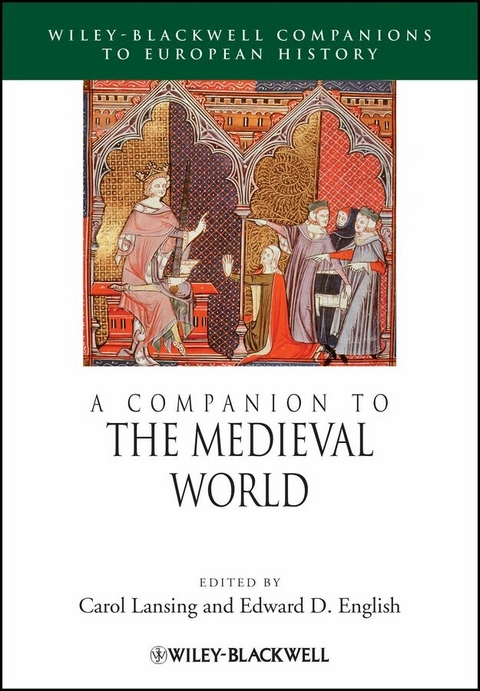
A Companion to the Medieval World (eBook)
John Wiley & Sons (Verlag)
978-1-118-49946-7 (ISBN)
Carol Lansing is Professor of History at the University of California, Santa Barbara. Her research focuses on medieval Italian politics, society, and culture. Previous publications include The Florentine Magnates: Lineage and Faction in a Medieval Commune (1991), Power and Purity: Cathar Heresy in Medieval Italy (1998) and Passion and Order: Restraint of Grief in the Medieval Italian Communes (2008).
Edward D. English is Executive Director of Medieval Studies and Associate Professor of History at the University of California, Santa Barbara. He is finishing the first of two volumes on the society and politics of Siena in the fourteenth century. His other publications include Enterprise and Liability in Sienese Banking, 1230-1350 (1988) and The Encyclopedia of the Medieval World, 2 volumes (2005).
Drawing on the expertise of 26 distinguished scholars, this important volume covers the major issues in the study of medieval Europe, highlighting the significant impact the time period had on cultural forms and institutions central to European identity. Examines changing approaches to the study of medieval Europe, its periodization, and central themes Includes coverage of important questions such as identity and the self, sexuality and gender, emotionality and ethnicity, as well as more traditional topics such as economic and demographic expansion; kingship; and the rise of the West Explores Europe s understanding of the wider world to place the study of the medieval society in a global context
Carol Lansing is Professor of History at the University of California, Santa Barbara. Her research focuses on medieval Italian politics, society, and culture. Previous publications include The Florentine Magnates: Lineage and Faction in a Medieval Commune (1991), Power and Purity: Cathar Heresy in Medieval Italy (1998) and Passion and Order: Restraint of Grief in the Medieval Italian Communes (2008). Edward D. English is Executive Director of Medieval Studies and Associate Professor of History at the University of California, Santa Barbara. He is finishing the first of two volumes on the society and politics of Siena in the fourteenth century. His other publications include Enterprise and Liability in Sienese Banking, 1230-1350 (1988) and The Encyclopedia of the Medieval World, 2 volumes (2005).
Notes on Contributors viii
PART I THE MIDDLE AGES 1
1 The Idea of a Middle Ages 3
Edward D. English and Carol Lansing
PART II EARLY MEDIEVAL FOUNDATIONS 7
2 Economies and Societies in Early Medieval Western Europe 9
Matthew Innes
3 Politics and Power 36
Hans Hummer
4 Religious Culture and the Power of Tradition in the Early Medieval West 67
Yitzhak Hen
PART III POPULATIONS AND THE ECONOMY 87
5 Economic Takeoff and the Rise of Markets 89
James Paul Masschaele
6 Rural Families in Medieval Europe 111
Phillipp R. Schofield
7 Marriage in Medieval Latin Christendom 130
Martha Howell
8 Gender and Sexuality 161
John Arnold
9 Society, Elite Families, and Politics in Late Medieval Italian Cities 185
Edward D. English
PART IV RELIGIOUS CULTURE 209
10 New Religious Movements and Reform 211
Maureen C. Miller
11 Monastic and Mendicant Communities 231
Constance H. Berman
12 Hospitals in the Middle Ages 257
James W. Brodman
13 Popular Belief and Heresy 276
Carol Lansing
14 Jews in the Middle Ages 293
Kenneth R. Stow
15 Muslims in Medieval Europe 313
Olivia Remie Constable
PART V POLITICS AND POWER 333
16 Conflict Resolution and Legal Systems 335
Thomas Kuehn
17 Medieval Rulers and Political Ideology 354
Robert W. Dyson
18 Papal Monarchy 372
Andreas Meyer
19 Urban Historical Geography and the Writing of Late Medieval Urban History 397
Teofilo F. Ruiz
20 Bureaucracy and Literacy 413
Richard Britnell
21 The Practice of War 435
Clifford J. Rogers
22 Expansion and the Crusades 455
Christopher Tyerman
PART VI TECHNOLOGIES AND CULTURE 475
23 Romanesque and Gothic Church Architecture 477
Stephen Murray
24 Aristocratic Culture: Kinship, Chivalry, and Court Culture 500
Richard E. Barton
25 Philosophy and Humanism 525
Stephen Gersh
26 Philosophy and Theology in the Universities 544
Philipp W. Rosemann
PART VII THE EUROPEAN MIDDLE AGES 561
27 Medieval Europe in World History 563
R. I. Moore
Index 581
"...a valuable reference book for students engaged in medieval studies at honours or postgraduate level seeking in-depth information on sources for essays and theses. It is useful for teachers and lecturers of medieval history (like me) striving to keep upto-date with the state of the discipline. Many of the essays would also be of interest to intelligent 'general readers' who wish to extend their knowledge of the medieval world."
(St. Mark's Review, August 2016 issue)
"Nonetheless, this Companion is an excellent manual for those who have never (or only partially) studied medieval history, as it provides clear outlines of extremely complex issues, a thought-provoking insight into historiographical and methodological trends, as well as an extremely rich bibliography to assist further investigation."
(English Historical Review, January 2013 issue)
"A Companion to the Medieval World will be of great value for instructors who want to pull their own thoughts together and to have a model for a concise explication of complicated topics. It will also bring home to students and general readers that there is no "party line" on the medieval world and that the past, as an intellectual and cultural construct, is very much alive."
(The Medieval Review)
'A Companion to the Medieval World will be of great
value for instructors who want to pull their own thoughts together
and to have a model for a concise explication of complicated
topics. It will also bring home to students and general readers
that there is no "party line" on the medieval world and that the
past, as an intellectual and cultural construct, is very much
alive.' --The Medieval Review
Notes on Contributors
John Arnold is Professor in the School of History, Classics, and Archaeology, Birkbeck, University of London. He is the author of Belief and Unbelief in Medieval Europe (London: Edward Arnold, 2005); co-edited with K. J. Lewis, A Companion to the Book of Margery Kempe (Woodbridge, Suffolk: Boydell, 2004); Inquisition and Power: Catharism and the Confessing Subject in Medieval Languedoc (Philadelphia: University of Pennsylvania Press, 2001); History: A Very Short Introduction (Oxford: Oxford University Press, 2000); co-edited with S. Ditchfield and K. Davies, History and Heritage: Consuming the Past in Contemporary Culture (Lower Coombe, Dorset: Donhead, 1998); and most recently What is Medieval History? (Cambridge: Polity, 2008).
Richard E. Barton is Associate Professor at the University of North Carolina, Greensboro. He is the author of “Making a Clamor to the Lord: Noise, Justice and Power in Eleventh- and Twelfth-Century France,” in Feud, Violence and Practice: Essays in Medieval Studies in Honor of Stephen D. White, ed. B. Tuten and T. Billado (Aldershot: Ashgate, forthcoming); “Gendering Anger: Ira, Furor and Discourses of Power and Masculinity in the 11th and 12th Centuries,” in In the Garden of Evil: the Vices in the Middle Ages, ed. Richard Newhauser (Toronto: University of Toronto Press, 2005), 371–392; and Lordship in the County of Maine, c. 890–1160 (Woodbridge, Suffolk: Boydell Press, 2004).
Constance H. Berman is Professor of History at the University of Iowa. She is the editor and a contributor to Medieval Religion: New Approaches (London: Routledge, 2005); The Cistercian Evolution: The Invention of a Religious Order in Twelfth-Century Europe (University of Pennsylvania Press, 2000); a co-editor of Medieval Agriculture, the Southern-French Countryside, and the Early Cistercians. A Study of Forty-three Monasteries (Philadelphia: American Philosophical Society, 1986); co-editor of The Worlds of Medieval Women: Creativity, Influence, Imagination (Morgantown: West Virginia University Press, 1985); the editor and translator of Women and Monasticism in Medieval Europe: Sisters and Patrons of the Cistercian Order, (Kalamazoo, MI: Medieval Institute Publications, 2002) and has two works in progress: The White Nuns: Cistercian Abbeys for Women and Their Property and After the Millennium: Women’s Work and European Economic Growth, 1050–1250.
Richard Britnell is emeritus professor of economic history at the University of Durham, fellow of the British Academy and co-editor of the Surtees Society. He is the author of many articles, editions, and Growth and Decline in Colchester, 1300–1525 (Cambridge: Cambridge University Press, 1986, reprint 2008); The Commercialisation of English Society, 1000–1500 (Cambridge: Cambridge University Press, 1993; 2nd edn, 1996); co-edited with B. M. S. Campbell, A Commercialising Economy: England 1086 to c. 1300 (Manchester: Manchester University Press, 1995); co-edited with A. J. Pollard, The McFarlane Legacy: Studies in Late Medieval Politics and Society (Stroud: Alan Sutton, 1995); The Closing of the Middle Ages? England, 1471–1529 (Oxford: Blackwell, 1997); edited Pragmatic Literacy, East and West, 1200–1330 (Woodbridge: Boydell and Brewer, 1997); and Britain and Ireland 1050–1530: Economy and Society (Oxford: Oxford University Press, 2004).
James W. Brodman is a Professor of History at the University of Central Arkansas, a past President of the American Academy of Research Historians of Medieval Spain, and founder and director of LIBRO: The Library of Iberian Resources Online. He has published Ransoming Captives in Crusader Spain: The Order of Merced on the Christian-Islamic Frontier (Philadelphia: University of Pennsylvania Press, 1986); L’Ordre de la Merce: El rescat de captius a l’Espanya de les croades (Barcelona: Edicions dels Quaderns Crema, 1990); Charity and Welfare: Hospitals and the Poor in Medieval Catalonia. The Middle Ages Series (Philadelphia: University of Pennsylvania Press, 1998); and Charity and Religion in Medieval Europe. Washington, DC: The Catholic University of America Press, 2009.
Olivia Remie Constable is Professor of History at the University of Notre Dame. She has published Trade and Traders in Muslim Spain: The Commercial Realignment of the Iberian Peninsula 900–1500 (Cambridge: Cambridge University Press, 1994); Medieval Iberia: Readings from Christian, Muslim, and Jewish Sources (Philadelphia: University of Pennsylvania Press, 1997); Housing the Stranger in the Mediterranean World: Lodging, Trade, and Travel in Late Antiquity and the Middle Ages (Cambridge: Cambridge University Press, 2003); and a new book project entitled Muslims in Medieval Europe.
Robert W. Dyson was Lecturer in the School of Government and International Affairs and a member of the Centre for Medieval and Renaissance Studies and the Centre for the History of Political Thought at the University of Durham. Among his numerous publications are St. Augustine of Hippo and the Christian Transformation of Political Philosophy (London: Continuum Press, 2005); Giles of Rome’s “On Ecclesiastical Power”: A Medieval Theory of World Government (New York: Columbia University Press, 2005); St Thomas Aquinas: The Political Writings (Cambridge: Cambridge University Press, 2002); St Augustine of Hippo: The City of God Against the Pagans (Cambridge: Cambridge University Press, 1998); James of Viterbo On Christian Government (Woodbridge, Suffolk: Boydell Press, 1995); and Giles of Rome on Ecclesiastical Power (Woodbridge, Suffolk: Boydell Press, 1986).
Edward D. English is Executive Director of Medieval Studies and Adjunct Associate Professor of History at the University of California, Santa Barbara. He is finishing the first of two volumes on the society and politics of Siena in the fourteenth century. His other publications include Enterprise and Liability in Sienese Banking, 1230–1350 (Cambridge: Medieval Academy of America, 1988) and The Encyclopedia of the Medieval World, 2 volumes (New York: Facts-on-File, 2005).
Stephen Gersh is Professor of Medieval Studies in the Medieval Institute at the University of Notre Dame. His publications include: Kinesis Akinetos. A Study of Spiritual Motion in the Philosophy of Proclus (Leiden: Brill 1973); From Iamblichus to Eriugena. An Investigation of the Prehistory and Evolution of the Pseudo-Dionysian Tradition (Leiden: Brill 1978); Middle Platonism and Neoplatonism. The Latin Tradition, 2 volumes (Notre Dame: University of Notre Dame Press, 1986); Concord in Discourse. Harmonics and Semiotics in Late Classical and Early Medieval Platonism (Berlin: Mouton-De Gruyter 1996); and with Maarten J. F. M. Hoenen, Plato in the Middle Ages. A Doxographical Approach (Berlin: De Gruyter 2002).
Yitzhak Hen is Associate Professor at Ben-Gurion University of the Negev. He has published Culture and Religion in Merovingian Gaul, A.D. 481–751 (Leiden: Brill, 1995); The Sacramentary of Echternach, Henry Bradshaw Society, 110 (London: Boydell and Brewer, 1997); co-edited with Matthew Innes, The Uses of the Past in the Early Middle Ages (Cambridge: Cambridge University Press, 2000); De Sion Exibit Lex et Verbum Domini de Hierusalem. Studies on Medieval Law, Liturgy and Literature in Honour of Amnon Linder, Cultural Encounters in Late Antiquity and the Middle Ages, 1 (Turnhout: Brepols, 2001); The Royal Patronage of Liturgy in Frankish Gaul to the Death of Charles the Bald (877), Henry Bradshaw Society Subsidia series, 3 (London: Boydell and Brewer, 2001); co-edited with Rob Meens, The Bobbio Missal: Liturgy and Religious Culture in Merovingian Gaul, (Cambridge: Cambridge University Press, 2004); Roman Barbarians: The Royal Court and Culture in the Early Medieval West (London: Palgrave, 2007); and is General Editor of the Series “Cultural Encounters in Late Antiquity and the Middle Ages” for Brepols.
Martha C. Howell is Miriam Champion Professor of History in Columbia University. She has published From Reliable Sources with Walter Prevenier (Ithaca: Cornell University Press, 2001); The Marriage Exchange: Property, Social Place and Gender in Cities of the Low Countries, 1300–1550 (Chicago: University of Chicago Press, 1998); and Women, Production, and Patriarchy in Late Medieval Cities (Chicago: University of Chicago Press, 1986); with Marc Boone, In But Not of the Market: Movable Goods in the Late Medieval and Early Modern Economy (2007), and Commerce before Capitalism in Europe, 1300–1600. (Cambridge: Cambridge University Press, 2010).
Hans Hummer is an Associate Professor in History at Wayne State University. He has published Politics and Power...
| Erscheint lt. Verlag | 11.10.2012 |
|---|---|
| Reihe/Serie | Blackwell Companions to European History |
| Blackwell Companions to European History | Blackwell Companions to European History |
| Sprache | englisch |
| Themenwelt | Geschichte ► Allgemeine Geschichte ► Mittelalter |
| Geisteswissenschaften ► Geschichte ► Regional- / Ländergeschichte | |
| Schlagworte | European Medieval History • Geschichte • Geschichte des europäischen Mittelalters • Geschichte des europäischen Mittelalters • History • Middle Ages, Europe, 'Dark Ages', post-Roman, Crusades, monasticism, Christianity, heresy • Mittelalter |
| ISBN-10 | 1-118-49946-8 / 1118499468 |
| ISBN-13 | 978-1-118-49946-7 / 9781118499467 |
| Informationen gemäß Produktsicherheitsverordnung (GPSR) | |
| Haben Sie eine Frage zum Produkt? |
 EPUB (Adobe DRM)
Kopierschutz: Adobe-DRM
Adobe-DRM ist ein Kopierschutz, der das eBook vor Mißbrauch schützen soll. Dabei wird das eBook bereits beim Download auf Ihre persönliche Adobe-ID autorisiert. Lesen können Sie das eBook dann nur auf den Geräten, welche ebenfalls auf Ihre Adobe-ID registriert sind.
Details zum Adobe-DRM
Dateiformat: EPUB (Electronic Publication)
EPUB ist ein offener Standard für eBooks und eignet sich besonders zur Darstellung von Belletristik und Sachbüchern. Der Fließtext wird dynamisch an die Display- und Schriftgröße angepasst. Auch für mobile Lesegeräte ist EPUB daher gut geeignet.
Systemvoraussetzungen:
PC/Mac: Mit einem PC oder Mac können Sie dieses eBook lesen. Sie benötigen eine
eReader: Dieses eBook kann mit (fast) allen eBook-Readern gelesen werden. Mit dem amazon-Kindle ist es aber nicht kompatibel.
Smartphone/Tablet: Egal ob Apple oder Android, dieses eBook können Sie lesen. Sie benötigen eine
Geräteliste und zusätzliche Hinweise
Buying eBooks from abroad
For tax law reasons we can sell eBooks just within Germany and Switzerland. Regrettably we cannot fulfill eBook-orders from other countries.
aus dem Bereich