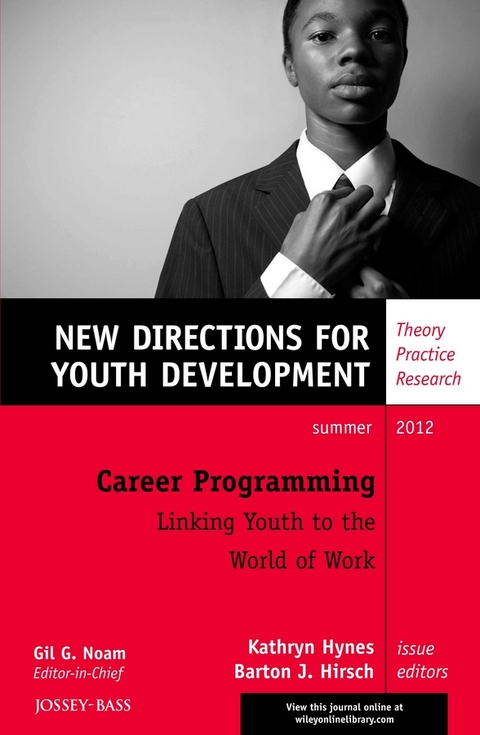
Career Programming (eBook)
128 Seiten
John Wiley & Sons (Verlag)
978-1-118-44082-7 (ISBN)
This issue brings together information from a variety ofdisciplines and fields to help researchers, practitioners, andpolicymakers understand what we know and need to learn to provideyouth with effective, engaging career-related programming. Thearticles highlight key findings about how youth learn about careersand develop a vocational identity, whether adolescent employment isbeneficial for youth, and how to align our various systems topromote positive youth development.
Models of career programming from education, afterschool,and workforce development are highlighted, as are strategies forcollaborating with businesses. The volume emphasizes the practicalimplications of research findings, keeping the focus on how todevelop evidence-based practices to support career development foryouth.
This is the 134th volume of New Directions for YouthDevelopment, the Jossey-Bass quarterly report series dedicated tobringing together everyone concerned with helping young people,including scholars, practitioners, and people from differentdisciplines and professions.
Kathryn Hynes and Barton J. Hirsch are the authors of Career Programming: Linking Youth to the World of Work: New Directions for Youth Development, Number 134, published by Wiley.
Issue Editors' Notes 1
Kathryn Hynes, Barton J. Hirsch
Executive Summary 7
1. Career development during childhood and adolescence 11
Erik J. Porfeli, Bora Lee
A review of the literature on how children and adolescentsdevelop careerrelated identities highlights importantconsiderations for intervention.
2. Teenage employment and career readiness 23
Kaylin M. Greene, Jeremy Staff
This article highlights recent research on the prevalence ofadolescent employment and its consequences and highlightsimplications for practice.
3. What schools are doing around career development:Implications for policy and practice 33
Justin C. Perry, Eric W. Wallace
This article describes the history of schools' involvementin career programming and identifies promising models for thefuture.
4. Support for career development in youth: Program models andevaluations 45
Megan A. Mekinda
After describing the evaluation findings from four programsoffering career development, this article highlights lessons forfuture program design.
5. Marketable job skills for high school students: What welearned from an evaluation of After School Matters 55
Kendra P. Alexander, Barton J. Hirsch
An in-depth exploration of data from the After School Mattersevaluation highlights an important component of career programmingand a promising area for intervention.
6. Development in youth enterprises 65
Stephen F. Hamilton, Mary Agnes Hamilton
This article describes several programs involving youth inenterprises and highlights how these programs connect to importantprinciples of youth development.
7. Building business-community partnerships to support youthdevelopment 77
Donna Klein
Based on experience working with the private sector, the authorsuggests ways to build community partnerships, with a special focuson engaging private employers in the effort.
8. Supporting vocationally oriented learning in the high schoolyears: Rationale, tasks, challenges 85
Robert Halpern
Drawing from diverse research fields, this article highlightsthe limitations of our current system of education and suggestsstrategies for improvement.
9. Next steps for research and practice in career programming107
Kathryn Hynes
Drawing from the various perspectives presented in this volume,this article highlights areas for further research andpractice.
Index 115
| Erscheint lt. Verlag | 17.7.2012 |
|---|---|
| Reihe/Serie | J-B MHS Single Issue Mental Health Services |
| Sprache | englisch |
| Themenwelt | Geisteswissenschaften |
| Sozialwissenschaften ► Pädagogik ► Berufspädagogik | |
| Sozialwissenschaften ► Pädagogik ► Bildungstheorie | |
| Schlagworte | Bildungswesen • Child & Adolescent Clinical Psychology • Education • K-12 / Entwicklung im Jugendalter • Klinische Psychologie / Kinder u. Jugendliche • Psychologie • Psychology • Youth Development (K-12) |
| ISBN-10 | 1-118-44082-X / 111844082X |
| ISBN-13 | 978-1-118-44082-7 / 9781118440827 |
| Informationen gemäß Produktsicherheitsverordnung (GPSR) | |
| Haben Sie eine Frage zum Produkt? |
 EPUB (Adobe DRM)
Kopierschutz: Adobe-DRM
Adobe-DRM ist ein Kopierschutz, der das eBook vor Mißbrauch schützen soll. Dabei wird das eBook bereits beim Download auf Ihre persönliche Adobe-ID autorisiert. Lesen können Sie das eBook dann nur auf den Geräten, welche ebenfalls auf Ihre Adobe-ID registriert sind.
Details zum Adobe-DRM
Dateiformat: EPUB (Electronic Publication)
EPUB ist ein offener Standard für eBooks und eignet sich besonders zur Darstellung von Belletristik und Sachbüchern. Der Fließtext wird dynamisch an die Display- und Schriftgröße angepasst. Auch für mobile Lesegeräte ist EPUB daher gut geeignet.
Systemvoraussetzungen:
PC/Mac: Mit einem PC oder Mac können Sie dieses eBook lesen. Sie benötigen eine
eReader: Dieses eBook kann mit (fast) allen eBook-Readern gelesen werden. Mit dem amazon-Kindle ist es aber nicht kompatibel.
Smartphone/Tablet: Egal ob Apple oder Android, dieses eBook können Sie lesen. Sie benötigen eine
Geräteliste und zusätzliche Hinweise
Buying eBooks from abroad
For tax law reasons we can sell eBooks just within Germany and Switzerland. Regrettably we cannot fulfill eBook-orders from other countries.
aus dem Bereich