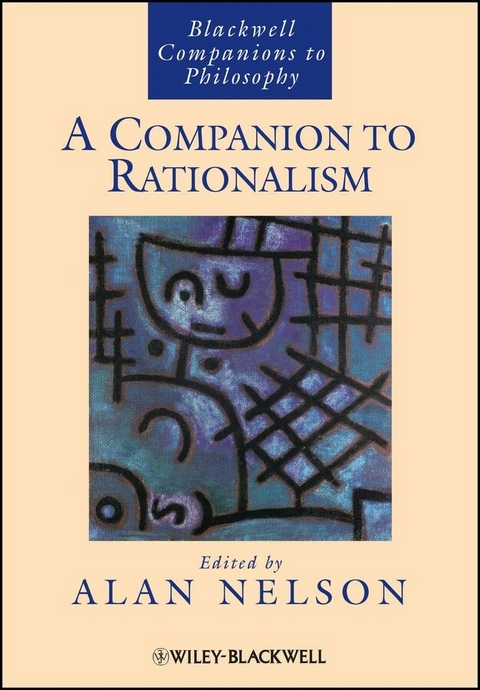
A Companion to Rationalism (eBook)
John Wiley & Sons (Verlag)
978-1-118-39420-5 (ISBN)
Alan Nelson is Professor of Philosophy at the University of California, Irvine. He is a leading scholar of the great philosophical systems of the seventeenth and eighteenth centuries and has published widely on rationalism in the history of philosophy and in the philosophy of science.
This book is a wide-ranging examination of rationalist thought in philosophy from ancient times to the present day. Written by a superbly qualified cast of philosophers Critically analyses the concept of rationalism Focuses principally on the golden age of rationalism in the seventeenth and early eighteenth centuries Also covers ancient rationalism, nineteenth-century rationalism, and rationalist themes in recent thought Organised chronologically Various philosophical methods and viewpoints are represented
Alan Nelson is Professor of Philosophy at the University of California, Irvine. He is a leading scholar of the great philosophical systems of the seventeenth and eighteenth centuries and has published widely on rationalism in the history of philosophy and in the philosophy of science.
List of Contributors ix
Acknowledgments xi
List of Abbreviations xii
Introduction xiv
Part I The Core of Rationalism 1
1 The Rationalist Impulse 3
Alan Nelson
2 The Rationalist Conception of Substance 12
Thomas M. Lennon
3 Rationalist Theories of Sense Perception and Mind-Body
Relation 31
Gary Hatfield
4 Rationalism and Education 61
David Cunning
Part II The Historical Background 83
5 Plato's Rationalistic Method 85
Hugh H. Benson
6 Rationalism in Jewish Philosophy 100
Steven Nadler
7 Early Modern Critiques of Rationalist Psychology 119
Antonia LoLordo
8 Rationalism and Method 137
Matthew J. Kisner
9 Cartesian Imaginations: The Method and Passions of Imagining
156
Dennis L. Sepper
Part III The Heyday of Rationalism 177
10 Descartes' Rationalist Epistemology 179
Lex Newman
11 Rationalism and Representation 206
Kurt Smith
12 The Role of the Imagination in Rationalist Philosophies of
Mathematics 224
Lawrence Nolan
13 Idealism and Cartesian Motion 250
Alice Sowaal
14 Leibniz on Shape and the Cartesian Conception of Body
262
Timothy Crockett
15 Leibniz on Modality, Cognition, and Expression 282
Alan Nelson
16 Rationalist Moral Philosophy 302
Andrew Youpa
17 Spinoza, Leibniz, and the Rationalist Reconceptions of
Imagination 322
Dennis L. Sepper
18 Kant and the Two Dogmas of Rationalism 343
Henry E. Allison
Part IV Rationalist Themes in Contemporary Philosophy
361
19 Rationalism in the Phenomenological Tradition 363
David Woodruff Smith
20 Rationalist Elements of Twentieth-Century Analytic Philosophy
379
Paul Livingston
21 Proust and the Rationalist Conception of the Self 399
Alan Nelson
22 Rationalism in Science 408
David Stump
23 Rational Decision Making: Descriptive, Prescriptive, or
Explanatory? 425
Jonathan Michael Kaplan
24 What is a Feminist to do with Rational Choice? 450
Mariam Thalos
25 Rationalism in the Philosophy of Donald Davidson 468
Richard N. Manning
Index 488
"Addressing topics from epistemology and metaphysics to
ethics and psychology, it is the most compete treatment of the
subject known to me." "I can recommend this book
without hesitation."
(Philosophy In Review)
"This companion is large indeed, but the size fits the largeness
of its subjects; and it does succeed in its 25 articles in covering
that subject . . . A job well done. Recommended."
(Choice)
Chapter 1
The Rationalist Impulse
ALAN NELSON
Philosophers are rightly suspicious of the usefulness of broadly conceived labels and “-isms.” They are particularly suspicious when the labels mark dichotomies. Rationalism thus qualifies as suspicious if it is taken to be a neatly delineated set of doctrines. The task assumed by this chapter is not to find such a set, but instead to provide an analysis of what I shall call the impulse to philosophize rationalistically. The analysis therefore does not purport to sharply distinguish a set of maxims or propositions characteristic of rationalism from another set proper to its foil, empiricism. Nor does it attempt to delineate specific doctrines to which all “rationalists” adhere. I shall, however, argue that attention to some overarching themes in rationalist systems of philosophy can be of considerable use in understanding the philosophical accomplishments of the great rationalists. Insufficient attention to these themes has often led to interpretations of rationalists that skew the dialectic with their empiricist antagonists in favor of the latter.
I shall draw some examples from Plato, who provides most of the earliest texts clearly articulating rationalist themes. The primary focus will be on the great thinkers from the seventeenth-century heyday of rationalism, but in conclusion some observations will be made about the rationalist impulse in Russell’s logical atomism. This should help bring into relief some respects in which the triumph of empiricist sensibilities among historians of philosophy in the twentieth century and beyond has made the rationalist impulse rather alien. Naturally, this is not conducive to recovering the spirit of rationalist projects.
I
The primary and customary sense of the term “rationalism” characterizes a philosophical attitude toward knowledge. Knowledge itself is partly characterized both by the subjects, or possessors, of knowledge and by the objects of knowledge, the things to be known. Rationalism, therefore, bears on ontology since it requires an understanding of the natures of these subjects and objects. There are also characteristically rational processes or techniques for obtaining or developing knowledge, so rationalism bears on method, philosophical education, and the nature of philosophy itself.
The traditional series of contrasts with its foil, empiricism, thus begins with subjects and objects of knowledge. Traditional rationalisms identify the intellect, the mind, or the rational part of the soul (or even the State) as of primary importance in receiving and holding knowledge. The corresponding objects of knowledge are then non-sensory, general, and unchanging or eternal. Traditional empiricisms, by contrast, identify the senses, or common sense, or the sensitive part of the soul as of primary importance. The corresponding objects of knowledge are then the inhabitants of the temporal world in flux. Of course, rationalists have a story to tell about how some kinds of derivative knowledge depend directly on the senses. We can come to know that the senses are reliable indicators of what is beneficial to us and we can then know (as opposed to taking it for granted) that, for example, bread nourishes. Furthermore, absolutely all knowledge depends in some attenuated ways on the sensory because we need to learn more esoteric truths by first hearing or reading things that bring us to understand them. Empiricists similarly have a story to tell about the role of the non-sensory. The clearest example is Locke’s essential reliance on innate operations of the mind. This is an extreme case, but all empiricists need to have some account of how abstract, general truths are derived from what is given by the senses.
These points are crucial to appreciating the depth of the chasm between rationalism and empiricism despite the pockets of shared concerns and overlap. It is easy to see that the empiricist has an initial debater’s advantage. Because human beings are born helpless, pre-linguistic, and dependent, they first become cognizant of the sensory qualities of objects familiar to common sense. A normal person not having a prior education in rationalist philosophy will cling to thoughts of these familiar things when beginning a philosophical education. Thus the empiricist finds a ready pupil, an ally in fact, in what we now like to call the “untutored common sense” of a “sensible” person or a person of “good sense.” Such a person is apt to appreciate an analysis of features of the intangible, vaguely perceived, intellectual objects of rationalist knowledge into commonsensical items and their features. The rationalist teacher cannot display the reward of hard study to the beginning student like candy in a jar. Students are instead told that their opinions, while perhaps of considerable utility, are strictly speaking false and that the truth can be only vaguely characterized until they can see it for themselves. And the goal is to see the truth. Not visually, of course, but with the mind’s eye, through a “purely mental scrutiny” as Descartes put it.
II
How is the esoteric truth of the rationalist to be accessed? If mere exhortation is the last resort, even open-minded students will be justifiably suspicious. And even those who are somehow moved to appreciate the truth by exhortations might be later persuaded by other, contrary doctrines. What is required is some technique or method for bringing the student from a starting place favoring empiricism to the truth. An effective method must start with easy steps and progressively draw the pupil away from sensory distractions. Let us consider examples with some detail.
A rudimentary development of such a method can be found in Plato’s dialogue, Symposium (210a–212b). Here, the esoteric truth to be sought is described as a “vision” of Beauty itself, the Platonic form. Love is characterized as desire, ultimately desire for Beauty. The method, then, can be regarded as instruction in the art of loving well. The first step in this form of Platonic education requires that one love a beautiful body. This is ingeniously designed to be an easy step that requires no prior commitment and no special effort from most students. Loving (that is, desiring) a beautiful body comes naturally to humans and can be mostly driven by sensual appetites. The Trojan horse, of course, is that the body is beautiful in a way that connects it, albeit distantly and vaguely, to the final goal of Beauty itself. The next step is to love many beautiful bodies and this is, unbeknownst to the pupil, loving the Beauty in all these bodies. The beginning students’ inability to understand fully their intermediate accomplishments is characteristic of rationalist enlightenment. As students progress, they typically will not fully understand the nature of the progress they have made, nor do they need to. It is the final goal that is important. So lovers of many bodies might conceive their achievement as the ability to love different kinds of corporeal beauty, but the already enlightened understand that those at the second step are loving Beauty despite its degradation by various corporeal guises.
In this course of instruction, students next progress to the love of individual souls, and then to what might be regarded as the soul of the State, its laws. This leads to love of various kinds of knowledge and then to the love of knowledge in general – philosophy. The Philosopher, having thus advanced through these stages of love, is prepared to catch glimpses of Beauty itself. One crucial aspect of this method is that those who completed the course of instruction are able to perceive in ways that are unavailable to the uninitiated. Even a generally competent adult immersed in the world of sense will be unable to perceive truth at will. The situation is quite analogous to the development that can be effected in sensory capacities. All wine might taste sour to the neophyte, but a trained wine taster might make very fine discriminations with some reliability. A symphony orchestra might sound like noise to a child or someone trained in another musical tradition and so on. It is to be expected, therefore, that if rationalists begin a lesson or an exposition with a plain statement of Truth, they will meet with skepticism and incomprehension.
An interesting feature of the method described in the Symposium is that it is much more than a means of acquiring some abstract doctrines. It also involves learning a way of life. Since the “bringing forth of beautiful ideas” is itself a high form of appreciating Beauty, the advanced philosopher is motivated to teach beginners. It is not expected that pupils go it alone. This makes progress highly contingent on the availability of suitable teachers. It also means that the process of education requires a very long-term, daunting initial commitment of time from the student. The search for a method of discovery with greater generality, reliability, efficiency, and power led Descartes to his infamous method of universal doubt. Descartes himself would, of course, be horrified by later use of the term “Cartesian Skepticism.” Universal doubt is meant to lead to “perfect knowledge” of the truth and it is for this reason that he calls it “methodical.” The various functions of the doubt include (a) withdrawal from the senses whose particular deliverances are most easily doubted, (b) a preemptive strike against later doubts; if the project begins with, and then overcomes a universal, all-inclusive doubt there is no room for subsequent second guessing of anything that...
| Erscheint lt. Verlag | 1.10.2012 |
|---|---|
| Reihe/Serie | Blackwell Companions to Philosophy |
| Blackwell Companions to Philosophy | Blackwell Companions to Philosophy |
| Sprache | englisch |
| Themenwelt | Geisteswissenschaften ► Philosophie ► Allgemeines / Lexika |
| Geisteswissenschaften ► Philosophie ► Geschichte der Philosophie | |
| Geisteswissenschaften ► Philosophie ► Philosophie der Neuzeit | |
| Schlagworte | 17th & 18th Century Philosophy • Geschichte der westlichen Philosophie • Historical Western Philosophy • Philosophie • Philosophie des 17. u. 18. Jhd. • Philosophy • Rationalism, philosophy, rationalist, representation, idealism, Leibniz, empiricism • Rationalismus |
| ISBN-10 | 1-118-39420-8 / 1118394208 |
| ISBN-13 | 978-1-118-39420-5 / 9781118394205 |
| Informationen gemäß Produktsicherheitsverordnung (GPSR) | |
| Haben Sie eine Frage zum Produkt? |
 EPUB (Adobe DRM)
Kopierschutz: Adobe-DRM
Adobe-DRM ist ein Kopierschutz, der das eBook vor Mißbrauch schützen soll. Dabei wird das eBook bereits beim Download auf Ihre persönliche Adobe-ID autorisiert. Lesen können Sie das eBook dann nur auf den Geräten, welche ebenfalls auf Ihre Adobe-ID registriert sind.
Details zum Adobe-DRM
Dateiformat: EPUB (Electronic Publication)
EPUB ist ein offener Standard für eBooks und eignet sich besonders zur Darstellung von Belletristik und Sachbüchern. Der Fließtext wird dynamisch an die Display- und Schriftgröße angepasst. Auch für mobile Lesegeräte ist EPUB daher gut geeignet.
Systemvoraussetzungen:
PC/Mac: Mit einem PC oder Mac können Sie dieses eBook lesen. Sie benötigen eine
eReader: Dieses eBook kann mit (fast) allen eBook-Readern gelesen werden. Mit dem amazon-Kindle ist es aber nicht kompatibel.
Smartphone/Tablet: Egal ob Apple oder Android, dieses eBook können Sie lesen. Sie benötigen eine
Geräteliste und zusätzliche Hinweise
Buying eBooks from abroad
For tax law reasons we can sell eBooks just within Germany and Switzerland. Regrettably we cannot fulfill eBook-orders from other countries.
aus dem Bereich