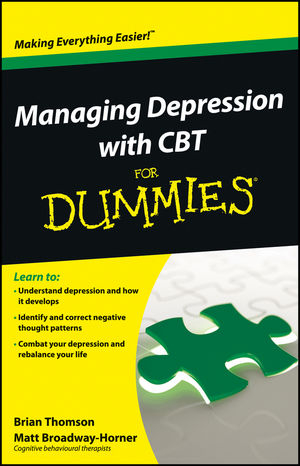
Cognitive Behavioral Therapy (CBT) is a hugely popular self-help technique, which teaches you to break free from destructive or negative behaviours and make positive changes to both your thoughts and your actions. This practical guide to managing depression with CBT will help you understand your depression, identify solutions to your problems, and maintain your gains and avoid relapse.
Managing Depression with CBT For Dummies is a practical guide to using CBT to demolish depression by identifying and correcting negative thought patterns, recognizing the destructive power of ruminative thinking, confronting problems, and finding positive solutions.
- Helps you understand depression and how it develops
- Shows you how to correct negative thought patterns
- Gives you tried-and-true CBT techniques to combat your depression
If you're struggling with depression, Managing Anger with CBT For Dummies gives you the tools you need to break down the barriers that prevent happiness from taking hold, and allowing you to build a positive future.
Rise above depression with CBT Cognitive Behavioural Therapy (CBT) is a hugely popular self-help technique, which teaches you to break free from destructive or negative behaviours and make positive changes to both your thoughts and your actions. This practical guide to managing depression with CBT will help you understand your depression, identify solutions to your problems, and maintain your gains and avoid relapse. Managing Depression with CBT For Dummies is a practical guide to using CBT to demolish depression by identifying and correcting negative thought patterns, recognizing the destructive power of ruminative thinking, confronting problems, and finding positive solutions. Helps you understand depression and how it develops Shows you how to correct negative thought patterns Gives you tried-and-true CBT techniques to combat your depression If you're struggling with depression, Managing Depression with CBT For Dummies gives you the tools you need to break down the barriers that prevent happiness from taking hold, and allowing you to build a positive future.
Brian Thomson is a Senior Lecturer on the Cognitive Behavioural Therapy MSc course at the University of Hertfordshire. He has 25 years' experience as a CBT therapist and is a Fellow of the Higher Education Academy. Matt Broadway-Horner is a CBT therapist who works in the Central London office of CBT in the City. He specialises in treating depression, anxiety and trauma problems.
Introduction 1
Part I: Understanding Depression and How It Develops 7
Chapter 1: Introducing Moods and Depression 9
Chapter 2: Introducing the Basic Principles of CBT 29
Part II: Putting What You Discover into Action 45
Chapter 3: Thinking about Thinking 47
Chapter 4: Changing Your Thinking to Change Your Life 61
Chapter 5: Facing Your Feelings to Tackle Depression 75
Chapter 6: Changing Your Attitudes to Combat Depression 97
Chapter 7: Raising Self-Esteem to Increase Your Motivation 113
Chapter 8: Developing Abilities that Challenge Depression 125
Chapter 9: Being Mindful, not Mind-full: Developing Your Awareness 143
Part III: Maintaining Momentum 155
Chapter 10: Discovering the New, Healthy You 157
Chapter 11: Reducing the Risk of Relapse 163
Part IV: The Part of Tens 169
Chapter 12: Ten Tips for Tackling Depression 171
Chapter 13: Ten Tips to Challenge Distorted Thinking 177
Appendix 183
Index 191
Chapter 2
Introducing the Basic Principles of CBT
In This Chapter
Helping yourself with CBT
Tackling troubling thoughts, feelings and behaviour
Avoiding going around in circles
One really useful aspect of CBT (cognitive behavioural therapy) is that it’s a scientific approach. I don’t mean that you need to wear a tweed jacket with elbow patches and play with test tubes (although by all means wear what you like!). I mean that you need to explore all the relevant issues of your depression with an open mind. CBT allows you to discover how to see your thoughts as theories or possibilities to be tested, and not simply accept them at face value as reality without considering the evidence or other possible alternative views.
Like a scientist exploring a chemical or biological process, in CBT you follow a structure, collect data, analyse things, take measurements and keep good notes. In other words, you have to develop a plan of action and a logical method.
If this process sounds a little daunting, don’t worry; it’s a lot simpler than it sounds, and you soon get the hang of it. To help, in this chapter I show you how CBT can assist you in managing your depression yourself. I break down your depression into three areas: thoughts, feelings and behaviours. This logical, structured approach helps you to understand the problems, analyse them, and develop a new strategy for tackling them.
Becoming Your Own Therapist
To practise CBT, you don’t always need a therapist. With the guidance in this book, you can in some ways become your own therapist. I provide all the necessary knowledge, understanding, advice and skills not only to effectively manage your depression, but also to keep it at bay throughout your life.
There are times, however, when seeking the help of an accredited therapist to guide you through the process is a wise move, especially if you find your sleep severely affected or are feeling suicidal and need help to stay safe while you recover. In instances such as these, the thing to do is contact your GP and ask to be referred for CBT. Alternatively, you can directly contact a therapist via the website of the British Association for Behavioural & Cognitive Psychotherapies (www.babcp.com), where a list of accredited therapists in your area is available.
In most situations, you can help yourself with CBT. You may not understand CBT yet – you don’t need to, because this book helps you develop the necessary expertise – but you’re an expert on you, on your own depression. The aim of CBT is to get you to a point where you can do it yourself and work out your own ways of tackling what’s causing your depression.
How often have you found yourself behaving in a self-destructive or self-defeating way and repeating that behaviour without knowing why? If you repeatedly engage in destructive relationships or behave in ways that you know hurt you, CBT helps you to understand the reasons. It allows you to control your own recovery and gain control over situations that used to overwhelm you, so you no longer feel like a victim.
According to CBT, your thinking about (and interpretation of) situations is what leads to your emotional and behavioural upsets. Human beings cause their own distress, and so, logically, they can discover how to ‘un-cause’ it. CBT uses an educational approach that leads you towards understanding how your depression developed and how to apply CBT techniques to tackle the problems.
Separating Depression into Three Domains
To provide a structured approach for you to tackle your depression, the CBT model separates the problems into three domains (elements):
Thoughts: The thoughts, or cognitive, domain refers to everything that goes on in your mind, including thoughts, images, memories, dreams, beliefs, attitudes and attention. These aspects contribute to your negative feelings.
Feelings: This domain covers the emotions and physical feelings that you experience, and how you understand or cope with them. These emotions can cause symptoms such as sleep problems, fatigue and appetite changes.
Behaviour: The behaviour domain concerns the way in which your thoughts and feelings help to make a situation worse, encouraging you to avoid doing some things that would actually make you feel better. You may find that you engage in behaviour that makes you feel worse, such as ruminating and berating yourself about what you avoid doing.
The best way to describe how these three domains work is through an example situation.
Peter has been made redundant after working for the same firm for 23 years; his position has been dissolved. In the following list, I connect each of the three domains to Peter:
Thoughts: Peter is having these types of thoughts:
• They didn’t think that I was worth keeping.
• I’m of no value.
• I’ll never get another job.
• I’m letting my family down.
• My friends are going to think I’m a scrounger and a burden on society.
• My life’s over.
Peter also has images in his mind of friends talking behind his back, criticising him and rejecting him, and he has memories of his school days when he experienced rejection and exclusion.
Feelings: Thinking in this way causes Peter to feel depressed. He feels uncomfortable around other people and hopeless about the future. He begins to have disturbed sleep, which leaves him constantly fatigued. He loses his confidence and motivation, and after a time, finds that he dreads each coming day.
Behaviour: These brooding thoughts and feelings lead Peter to start avoiding friends and even family. He withdraws from the activities he regularly used to enjoy. He isolates himself at home and stops doing all his usual pursuits. He spends hours just berating himself for being such a failure and telling himself that he can do nothing about his problem so the situation is hopeless.
This despondent and lonely lifestyle apparently confirms to Peter how miserable and hopeless his life is. In turn, this leads to more negative brooding and a slow spiral down into depression. Figure 2-1 shows the four negative, self-perpetuating cycles, which are:
(a): Negative thinking
(b): Avoiding activities
(c): Self-berating
(d): Neglecting self–care
In this section, I look at identifying problems in each domain and setting goals so you can move towards more healthy responses.
Figure 2-1: The four negative cycles.
Defining problems and setting goals
When you understand the three domains (see the preceding section), you can use them to help paint an accurate picture of the problems associated with your depression. Armed with this picture, you can then compare your thoughts, feelings and behaviour with a healthier response to the same situation.
To illustrate, I continue using the example of Peter from the preceding section.
Take a look at Table 2-1. In the left column, you can see Peter’s cognitive (thoughts), emotional (feelings), and behavioural reactions; in the right one, I show a healthy response to the same situation. The two different responses are equally valid.
Understanding the thought– feeling connection
When you identify the problems and understand what’s causing your depression (see the preceding section), you begin to see what you need to change in each of the three domains in order to overcome it. You can then set yourself goals in each domain. These goals form a route, taking you from your unhealthy responses to more healthy and helpful responses in each area.
In this section and the next, I examine the two connections between the three domains: from thought to feelings and then feelings to behaviour. These connections are a key element in the CBT model and are fundamental when you look at changing how you respond to thoughts and emotions.
When something happens that makes a person feel anxious, depressed, angry, and so on, most people naturally assume that the event caused the emotion (the common sense approach). But consider the following example:
You’re walking down the road and see an old friend; you wave and say hello, but your friend walks past without acknowledging you. Here are four possibilities of what you may think and how such thoughts can make you feel:
‘She doesn’t like me, doesn’t think that I’m worth talking to; this is probably how others feel about me too.’
This type of thinking is likely to make you feel depressed and uncomfortable around people.
‘How rude she’s being to me; there’s no reason to be like that.’
This type of thinking is likely to make you feel angry, annoyed or irritated.
‘She looked unhappy and preoccupied; I hope she’s all right.’
This type of thinking is likely to make you feel concern and compassion for your friend.
‘I wonder what’s wrong; it’s not like her to be like that.’
This type of thinking is likely to make you feel curious and emotionally fairly neutral.
As you can see, your thoughts and beliefs – not the event itself – determine...
| Erscheint lt. Verlag | 28.9.2012 |
|---|---|
| Sprache | englisch |
| Themenwelt | Sachbuch/Ratgeber ► Gesundheit / Leben / Psychologie ► Krankheiten / Heilverfahren |
| Sachbuch/Ratgeber ► Gesundheit / Leben / Psychologie ► Lebenshilfe / Lebensführung | |
| Sachbuch/Ratgeber ► Gesundheit / Leben / Psychologie ► Psychologie | |
| Geisteswissenschaften ► Psychologie ► Angst / Depression / Zwang | |
| Schlagworte | Kognitive Verhaltenstherapie • Managing Depression with CBT For Dummies, Managing Depression For Dummies, CBT book, CBT books, Cognitive Behavioural Therapy book, Cognitive Behavioural Therapy books, managing depression, how to manage depression, guide to managing depression, Cognitive Behavioral Therapy book, Cognitive Behavioral Therapy books • Ratgeber • Self-Help |
| ISBN-13 | 9781118357163 / 9781118357163 |
| Informationen gemäß Produktsicherheitsverordnung (GPSR) | |
| Haben Sie eine Frage zum Produkt? |
 EPUB (Adobe DRM)
Kopierschutz: Adobe-DRM
Adobe-DRM ist ein Kopierschutz, der das eBook vor Mißbrauch schützen soll. Dabei wird das eBook bereits beim Download auf Ihre persönliche Adobe-ID autorisiert. Lesen können Sie das eBook dann nur auf den Geräten, welche ebenfalls auf Ihre Adobe-ID registriert sind.
Details zum Adobe-DRM
Dateiformat: EPUB (Electronic Publication)
EPUB ist ein offener Standard für eBooks und eignet sich besonders zur Darstellung von Belletristik und Sachbüchern. Der Fließtext wird dynamisch an die Display- und Schriftgröße angepasst. Auch für mobile Lesegeräte ist EPUB daher gut geeignet.
Systemvoraussetzungen:
PC/Mac: Mit einem PC oder Mac können Sie dieses eBook lesen. Sie benötigen eine
eReader: Dieses eBook kann mit (fast) allen eBook-Readern gelesen werden. Mit dem amazon-Kindle ist es aber nicht kompatibel.
Smartphone/Tablet: Egal ob Apple oder Android, dieses eBook können Sie lesen. Sie benötigen eine
Geräteliste und zusätzliche Hinweise
Buying eBooks from abroad
For tax law reasons we can sell eBooks just within Germany and Switzerland. Regrettably we cannot fulfill eBook-orders from other countries.
aus dem Bereich