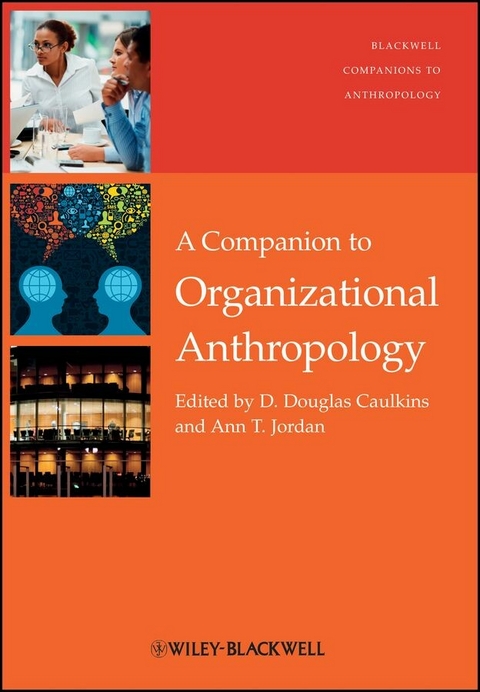
A Companion to Organizational Anthropology (eBook)
John Wiley & Sons (Verlag)
978-1-118-32557-5 (ISBN)
- Offers the first comprehensive reference to the anthropological study of complex organizations
- Details how organizational theory and research in business has adopted anthropology’s key concept of culture, inspiring new insights into organizational dynamics and development
- Highlights pioneering theoretical perspectives ranging from symbolic and semiotic approaches to neuroscientific frameworks for studying contemporary organizations
- Addresses the comparative and cross-cultural dimensions of multinational corporations and of non-governmental organizations working in the globalizing economy
- Topics covered include organizational dynamics, entrepreneurship, innovation, social networks, cognitive models and team building, organizational dysfunctions, global networked organizations, NGOs, unions, virtual communities, corporate culture and social responsibility
- Presents a body of work that reflects the breadth and depth of the field of organizational anthropology and makes the case for the importance of the field in the anthropology of the twenty-first century
D. Douglas Caulkins is emeritus professor of anthropology at Grinnell College and emeritus director of the Donald L. Wilson Program in Enterprise and Leadership. His research encompasses voluntary organizations and social capital in Norway, entrepreneurship and regional development in the UK (Wales, Scotland, Northeast England), heritage sites and national identity in the UK and US, and anthropological contributions to management theory. He has published in various journals and books and currently is engaged in social entrepreneurship and organizational development projects.
Ann T. Jordan is professor of anthropology at University of North Texas. She is an applied anthropologist specializing in business anthropology, globalization and transnational organizations, Saudi Arabia, and North American Indian studies, and is the author of the books Business Anthropology and The Making of a Modern Kingdom: Globalization and Change in Saudi Arabia.
D. Douglas Caulkins is emeritus professor of anthropology at Grinnell College and emeritus director of the Donald L. Wilson Program in Enterprise and Leadership. His research encompasses voluntary organizations and social capital in Norway, entrepreneurship and regional development in the UK (Wales, Scotland, Northeast England), heritage sites and national identity in the UK and US, and anthropological contributions to management theory. He has published in various journals and books and currently is engaged in social entrepreneurship and organizational development projects. Ann T. Jordan is professor of anthropology at University of North Texas. She is an applied anthropologist specializing in business anthropology, globalization and transnational organizations, Saudi Arabia, and North American Indian studies, and is the author of the books Business Anthropology and The Making of a Modern Kingdom: Globalization and Change in Saudi Arabia.
Notes on Contributors viii
Abstracts xiv
Expanding the Field of Organizational Anthropology for the
Twenty-first Century 1
Ann T. Jordan and D. Douglas Caulkins
Part I Critique and Theory 25
1. The Organization of Anthropology and Higher Education in the
United States 27
Davydd J. Greenwood
2. The Changing Rhetoric of Corporate Culture 56
Allen W. Batteau
3. New Institutional Approaches to Formal Organizations 74
Marietta L. Baba, Jeanette Blomberg, Christine LaBond, and Inez
Adams
4. Entrepreneurship Studies 98
Peter Rosa and D. Douglas Caulkins
5. Neurological Model of Organizational Culture 122
Tomoko Hamada Connolly
Part II Methods and Analysis 147
6. Social Networks and Organizations 149
Brandon Ofem, Theresa M. Floyd, and Stephen P. Borgatti
7. A Mixed-Methods Approach to Understand Global Networked
Organizations 167
Julia C. Gluesing
8. Measuring Organizational Dynamics 193
Gerald Mars
9. Semiotics of Organizations 204
Joseph D. Hankins
10. An Ethnography of Numbers 219
Daniel Neyland
11. Managing Conflict on Organizational Partnerships 236
Elizabeth K. Briody
Part III Organizational Processes 257
12. Working on Work Organizations 259
Charles N. Darrah and Alicia Dornadic
13. Organizational Innovation Is a Participative Process
275
Morten Levin
14. Communities of Practice 289
Susan Squires and Michael L. Van De Vanter
15. Organizational Networks and Social Capital 311
Gunnar Lind Haase Svendsen and Christian Waldstrøm
16. American Labor Unions as Organizations 328
Paul Durrenberger and Suzan Erem
17. Virtual Organizations 346
Christina Wasson
18. Sustaining Social Sector Organizations 362
Joan A. Tucker and D. Douglas Caulkins
Part IV Globalization, Development, and Modernization
379
19. The Contemporary World of Finance 381
Allen W. Batteau
20. Globalization, Modernization, and Complex Organizations
399
Ann T. Jordan
21. Chinese Business Ventures into China 418
Heidi Dahles and Juliette Koning
22. Corporate Social Responsibility: Interaction between Market
and Community 438
Bengi Ertuna
23. NGOs and Community Development: Assessing the Contributions
from Sen's Perspective of Freedom 455
J. Montgomery Roper
24. Why Are Indigenous Organizations Declining in Latin America?
471
Carmen Martínez Novo
25. Australian Indigenous Organizations 493
Sarah E. Holcombe and Patrick Sullivan
26. Organization of Schooling in Three Countries 519
Edmund T. Hamann, Saloshna Vandeyar, and Juan Sánchez
García
Index 538
"Douglas Caulkins and Ann Jordan's Companion
represents an important framing of knowledge about organizations
that combines insights from anthropology and organizational
studies. Scholars in both disciplines should take note:
Organizational anthropology has come of age!."
(Expofairs.com, 11 November 2014)
"A timely compendium of illuminating breadth. Both
reclaims and updates existing theories for understanding
organizations and their effects and exposes and explores emergent
currents. Demonstrates the benefits of viewing organizations
anthropologically."
- Melissa Cefkin, IBM Research - Almaden
"Douglas Caulkins and Ann Jordan's Companion
represents an important framing of knowledge about organizations
that combines insights from anthropology and organizational
studies. Scholars in both disciplines should take note:
Organizational anthropology has come of age!"
- Simon Down, Anglia Ruskin University
| Erscheint lt. Verlag | 24.9.2012 |
|---|---|
| Reihe/Serie | Blackwell Companions to Anthropology |
| Blackwell Companions to Anthropology | Wiley Blackwell Companions to Anthropology |
| Sprache | englisch |
| Themenwelt | Geisteswissenschaften ► Archäologie |
| Geschichte ► Allgemeine Geschichte ► Vor- und Frühgeschichte | |
| Sozialwissenschaften ► Ethnologie | |
| Sozialwissenschaften ► Soziologie ► Mikrosoziologie | |
| Technik | |
| Schlagworte | Anthropological Theory & Methods/Ethnography • Anthropologie • Anthropologie / Theorie u. Methoden, Ethnographie • Anthropology • Corporate, Culture, Entrepreneur, Business, Finance, Dynamics, Globalization, work, labor, networks |
| ISBN-10 | 1-118-32557-5 / 1118325575 |
| ISBN-13 | 978-1-118-32557-5 / 9781118325575 |
| Informationen gemäß Produktsicherheitsverordnung (GPSR) | |
| Haben Sie eine Frage zum Produkt? |
 EPUB (Adobe DRM)
Kopierschutz: Adobe-DRM
Adobe-DRM ist ein Kopierschutz, der das eBook vor Mißbrauch schützen soll. Dabei wird das eBook bereits beim Download auf Ihre persönliche Adobe-ID autorisiert. Lesen können Sie das eBook dann nur auf den Geräten, welche ebenfalls auf Ihre Adobe-ID registriert sind.
Details zum Adobe-DRM
Dateiformat: EPUB (Electronic Publication)
EPUB ist ein offener Standard für eBooks und eignet sich besonders zur Darstellung von Belletristik und Sachbüchern. Der Fließtext wird dynamisch an die Display- und Schriftgröße angepasst. Auch für mobile Lesegeräte ist EPUB daher gut geeignet.
Systemvoraussetzungen:
PC/Mac: Mit einem PC oder Mac können Sie dieses eBook lesen. Sie benötigen eine
eReader: Dieses eBook kann mit (fast) allen eBook-Readern gelesen werden. Mit dem amazon-Kindle ist es aber nicht kompatibel.
Smartphone/Tablet: Egal ob Apple oder Android, dieses eBook können Sie lesen. Sie benötigen eine
Geräteliste und zusätzliche Hinweise
Buying eBooks from abroad
For tax law reasons we can sell eBooks just within Germany and Switzerland. Regrettably we cannot fulfill eBook-orders from other countries.
aus dem Bereich