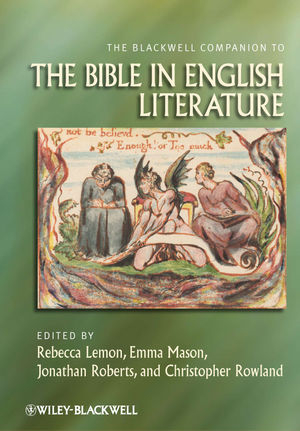
The Blackwell Companion to the Bible in English Literature (eBook)
John Wiley & Sons (Verlag)
978-1-118-24115-8 (ISBN)
- An ambitious overview of the Bible's impact on English literature – as arguably the most powerful work of literature in history – from the medieval period through to the twentieth-century
- Includes introductory sections to each period giving background information about the Bible as a source text in English literature, and placing writers in their historical context
- Draws on examples from medieval, early-modern, eighteenth-century and Romantic, Victorian, and Modernist literature
- Includes many 'secular' or 'anti-clerical' writers alongside their 'Christian' contemporaries, revealing how the Bible's text shifts and changes in the writing of each author who reads and studies it
Rebecca Lemon is an associate professor of English literature at the University of Southern California. She is the author of Treason by Words: Literature, Law, and Rebellion in Shakespeare's England (2006), as well as articles on Mary Wroth and Petrarchism, Shakespeare and Agamben, and Hayward and censorship.
Emma Mason is a senior lecturer in English at the University of Warwick. She is the author of Women Poets of the Nineteenth Century (2006), Nineteenth Century Religion and Literature: An Introduction (with Mark Knight, 2006), and The Cambridge Introduction to Wordsworth (2009), and is co-editor of The Oxford Handbook of the Reception History of the Bible (with Michael Lieb and Jonathan Roberts, 2010).
Jonathan Roberts is a lecturer in English at the University of Liverpool. He is the author of William Blake's Poetry (2007), The Bible for Sinners (with Christopher Rowland, 2008), Blake. Wordsworth. Religion. (2010), and is co-editor of The Oxford Handbook of the Reception History of the Bible (with Michael Lieb and Emma Mason, 2010).
Christopher Rowland is Dean Ireland's Professor of Holy Exegesis at the University of Oxford. He is the author of a number of books, including The Nature of New Testament Theology (2006), Revelation Through the Centuries (with Judith Kovacs, 2003), and Radical Christian Writings: A Reader (with Andrew Bradstock, 2002), all published by Wiley-Blackwell. He is Consultant Editor of The Oxford Handbook of the Reception History of the Bible (edited by Michael Lieb, Emma Mason, and Jonathan Roberts, 2010), and together with John Sawyer, Judith Kovacs, and David Gunn, he also edits the Blackwell Bible Commentary series.
This Companion explores the Bible's role and influence on individual writers, whilst tracing the key developments of Biblical themes and literary theory through the ages. An ambitious overview of the Bible's impact on English literature as arguably the most powerful work of literature in history from the medieval period through to the twentieth-century Includes introductory sections to each period giving background information about the Bible as a source text in English literature, and placing writers in their historical context Draws on examples from medieval, early-modern, eighteenth-century and Romantic, Victorian, and Modernist literature Includes many 'secular' or 'anti-clerical' writers alongside their 'Christian' contemporaries, revealing how the Bible's text shifts and changes in the writing of each author who reads and studies it
Rebecca Lemon is an associate professor of English literature at the University of Southern California. She is the author of Treason by Words: Literature, Law, and Rebellion in Shakespeare's England (2006), as well as articles on Mary Wroth and Petrarchism, Shakespeare and Agamben, and Hayward and censorship. Emma Mason is a senior lecturer in English at the University of Warwick. She is the author of Women Poets of the Nineteenth Century (2006), Nineteenth Century Religion and Literature: An Introduction (with Mark Knight, 2006), and The Cambridge Introduction to Wordsworth (2009), and is co-editor of The Oxford Handbook of the Reception History of the Bible (with Michael Lieb and Jonathan Roberts, 2010). Jonathan Roberts is a lecturer in English at the University of Liverpool. He is the author of William Blake's Poetry (2007), The Bible for Sinners (with Christopher Rowland, 2008), Blake. Wordsworth. Religion. (2010), and is co-editor of The Oxford Handbook of the Reception History of the Bible (with Michael Lieb and Emma Mason, 2010). Christopher Rowland is Dean Ireland's Professor of Holy Exegesis at the University of Oxford. He is the author of a number of books, including The Nature of New Testament Theology (2006), Revelation Through the Centuries (with Judith Kovacs, 2003), and Radical Christian Writings: A Reader (with Andrew Bradstock, 2002), all published by Wiley-Blackwell. He is Consultant Editor of The Oxford Handbook of the Reception History of the Bible (edited by Michael Lieb, Emma Mason, and Jonathan Roberts, 2010), and together with John Sawyer, Judith Kovacs, and David Gunn, he also edits the Blackwell Bible Commentary series.
List of Contributors ix
Part I Introduction 1
1 General Introduction
Rebecca Lemon, Emma Mason, and Jonathan Roberts 3
2 The Literature of the Bible
Christopher Rowland 10
3 Biblical Hermeneutics and Literary Theory
David Jasper 22
Part II Medieval 39
4 Introduction
Daniel Anlezark 41
5 Old English Poetry
Catherine A. M. Clarke 61
6 The Medieval Religious Lyric
Douglas Gray 76
7 The Middle English Mystics
Annie Sutherland 85
8 The Pearl-Poet
Helen Barr 100
9 William Langland
Sister Mary Clemente Davlin, OP 116
10 Geoffrey Chaucer
Christiania Whitehead 134
Part III Early Modern 153
11 Introduction
Roger Pooley 155
12 Early Modern Women
Elizabeth Clarke 169
13 Early Modern Religious Prose
Julie Maxwell 184
14 Edmund Spenser
Carol V. Kaske 197
15 Mary Sidney
Rivkah Zim 211
16 William Shakespeare
Hannibal Hamlin 225
17 John Donne
Jeanne Shami 239
18 George Herbert
John Drury 254
19 John Milton
Michael Lieb 269
20 John Bunyan
Andrew Bradstock 286
21 John Dryden
Gerard Reedy, S.J. 297
Part IV Eighteenth Century and Romantic 311
22 Introduction
Stephen Prickett 313
23 Eighteenth-Century Hymn Writers
J. R. Watson 329
24 Daniel Defoe
Valentine Cunningham 345
25 Jonathan Swift
Michael F. Suarez, S.J. 359
26 William Blake
Jonathan Roberts and Christopher Rowland 373
27 Women Romantic Poets
Penny Bradshaw 383
28 William Wordsworth
Deeanne Westbrook 397
29 S. T. Coleridge
Graham Davidson 413
30 Jane Austen
Michael Giffin 425
31 George Gordon Byron
Wolf Z. Hirst 438
32 P. B. Shelley
Bernard Beatty 451
Part V Victorian 463
33 Introduction
Elisabeth Jay 465
34 The Brownings
Kevin Mills 482
35 Alfred Tennyson
Kirstie Blair 496
36 The Brontës
Marianne Thormählen 512
37 John Ruskin
Dinah Birch 525
38 George Eliot
Charles LaPorte 536
39 Christina Rossetti
Elizabeth Ludlow 551
40 G. M. Hopkins
Paul S. Fiddes 563
41 Sensation Fiction
Mark Knight 577
42 Decadence
Andrew Tate 587
Part VI Modernist 601
43 Introduction
Ward Blanton 603
44 W. B. Yeats
Edward Larrissy 617
45 Virginia Woolf
Douglas L. Howard 629
46 James Joyce
William Franke 642
47 D. H. Lawrence
T. R. Wright 654
48 T. S. Eliot
David Fuller 667
49 The Great War Poets
Jane Potter 681
Index 696
"This is indeed a true companion, one that succeeds in its aim of being both scholarly and accessible to all lovers of English literature. In short, all students of English literature ought to put aside a month to read and study this book before going up to university." (Church Times)
"Probably what comes across most clearly is how, and that, many of the writers chose deliberately to draw on the Bible, and for students increasingly unfamiliar with the Bible, this approach challenges as well as informs." (Reference Reviews)
"An extremely useful volume." (The Year's Work in English Studies)
"This magnificent collection completely re-imagines the vast
and well-trodden field of the Bible and Literature. From Chaucer to
T. S. Eliot, The Blackwell Companion to the Bible in English
Literature offers a compelling narrative of how the English
literary tradition has itself used, re-written and re-visioned
sacred texts. In my view, the result is indispensable reading
- a Bible no less - for students and scholars
alike."
--Arthur Bradley, Lancaster University
"This is an extremely valuable resource for students,
scholars, and anyone else interested in the relationship between
the Bible and English Literature. Through a series of stimulating
essays, the editors and contributors highlight the unparalleled
importance of the Bible within the literary tradition. They explore
the multitude of ways in which this sacred text has both shaped and
been shaped by the imagination of writers. Our thinking will be
much richer as a result of what this book has to say."
--Mark Knight, Roehampton University
| Erscheint lt. Verlag | 28.2.2012 |
|---|---|
| Reihe/Serie | Blackwell Companions to Religion |
| Blackwell Companions to Religion | Wiley Blackwell Companions to Religion |
| Sprache | englisch |
| Themenwelt | Religion / Theologie ► Christentum ► Kirchengeschichte |
| Geisteswissenschaften ► Sprach- / Literaturwissenschaft ► Anglistik / Amerikanistik | |
| Geisteswissenschaften ► Sprach- / Literaturwissenschaft ► Literaturwissenschaft | |
| Schlagworte | across • Bibel • Bibel als literarisches Werk • Bible • Bible as Literature • Bibles • Blackwell • Book • builds • Companion • demonstrates • Doctrinal • English • Examination • Examples • existing • Individual • Interdisciplinary • Literary Criticism & History • Literatur • Literature • Literaturkritik u. -geschichte • Literaturwissenschaft • Medieval • Old • periods • Poetry • Religion • Religion & Culture • Religion & Theology • Religion u. Kultur • Religion u. Theologie • wideranging • Work • writers |
| ISBN-10 | 1-118-24115-0 / 1118241150 |
| ISBN-13 | 978-1-118-24115-8 / 9781118241158 |
| Informationen gemäß Produktsicherheitsverordnung (GPSR) | |
| Haben Sie eine Frage zum Produkt? |
 EPUB (Adobe DRM)
Kopierschutz: Adobe-DRM
Adobe-DRM ist ein Kopierschutz, der das eBook vor Mißbrauch schützen soll. Dabei wird das eBook bereits beim Download auf Ihre persönliche Adobe-ID autorisiert. Lesen können Sie das eBook dann nur auf den Geräten, welche ebenfalls auf Ihre Adobe-ID registriert sind.
Details zum Adobe-DRM
Dateiformat: EPUB (Electronic Publication)
EPUB ist ein offener Standard für eBooks und eignet sich besonders zur Darstellung von Belletristik und Sachbüchern. Der Fließtext wird dynamisch an die Display- und Schriftgröße angepasst. Auch für mobile Lesegeräte ist EPUB daher gut geeignet.
Systemvoraussetzungen:
PC/Mac: Mit einem PC oder Mac können Sie dieses eBook lesen. Sie benötigen eine
eReader: Dieses eBook kann mit (fast) allen eBook-Readern gelesen werden. Mit dem amazon-Kindle ist es aber nicht kompatibel.
Smartphone/Tablet: Egal ob Apple oder Android, dieses eBook können Sie lesen. Sie benötigen eine
Geräteliste und zusätzliche Hinweise
Buying eBooks from abroad
For tax law reasons we can sell eBooks just within Germany and Switzerland. Regrettably we cannot fulfill eBook-orders from other countries.
aus dem Bereich