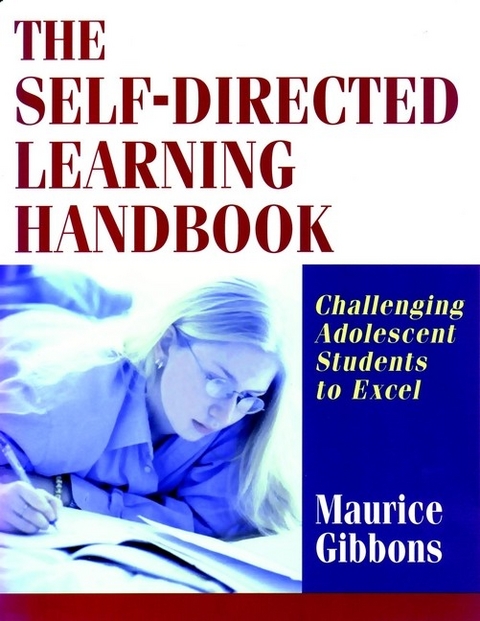
The Self-Directed Learning Handbook (eBook)
208 Seiten
John Wiley & Sons (Verlag)
978-0-7879-6827-4 (ISBN)

Maurice Gibbons is education professor emeritus, Simon Fraser University, British Columbia and a former teacher of grades 4 through 13. In his university position he specialized in the development of innovative educational programs, including the internationally celebrated Walkabout program for the transition of youth to adulthood. He has written books and journal articles on innovative education and self-directed learning and currently speaks and consults throughout Canada and the United States Contact Self-Directed Learning at www.mauricegibbons.com.
Preface xiii
Acknowledgments xvii
1 The Case for Self-Directed Learning 1
What Is Self-Directed Learning? 2
How Does Research Support SDL? 6
The Major Principles of an SDL Program 9
The Essential Elements of SDL 11
Approaching SDL in Stages 13
2 A Framework for Teaching SDL 14
Defining the Course 15
Expanding Learning Options and Environments 16
Building Independent Thinking Skills 18
Negotiating Student Learning Agreements 20
Establishing Assessment Processes 21
3 Rethinking Student Coursework 23
Essential Planning Steps 23
Understanding the Stages of SDL 24
Linking the Stages to Grade Levels 28
Designating Course Outcomes 29
Developing Self-Managed Course Units 34
Student-Planned Coursework and Projects 38
Focusing on Competencies and Challenges 39
4 Planning Lessons and Projects 43
Planning Lessons and Projects 43
Principles for Planning Lessons 43
Designing Learning Episodes 46
Creating Experiences 47
Promoting Study 49
Encouraging Productivity 51
Involving Students in Project Planning 52
5 Teaching Independent Thinking 57
Inviting Inquiry and Initiative 58
Developing Problem-Solving Skills 64
Using Process Frameworks: Investigation and Action 65
Cultivating Process Thinking and Attitudes 68
6 Negotiating Student Learning Agreements 73
The Learning Agreement or Contract 73
The Elements of a Contract 74
Negotiating Contract Agreements 81
Sample Contracts 87
Tracking Student Progress 90
7 Motivating and Empowering Students 93
Encouraging Students to Pursue SDL 93
Motivating Students to Motivate Themselves 95
The Working Journal as a Motivational Tool 99
Dealing with the SDL Crisis 101
Working with Difficult Students 106
8 Assessing Student Achievement 110
Promoting Student Self-Assessment 111
Assessing General Skills 113
Assessing Coursework 113
Evaluating Projects and Assignments 119
Portfolios for Personal Learning 121
Passage and Graduation Criteria 122
Demonstrations, Celebrations, and Conferences 126
9 Pursuing a Path of Excellence 132
The Teacher Is the Key Person 132
Making a Difference to the Student 135
Starting an SDL School 137
Administrative Support for SDL 138
Creating a Shared Vision 140
Resource A: How Much SDL Are You Teaching Now? 142
Resource B: How Self-Directing Are You? A Self-Assessment Instrument 144
Resource C: The Passage Process 148
Resource D: The Integrated SDL Unit: The Kinds of Activities Involved 152
Resource E: Inner States for SDL 154
Resource F: Sample Process Templates 157
Resource G: Guidelines, Traps, and Boosters 159
Resource H: The Support Group or Triad 163
Resource I: Samples from a Student's Working Journal 166
Resource J: Some of the Many Ways Students Can Learn 170
Bibliography 172
Index177
The Author 183
"This is a how to book for adventurous teachers who understand that learning is an integral component of teaching." (Education Review, December 2, 2003)
"When Maurice Gibbons introduced his Walkabout model a few years
ago, he opened exciting new possibilities for relevant, meaningful,
and challenging learning to take place in high schools. In this new
book he provides teachers with a comprehensive, step-by-step
process for realizing these possibilities in their classrooms."
-- Ron Miller, executive editor, Paths of Learning
magazine
"This book offers thorough and detailed instruction in the
creation of self-directed learning environments. It's a much-needed
'how-to' manual for classroom teachers who want to motivate and
empower their students to flourish as learners."
-- Karen Fernandez, teacher, Denver Public Schools
"Will help teachers and administrators implement a vision of
schooling that will revitalize their professional lives while
providing avenues to success for all their students. I have seen
the successful application of his vision for over twenty years, and
this handbook is a practical guide for expanding the possibilities
to any school that wishes to challenge itself to become the best
that it can be."
-- Arnold Langberg, educational consultant, former principal
of Jefferson County Open High School
"This is one of the most practical, wisest, and most upbeat
books I've encountered in thirty years of teaching, and working
with teachers. Educators who want to do SDL will find this an
extraordinary valuable resource, one they use over and over
again."
-- Joe Nathan, director, University of Minnesota Center for
School Change
| Erscheint lt. Verlag | 17.2.2003 |
|---|---|
| Sprache | englisch |
| Themenwelt | Geisteswissenschaften |
| Sozialwissenschaften ► Pädagogik ► Bildungstheorie | |
| Sozialwissenschaften ► Pädagogik ► Schulpädagogik / Sekundarstufe I+II | |
| Schlagworte | Assessment (K-12) • Bildungswesen • Education • K-12 / Lehren u. Lernen • K-12 / Qualitätskontrolle • K-12 / Qualitätskontrolle • Teaching & Learning (K-12) |
| ISBN-10 | 0-7879-6827-7 / 0787968277 |
| ISBN-13 | 978-0-7879-6827-4 / 9780787968274 |
| Informationen gemäß Produktsicherheitsverordnung (GPSR) | |
| Haben Sie eine Frage zum Produkt? |
 PDF (Adobe DRM)
Kopierschutz: Adobe-DRM
Adobe-DRM ist ein Kopierschutz, der das eBook vor Mißbrauch schützen soll. Dabei wird das eBook bereits beim Download auf Ihre persönliche Adobe-ID autorisiert. Lesen können Sie das eBook dann nur auf den Geräten, welche ebenfalls auf Ihre Adobe-ID registriert sind.
Details zum Adobe-DRM
Dateiformat: PDF (Portable Document Format)
Mit einem festen Seitenlayout eignet sich die PDF besonders für Fachbücher mit Spalten, Tabellen und Abbildungen. Eine PDF kann auf fast allen Geräten angezeigt werden, ist aber für kleine Displays (Smartphone, eReader) nur eingeschränkt geeignet.
Systemvoraussetzungen:
PC/Mac: Mit einem PC oder Mac können Sie dieses eBook lesen. Sie benötigen eine
eReader: Dieses eBook kann mit (fast) allen eBook-Readern gelesen werden. Mit dem amazon-Kindle ist es aber nicht kompatibel.
Smartphone/Tablet: Egal ob Apple oder Android, dieses eBook können Sie lesen. Sie benötigen eine
Geräteliste und zusätzliche Hinweise
Buying eBooks from abroad
For tax law reasons we can sell eBooks just within Germany and Switzerland. Regrettably we cannot fulfill eBook-orders from other countries.
aus dem Bereich