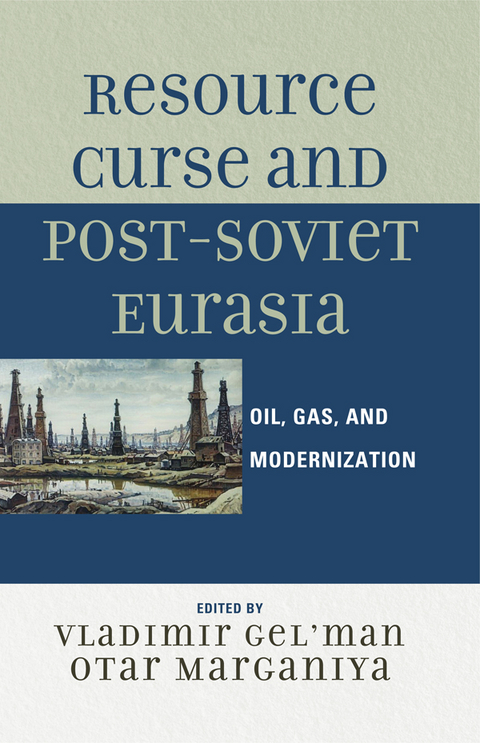
Resource Curse and Post-Soviet Eurasia (eBook)
226 Seiten
Lexington Books (Verlag)
978-0-7391-4375-9 (ISBN)
By the end of the 2000s, the term "e;resource curse"e; had become so widespread that it had turned into a kind of magic keyword, not only in the scholarly language of the social sciences, but also in the discourse of politicians, commentators and analysts all over the world--like the term "e;modernization"e; in the early 1960s or "e;transition"e; in the early 1990s. In fact, the aggravation of many problems in the global economy and politics, against the background of the rally of oil prices in 2004-2008, became the environment for academic and public debates about the role of natural resources in general, and oil and gas in particular, in the development of various societies. The results of numerous studies do not give a clear answer to questions about the nature and mechanisms of the influence of the oil and gas abundance on the economic, political and social processes in various states and nations. However, the majority of scholars and observers agree that this influence in the most of countries is primarily negative.Resource Curse and Post-Soviet Eurasia: Oil, Gas, and Modernization is an in-depth analysis of the impact of oil and gas abundance on political, economic, and social developments of Russia and other post-Soviet states and nations (such as Kazakhstan and Azerbaijan). The chapters of the book systematically examine various effects of "e;resource curse"e; in different arenas such as state building, regime changes, rule of law, property rights, policy-making, interest representation, and international relations in theoretical, historical, and comparative perspectives. The authors analyze the role of oil and gas dependency in the evolution and subsequent collapse of the Soviet Union, authoritarian drift of post-Soviet countries, building of predatory state and pendulum-like swings of Russia from "e;state capture"e; of 1990s to "e;business capture"e; of 2000s, uneasy relationships between the state and special interest groups, and numerous problems of "e;geo-economics"e; of pipelines in post-Soviet Eurasia.
Vladimir Gel'man is a professor in the Department of Political Science and Sociology at the European University at St.Petersburg. Otar Marganiya is president of the Center for Modernization Studies at the European University at St. Petersburg and an advisor to the minister of finance of the Russian Federation.
Chapter 1. Introduction: Resource Curse and Post-Soviet EurasiaChapter 2. Resource Curse: Rethinking the Soviet ExperienceChapter 3. The Impact of the "Oil Shock" on the Post-Soviet Regime ChangesChapter 4. Oil Boom: Is It Devastating to the Property Rights and the Rule of Law?Chapter 5. The Logic of Crony Capitalism: Big Oil, Big Politics, and Big Business in RussiaChapter 6. Oil Boom and Government Finance in Russia: Stabilization Fund and Its FateChapter 7. Oil, Gas, Transit, and Boundaries: Problems of "Transport Curse"Chapter 8. Oil, Gas, and Modernization of Global South: African Lessons for Post-Soviet StatesChapter 9. Conclusion: Oil, Gas, Russia and 2008-2009 Economic Crisis
| Informationen gemäß Produktsicherheitsverordnung (GPSR) | |
| Haben Sie eine Frage zum Produkt? |
 EPUB (Adobe DRM)
Kopierschutz: Adobe-DRM
Adobe-DRM ist ein Kopierschutz, der das eBook vor Mißbrauch schützen soll. Dabei wird das eBook bereits beim Download auf Ihre persönliche Adobe-ID autorisiert. Lesen können Sie das eBook dann nur auf den Geräten, welche ebenfalls auf Ihre Adobe-ID registriert sind.
Details zum Adobe-DRM
Dateiformat: EPUB (Electronic Publication)
EPUB ist ein offener Standard für eBooks und eignet sich besonders zur Darstellung von Belletristik und Sachbüchern. Der Fließtext wird dynamisch an die Display- und Schriftgröße angepasst. Auch für mobile Lesegeräte ist EPUB daher gut geeignet.
Systemvoraussetzungen:
PC/Mac: Mit einem PC oder Mac können Sie dieses eBook lesen. Sie benötigen eine
eReader: Dieses eBook kann mit (fast) allen eBook-Readern gelesen werden. Mit dem amazon-Kindle ist es aber nicht kompatibel.
Smartphone/Tablet: Egal ob Apple oder Android, dieses eBook können Sie lesen. Sie benötigen eine
Geräteliste und zusätzliche Hinweise
Buying eBooks from abroad
For tax law reasons we can sell eBooks just within Germany and Switzerland. Regrettably we cannot fulfill eBook-orders from other countries.
aus dem Bereich