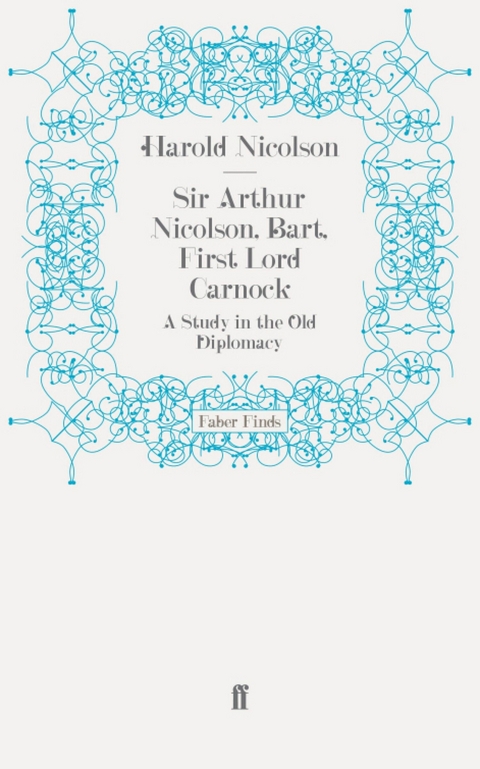
Sir Arthur Nicolson, Bart, First Lord Carnock (eBook)
200 Seiten
Faber & Faber (Verlag)
9780571287499 (ISBN)
Harold Nicolson (1886-1968) was a man of manifold talents: a diplomat, politician, journalist, broadcaster, historian, biographer, diarist, novelist, lecturer, literary critic, essayist and gardener. Perhaps most celebrated for his Diaries (reissued by Faber Finds in their original three volumes), they run the risk of obscuring the excellence of his other books. He wrote over thirty: Some People, Sir Arthur Nicolson, Peacemaking, 1919, Curzon, The Last Phase, 1919-1925, and The Congress of Vienna are all being reissued in Faber Finds. Harold Nicolson was educated at Wellington and at Balliol College, Oxford. He joined the Foreign Office in 1909, and in 1913 married the writer Vita Sackville-West. He was a member of the British delegation to the Versailles Peace Conference in 1919. He left the Foreign Office in 1929, and in 1935 he was elected National Labour Member of Parliament for West Leicester. In 1940 he was appointed a Junior Minister in Churchill's wartime government. In his eulogy, John Sparrow, with affectionate aptness, described Harold Nicolson as 'a nineteenth-century Whig leading an eighteenth-century existence in the twentieth-century.'
Without exaggeration this can be said to be two books in one: it is both a biography of Harold Nicolson's father and a history of British diplomacy from the late nineteenth-century until the middle of the First World War. Described as 'the quintessential diplomat' Sir Arthur's various postings took in Berlin, Peking, Athens, Teheran, Budapest, Constantinople, Madrid and St Petersburg. During his career his instincts mutated from pro-German and hating France and Russia, into a stage of wanting to make friends with those two countries and hating Germany. Harold Nicolson has an interesting and brave hypothesis regarding the First World War making a distinction between its origin and its causes. Regarding the former, in the words of his biographer James Lees-Milne, 'Harold maintained that from the years 1900 to 1914 we, compared to the Germans, had a clean sheet, whereas regarding the latter, say from the year 1500 to 1900 our sheet was very black indeed. Our Elizabethans behaved worse than the Kaiser's imperialists. And when the Kaiser's imperialists in the last two decades of the nineteenth-century developed predatory instincts in Africa, they met from us ''pained and patronising surprise.'' Harold with justice and a good deal of courage blamed Great Britain for the causes and Germany for the origin of the great conflict.'Harold Nicolson always considered this to be his best book and its universally favourable reception supports that with the Times Literary Supplement observing that as a biography it was composed in the new intimate fashion introduced by Lytton Strachey. As has been said though, it was more than a biography, it was a history, and a most fascinating one, of the period leading up to the Great War.
THIS book covers nearly half a century of diplomatic history. Arthur Nicolson entered the British Foreign Service a week before the Battle of Sedan, and left it a fortnight after the Battle of Jutland. During these forty-six years he witnessed the rise and fall of the German Empire, and saw his own country cease to be the strongest Power in the world.
He was personally identified with almost every phase in that slow, and at the time unrealised, process, by which England and Germany were gradually impelled towards their mutual destruction. It may thus be of value to trace, in terms of an individual experience and of a single personality, those recondite displacements of weight, prejudice and sympathy, which, between the year 1870 and the year 1914, produced the European War.
The old diplomatist has not been fairly treated by his posterity. If he failed to foresee the war, he is, and with full justice, called a fool: if he did foresee the war, he is, quite unjustly, considered a knave. I trust that this biography may do something to correct such false perspectives. It is unnecessary to assume that such men as Bethmann Hollweg, Grey, the two Cambons, Hardinge, Jagow, Metternich, Pourtalès, Mensdorff, Schoen, or Nicolson were less high-minded than those who gather to-day in the Salle de la Réformation at Geneva. What was wrong was the civilisation which they represented. But if we are tempted to regard our own state of mind as more humane and more enlightened, we should remember that we were taught our lesson by the death and mutilation of ten million young men. We have no cause to feel self-righteous when backed by so expensive an education.
Arthur Nicolson provides an admirable example for the study of the old diplomacy at its best.
In the first place, he had actual experience, from 1870 onwards, of all the main factors, which contributed towards the final catastrophe. In the second place his frank and gentle character furnishes an excellent mirror in which the clouds and shadows of that epoch are reflected simply, clearly, and without distortion.
Arthur Nicolson was neither imaginative nor intellectual: he was merely intelligent, honest, sensible, high-minded and fair. In temperament he was essentially English. The unhappiness of his childhood, the rigours and limitations of his early education, rendered him, even for an Englishman, unduly diffident and reserved. He curbed his instinctive tendency towards original or individual thought. He adopted, rather, the mental habits of his generation,—and among other fallacies, he imagined that virility was among the highest aims of human endeavour. He thus, in common with the vast majority of his contemporaries, came to believe that patriotism was in its turn the sublimation of the virility-ideal,—that it was the duty of every Englishman to render his own country more powerful, richer, and larger than any other country. This nineteenth century patriotism, although not entirely a vulgar thing, laid too heavy an emphasis upon the standards of power and possession: the patriots of 1850–1899 were inclined, when thinking about the British Empire, to render unto God the things that were Caesar’s. And for this error they paid a heavy price.
Guided as he was by such solid simple landmarks, Nicolson’s political journey falls into two distinct periods. There is the period, from 1870 to 1900, when he believed in splendid isolation; there is the period, from 1900 to 1914, when he believed in the German menace. Both these periods have their successive phases.
During the period when he believed in splendid isolation he passed through the following modifications. He began by sharing completely the mid-Victorian doctrine that the Continent did not matter very much; that Germany was delightful and related to us dynastically; that France and Russia were the countries whom one ought to combat and despise. His experiences at Constantinople and Cairo at the moment when we acquired Egypt led him to wonder whether we were really strong enough to cast aside the old Crimean combine, and permanently to antagonise both Turkey and France. His experiences in Persia made him realise the immense force of Russian infiltration, and to question whether this immeasurable tide should not be stayed at its source in St. Petersburg rather than in the sandy reaches of Central Asia. His second experience of Constantinople, a decade later, convinced him that the old patronising assumption of German friendliness must be qualified by the realisation that Germany was expansive and determined. His experiences in Morocco, his acute realisation of the shame and implications of the South African War, coupled with the first menacing symptoms of German naval ambition, combined to destroy his faith in isolation and to make him feel that England must cease to be the enemy of all the world.
The second period is marked by similar phases of progression. At first he thought only in terms of the danger of continued isolation, and of the necessity of making friends in Europe, primarily with Germany. The rejection of our overtures to Berlin led him, as it led the British Government, to look to France. It was only when Germany tried to smash the Anglo-French Agreement of 1904 that he came to regard that understanding as more than a removal of past difficulties, and to look upon it as an insurance against future dangers. At Algeciras he was himself able to mark that transition. By 1906 he was already convinced of the German menace, and his activity in Russia was inspired as much by considerations of the balance of power as by fears of Anglo-Russian rivalry. In 1910 he became head of the Foreign Office. His whole efforts were directed towards rendering our understandings with France and Russia active, and not merely passive, towards the maintenance of peace. The German historians are perfectly correct in regarding him as a protagonist in the so-called policy of encirclement. They are apt, however, to attribute his efforts and convictions to an envious desire to destroy the growing might of Germany. In this they are mistaken. Nicolson conceived of the “German menace” in far other terms.
It is a commonplace among a certain school of German publicists, of whom Herr von Tirpitz may be taken as representative, that Anglo-German rivalry was due to British envy of German commercial and colonial expansion. I am profoundly convinced that this suspicion is unjust. In the first place the British, whatever their faults, are the least envious race on earth. They are arrogant: but they are not envious. In the second place, from 1900 onwards, we were only too anxious that Germany should find a field for colonial expansion provided that she took other peoples’ colonies and not our own. And in the third place it was only those people who were completely ignorant of commerce or economics (a small minority in England) who felt anything but satisfaction at the increased purchasing power of our richest customer. The belief in the “German menace” arose simply and solely from the fact that Germany, who already possessed the greatest army in the world, from 1900 onwards began to construct a fleet which was deliberately devised to challenge our naval superiority. The German mind, as is indicated by Prince Bülow’s memoirs,1 is somewhat obtuse to the mental attitudes of other countries. They do not pause to consider what apprehensions would have been raised in Germany, if we, from 1900 onwards, had embarked upon the recruiting and equipment of a vast standing army. At one breath they admit that the German Battle Fleet was devised in order to frighten England, and at the next breath they express pained astonishment at the fact that we eventually became alarmed. I do not deny that Germany had the “right” (whatever that may mean) to compete with England in naval construction. All I contend is that it was ignorant of them not to realise from the start that any such competition in a matter which threatened our existence would render England not pacific but bellicose.
It was thus under the pressure of German naval construction that Nicolson first came to fear “the German menace.” What, exactly (for unless we are clear on this point the whole story will be unintelligible) did he mean by this phrase? He did not imagine that Germany wished to attack England. He did not imagine, even, that she hoped to construct a fleet which would by itself be able to destroy or subjugate the British Navy. He thought that German sea power was dangerous because it was reinforced by preponderating military power on land. He thought that, relying on the latter, she would “dominate the Continent.” Here again is a phrase which requires precision. Nicolson meant thereby that Germany by threatening France or Russia with her army could force those two countries into neutrality, if not into an alliance. That the defection or subjugation of France and Russia would mean not only that our naval forces in the Mediterranean and elsewhere would be inadequate, but also that Russia would be in a position to menace us in Central Asia. Germany already had at her command the fleets of Austria and...
| Erscheint lt. Verlag | 2.2.2012 |
|---|---|
| Verlagsort | London |
| Sprache | englisch |
| Themenwelt | Geisteswissenschaften ► Geschichte |
| Schlagworte | Diplomacy • Europe • Faber Finds • Government • Politicians • Victorian • wwi |
| ISBN-13 | 9780571287499 / 9780571287499 |
| Informationen gemäß Produktsicherheitsverordnung (GPSR) | |
| Haben Sie eine Frage zum Produkt? |
 EPUB (Adobe DRM)
Kopierschutz: Adobe-DRM
Adobe-DRM ist ein Kopierschutz, der das eBook vor Mißbrauch schützen soll. Dabei wird das eBook bereits beim Download auf Ihre persönliche Adobe-ID autorisiert. Lesen können Sie das eBook dann nur auf den Geräten, welche ebenfalls auf Ihre Adobe-ID registriert sind.
Details zum Adobe-DRM
Dateiformat: EPUB (Electronic Publication)
EPUB ist ein offener Standard für eBooks und eignet sich besonders zur Darstellung von Belletristik und Sachbüchern. Der Fließtext wird dynamisch an die Display- und Schriftgröße angepasst. Auch für mobile Lesegeräte ist EPUB daher gut geeignet.
Systemvoraussetzungen:
PC/Mac: Mit einem PC oder Mac können Sie dieses eBook lesen. Sie benötigen eine
eReader: Dieses eBook kann mit (fast) allen eBook-Readern gelesen werden. Mit dem amazon-Kindle ist es aber nicht kompatibel.
Smartphone/Tablet: Egal ob Apple oder Android, dieses eBook können Sie lesen. Sie benötigen eine
Geräteliste und zusätzliche Hinweise
Buying eBooks from abroad
For tax law reasons we can sell eBooks just within Germany and Switzerland. Regrettably we cannot fulfill eBook-orders from other countries.
aus dem Bereich