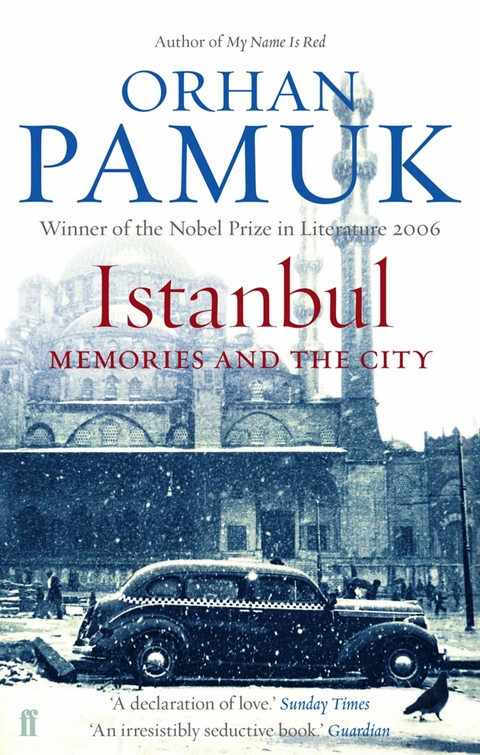
Istanbul (eBook)
200 Seiten
Faber & Faber (Verlag)
978-0-571-26619-7 (ISBN)
Orhan Pamuk is the author of many celebrated books of fiction, nonfiction, and photography. In 2003 he won the IMPAC prize for My Name is Red, and in 2006 he was awarded the Nobel Prize in Literature.
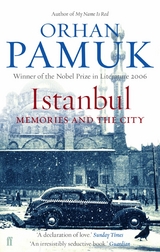
Istanbul, through the mind of its most celebrated writerWinner of the Nobel Prize for Literature'A declaration of love.' Sunday Times'A fascinating read for anyone who has even the slightest acquaintance with this fabled bridge between east and west.' The Economist'An irresistibly seductive book' Jan Morris, GuardianIn a surprising and original blend of personal memoir and cultural history, Turkey's most celebrated novelist, Orhan Pamuk, explores his home of more than fifty years. What begins as a portrait of the artist as a young man becomes a shimmering evocation, by turns intimate and panoramic, of one of the world's greatest cities. Beginning in the family apartment building where he was born, and still lives, Pamuk uses his family secrets to show how they were typical of their time and place. He then guides us through Istanbul's monuments and lost paradises, dilapidated Ottoman villas, back streets and waterways, and introduces us to the city's writers, artists and murderers. Like Joyce's Dublin and Borges' Buenos Aires, Pamuk's Istanbul is a triumphant encounter of place and sensibility, beautifully written and immensely moving.
Orhan Pamuk is the author of many celebrated books of fiction, nonfiction, and photography. In 2003 he won the IMPAC prize for My Name is Red, and in 2006 he was awarded the Nobel Prize in Literature.
'This evocative book succeeds at both its tasks. It is one of the most touching childhood memoirs I have read in a very long time; and it makes me yearn -- more than any glossy tourist brochure could possibly do -- to be once again in Istanbul.'
'An irresistibly seductive book, and its seduction lies not in the author's self-portrait, but in his poetical identification with Istanbul . . . His novels have already made him celebrated throughout the world, but perhaps he will be longest remembered for this wistful memorial to the city of his heart.'
'This erudite book manages to be an addictive childhood memoir, a museum-in-prose of a city with west in its head but east in its soul, and a study of the alchemy between place and self.'
'Magnificent, elegiac, impressionistic.'
'Extraordinary and moving.'
'A declaration of love.'
'An extraordinary and transcendentally beautiful book . . . It is a long time since I have read a book of such crystalline originality, or one that moved me so much.'
From a very young age, I suspected there was more to my world than I could see: somewhere in the streets of Istanbul, in a house resembling ours, there lived another Orhan so much like me that he could pass for my twin, even my double. I can’t remember where I got this idea or how it came to me. It must have emerged from a web of rumours, misunderstandings, illusions and fears. But in one of my earliest memories, it is already clear how I’ve come to feel about my ghostly other.
When I was five I was sent to live for a short time in another house. It was at the end of one of their many stormy separations that my parents arranged to meet in Paris, and it was decided that my older brother and I should remain in Istanbul, in separate places. My brother remained in the heart of the family with our grandmother in the Pamuk Apartments, in Nişantaşı. But I would be sent to stay with my aunt in Cihangir. Hanging on the wall in this house, where I was treated with the utmost kindness, was a picture of a small child. Every once in a while, my aunt or uncle would point at him and say with a smile, ‘Look! That’s you.’
The sweet, doe-eyed boy inside the small white frame did look a bit like me, it’s true. He was even wearing the cap I sometimes wore. I knew I was not that boy in the picture (a kitsch representation of a ‘cute child’ that someone had brought back from Europe). And yet I kept asking myself, Is this the Orhan who lives in that other house?
Of course now I, too, was living in another house. It was as if I’d had to move here before I could meet my twin, but as I wanted only to return to my real home, I took no pleasure in the idea of making his acquaintance. Each time my aunt and uncle teased me about being the boy in the picture I felt my mind unravelling: my ideas about myself, my house, my picture and the picture I resembled, the boy who looked like me, and the other house would slide about in a confusion that made me long all the more to be at home again, surrounded by my family.
Soon my wish came true. But the ghost of the other Orhan in another house somewhere in Istanbul never left me. Throughout my childhood and well into adolescence, he haunted my thoughts. On winter evenings, walking through the streets of the city, I would gaze into other people’s houses through the pale orange light of home and dream of happy, peaceful families living comfortable lives. Then I would shudder, thinking that the other Orhan might be living in one of these houses. As I grew older, the ghost became a fantasy and the fantasy a recurrent nightmare. In some dreams I would greet this Orhan – always in another house – with shrieks of horror; in others the two of us would stare each other down in eerie, merciless silence. Afterwards, as I wafted in and out of sleep, I would cling ever more fiercely to my pillow, my house, my street, my place in the world. Whenever I was unhappy, I imagined going to the other house, the other life, the place where the other Orhan lived, and in spite of everything, I’d half convince myself that I was he and took pleasure in imagining how happy he was, such pleasure that, for a time, I felt no need to go to seek out the other house in that other imagined part of the city.
Here we come to the heart of the matter: I’ve never left Istanbul – never left the houses, streets and neighbourhoods of my childhood. Although I’ve lived in other districts from time to time, fifty years on I find myself back in the Pamuk Apartments, where my first photographs were taken and where my mother first held me in her arms to show me the world. I know this persistence owes something to my imaginary friend, and to the solace I took from the bond between us. But we live in an age defined by mass migration and creative immigrants, and so I am sometimes hard-pressed to explain why I’ve stayed not only in the same place, but the same building. My mother’s sorrowful voice comes back to me, ‘Why don’t you go outside for a while, why don’t you try a change of scene, do some travelling …?’
Conrad, Nabokov, Naipaul – these are writers known for having managed to migrate between languages, cultures, countries, continents, even civilisations. Their imaginations were fed by exile, a nourishment drawn not through roots but through rootlessness; mine, however, requires that I stay in the same city, on the same street, in the same house, gazing at the same view. Istanbul’s fate is my fate: I am attached to this city because it has made me who I am.
Flaubert, who visited Istanbul a hundred and two years before my birth, was struck by the variety of life in its teeming streets; in one of his letters he predicted that in a century’s time it would be the capital of the world. The reverse came true: after the Ottoman Empire collapsed, the world almost forgot that Istanbul existed. The city into which I was born was poorer, shabbier, and more isolated than it had ever been its two-thousand-year history. For me it has always been a city of ruins and of end-of-empire melancholy. I’ve spent my life either battling with this melancholy, or (like all Istanbullus) making it my own.
At least once in a lifetime, self-reflection leads us to examine the circumstances of our birth. Why were we born in this particular corner of the world, on this particular date? These families into which we were born, these countries and cities to which the lottery of life has assigned us – they expect love from us, and in the end, we do love them, from the bottom of our hearts – but did we perhaps deserve better? I sometimes think myself unlucky to have been born in an ageing and impoverished city buried under the ashes of a ruined empire. But a voice inside me always insists this was really a piece of luck. If it were a matter of wealth, then I could certainly count myself fortunate to have been born into an affluent family at a time when the city was at its lowest ebb (though some have ably argued the contrary). Mostly I am disinclined to complain: I’ve accepted the city into which I was born in the same way I’ve accepted my body (much as I would have preferred to be more handsome and better built) and my gender (even though I still ask myself, naively, whether I might have been better off had I been born a woman). This is my fate, and there’s no sense arguing with it. This book is about fate ….
I was born in the middle of the night on 7 June 1952, in a small private hospital in Moda. Its corridors, I’m told, were peaceful that night, and so was the world. Aside from the Strombolini Volcano’s having suddenly begun to spew flames and ash two days earlier, relatively little seems to have been happening on our planet. The newspapers were full of small news – a few stories about the Turkish troops fighting in Korea, a few rumours spread by the Americans stoking fears that the Northern Koreans might be preparing to use biological weapons. In the hours before I was born, my mother had been avidly following a local story: two days earlier, the caretakers and ‘heroic’ residents of the Konya Student Centre had seen a man in a terrifying mask trying to enter a house in Langa through the bathroom window; they’d chased him through the streets to a lumber yard, where, after cursing the police, the hardened criminal had committed suicide; a dry-goods seller identified the corpse as a gangster who the year before had entered his shop in broad daylight and had robbed him at gunpoint. When she was reading the latest on this drama, my mother was alone in her room, or so she told me with a mixture of regret and annoyance many years later. After taking her into hospital, my father had grown restless and when my mother’s labour failed to progress, he’d gone out to meet with friends. The only person with her in the delivery room was my aunt, who’d managed to climb over the hospital’s garden wall in the middle of the night. When my mother first set eyes on me, she found me thinner and more fragile than my brother had been.
I feel compelled to add ‘or so I’ve been told’. In Turkish we have a special tense that allows us to distinguish hearsay from what we’ve seen with our own eyes; when we are relating dreams, fairy tales, or past events we could not have witnessed, we use this tense. It is a useful distinction to make as we ‘remember’ our earliest life experiences, our cradles, our baby carriages, our first steps, as reported by our parents, stories to which we listen with the same rapt attention we might pay some brilliant tale that happened to concern some other person. It’s a sensation as sweet as seeing ourselves in our dreams, but we pay a heavy price for it. Once imprinted in our minds, other people’s reports of what we’ve done end up mattering more than what we ourselves remember. And just as we learn about our lives from others, so, too, do we let others shape our understanding of the city in which we live.
At times when I accept as my own the stories I’ve heard about my city and myself, I’m tempted to say, ‘Once upon a time I used to paint. I hear I was born in Istanbul, and I understand that I was a somewhat curious child. Then, when I was twenty-two, I seem to have begun writing novels without knowing why.’ I’d have liked to write my entire story this way – as if my life were something that happened to someone else, as if it were a dream in which I felt my voice fading and my will succumbing to...
| Erscheint lt. Verlag | 21.7.2011 |
|---|---|
| Übersetzer | Maureen Freely |
| Verlagsort | London |
| Sprache | englisch |
| Themenwelt | Sachbuch/Ratgeber |
| Reisen ► Reiseberichte | |
| Reiseführer ► Europa ► Türkei | |
| Geschichte ► Allgemeine Geschichte ► Neuzeit (bis 1918) | |
| Geisteswissenschaften ► Geschichte ► Regional- / Ländergeschichte | |
| Schlagworte | city breaks • Constantinople • Istanbul • Istanbul Travel Guide • Lonely Planet Istanbul (Travel Guide) • nobel prize for literature winners • The Architects Apprentice Elif Shafak |
| ISBN-10 | 0-571-26619-3 / 0571266193 |
| ISBN-13 | 978-0-571-26619-7 / 9780571266197 |
| Informationen gemäß Produktsicherheitsverordnung (GPSR) | |
| Haben Sie eine Frage zum Produkt? |
 EPUB (Adobe DRM)
Kopierschutz: Adobe-DRM
Adobe-DRM ist ein Kopierschutz, der das eBook vor Mißbrauch schützen soll. Dabei wird das eBook bereits beim Download auf Ihre persönliche Adobe-ID autorisiert. Lesen können Sie das eBook dann nur auf den Geräten, welche ebenfalls auf Ihre Adobe-ID registriert sind.
Details zum Adobe-DRM
Dateiformat: EPUB (Electronic Publication)
EPUB ist ein offener Standard für eBooks und eignet sich besonders zur Darstellung von Belletristik und Sachbüchern. Der Fließtext wird dynamisch an die Display- und Schriftgröße angepasst. Auch für mobile Lesegeräte ist EPUB daher gut geeignet.
Systemvoraussetzungen:
PC/Mac: Mit einem PC oder Mac können Sie dieses eBook lesen. Sie benötigen eine
eReader: Dieses eBook kann mit (fast) allen eBook-Readern gelesen werden. Mit dem amazon-Kindle ist es aber nicht kompatibel.
Smartphone/Tablet: Egal ob Apple oder Android, dieses eBook können Sie lesen. Sie benötigen eine
Geräteliste und zusätzliche Hinweise
Buying eBooks from abroad
For tax law reasons we can sell eBooks just within Germany and Switzerland. Regrettably we cannot fulfill eBook-orders from other countries.
aus dem Bereich