Timbuktu (eBook)
200 Seiten
Faber & Faber (Verlag)
978-0-571-26486-5 (ISBN)
Paul Auster was the bestselling author of 4 3 2 1, Sunset Park, The Book of Illusions, Moon Palace and The New York Trilogy. He and Spencer Ostrander collaborated on Bloodbath Nation. In 2006, he was awarded the Prince of Asturias Prize for Literature. His other honours include the Prix Medicis Étranger for Leviathan, the Independent Spirit Award for the Screenplay of Smoke, the Los Angeles Times Book Prize for Burning Boy, and the Carlos Fuentes Prize for his body of work. His novel 4 3 2 1 was shortlisted for the 2017 Man Booker Prize. He was a member of the American Academy of Arts and Letters, and was a Commandeur de l'Ordre des Arts et des Lettres. His work was translated into more than forty languages. His final novel, Baumgartner, was published in November 2023. He died on 30 April 2024.
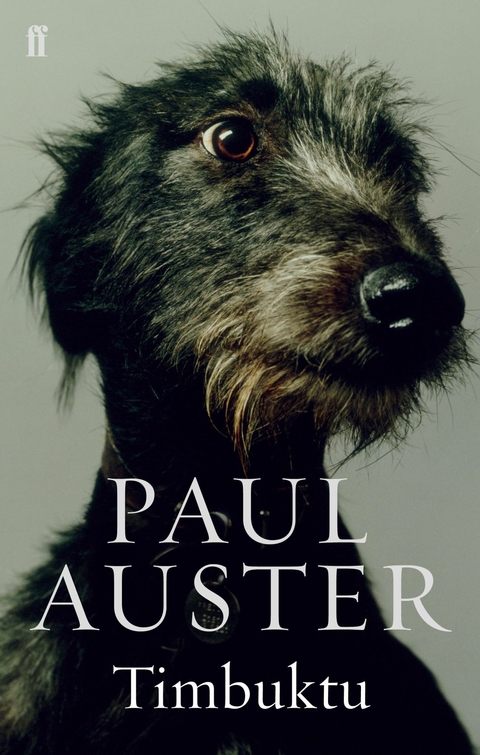
Auster's tragicomic tale of one unforgettable dog from the author of contemporary classic The New York Trilogy: 'a literary voice for the ages' (Guardian)Meet Mr Bones, the canine hero of Paul Auster's remarkable novel. Bones is the sidekick of Willy G. Christmas, a brilliant but troubled poet-saint from Brooklyn. Together they sally forth across America to Baltimore, Maryland, on one last great adventure, searching for Willy's old teacher, Bea Swanson. Years have passed since Willy last saw his beloved mentor, who used to know him as William Gurevitch, son of Polish war refugees. But is Mrs Swanson still alive? And if not, what will prevent Willy from vanishing into that other world known as Timbuktu?'In this brilliant novel, Auster writes with economy, precision and the quirky pathos of noir, addressing the pernicious ubiquity of American consumerism, the nature of love and the core riddles of ontology. Above all, though, this is the affecting tale of a special dog's place in the universe of humans and in the fleeting life of a special man.' Publishers Weekly
"A howling success."
Nothing did. For the longest time, it was as if the entire neighborhood had stopped breathing. No one walked by, no cars passed, not a single person went in or out of a house. The rain poured down, just as Mr. Bones had predicted it would, but then it slackened, gradually turned into a drizzle again, and at last made a quiet departure from the scene. Willy stirred not a muscle during these skyward agitations. He lay sprawled out against the brick building as before, his eyes shut and his mouth partly open, and if not for the rusty, creaking noise that intermittently emerged from his lungs, Mr. Bones might well have assumed that his master had already slipped into the next world.
That was where people went after they died. Once your soul had been separated from your body, your body was buried in the ground and your soul lit out for the next world. Willy had been harping on this subject for the past several weeks, and by now there was no doubt in the dog’s mind that the next world was a real place. It was called Timbuktu, and from everything Mr. Bones could gather, it was located in the middle of a desert somewhere, far from New York or Baltimore, far from Poland or any other city they had visited in the course of their travels. At one point, Willy described it as “an oasis of spirits.” At another point he said: “Where the map of this world ends, that’s where the map of Timbuktu begins.” In order to get there, you apparently had to walk across an immense kingdom of sand and heat, a realm of eternal nothingness. It struck Mr. Bones as a most difficult and unpleasant journey, but Willy assured him that it wasn’t, that it took no more than a blink of an eye to cover the whole distance. And once you were there, he said, once you had crossed the boundaries of that refuge, you no longer had to worry about eating food or sleeping at night or emptying your bladder. You were at one with the universe, a speck of antimatter lodged in the brain of God. Mr. Bones had trouble imagining what life would be like in such a place, but Willy talked about it with such longing, with such pangs of tenderness reverberating in his voice, that the dog eventually gave up his qualms. Tim-buk-tu. By now, even the sound of the word was enough to make him happy. The blunt combination of vowels and consonants rarely failed to stir him in the deepest parts of his soul, and whenever those three syllables came rolling off his master’s tongue, a wave of blissful well-being would wash through the entire length of his body – as if the word alone were a promise, a guarantee of better days ahead.
It didn’t matter how hot it was there. It didn’t matter that there was nothing to eat or drink or smell. If that’s where Willy was going, that’s where he wanted to go too. When the moment came for him to part company with this world, it seemed only right that he should be allowed to dwell in the hereafter with the same person he had loved in the here-before. Wild beasts no doubt had their own Timbuktu, giant forests in which they were free to roam without threat from two-legged hunters and trappers, but lions and tigers were different from dogs, and it made no sense to throw the tamed and untamed together in the afterlife. The strong would devour the weak, and in no time flat every dog in the place would be dead, dispatched to yet another afterlife, a beyond beyond the beyond, and what would be the point of arranging things like that? If there was any justice in the world, if the dog god had any influence on what happened to his creatures, then man’s best friend would stay by the side of man after said man and said best friend had both kicked the bucket. More than that, in Timbuktu dogs would be able to speak man’s language and converse with him as an equal. That was what logic dictated, but who knew if justice or logic had any more impact on the next world than they did on this one? Willy had somehow forgotten to mention the matter, and because Mr. Bones’s name had not come up once, not once in all their conversations about Timbuktu, the dog was still in the dark as to where he was headed after his own demise. What if Timbuktu turned out to be one of those places with fancy carpets and expensive antiques? What if no pets were allowed? It didn’t seem possible, and yet Mr. Bones had lived long enough to know that anything was possible, that impossible things happened all the time. Perhaps this was one of them, and in that perhaps hung a thousand dreads and agonies, an unthinkable horror that gripped him every time he thought about it.
Then, against all odds, just as he was about to fall into another one of his funks, the sky began to brighten. Not only had the rain stopped, but the bulked-up clouds overhead were slowly breaking apart, and whereas just an hour before everything had been gray and gloom, now the sky was tinged with color, a motley jumble of pink and yellow streaks that bore down from the west and steadily advanced across the breadth of the city.
Mr. Bones lifted his head. A moment later, as if the two actions were secretly connected, a shaft of light came slanting through the clouds. It struck the sidewalk an inch or two from the dog’s left paw, and then, almost immediately, another beam landed just to his right. A crisscross of light and shadow began to form on the pavement in front of him, and it was a beautiful thing to behold, he felt, a small, unexpected gift on the heels of so much sadness and pain. He looked back at Willy then, and just as he was turning his head, a great bucketful of light poured down on the poet’s face, and so intense was the light as it crashed against the sleeping man’s eyelids that his eyes involuntarily opened – and there was Willy, all but defunct a moment ago, back in the land of the living, dusting off the cobwebs and trying to wake up.
He coughed once, then again, and then a third time before lapsing into a prolonged seizure. Mr. Bones stood by helplessly as globules of phlegm came flying from his master’s mouth. Some landed on Willy’s shirt, others on the pavement. Still others, the looser and more slithery ones, dribbled weakly down his chin. There they remained, dangling from his beard like noodles, and as the fit wore on, punctuated by violent jolts, lurches, and doublings over, they bobbed back and forth in a crazy, syncopated dance. Mr. Bones was stunned by the ferocity of the attack. Surely this was the end, he said to himself, surely this was the limit of what a man could take. But Willy still had some fight left in him, and once he wiped his face with the sleeve of his jacket and managed to recover his breath, he surprised Mr. Bones by breaking into a broad, almost beatific smile. With much difficulty, he maneuvered himself into a more comfortable position, leaning his back against the wall of the house and stretching out his legs before him. Once his master was still again, Mr. Bones lowered his head on to his right thigh. When Willy reached out and started stroking the top of that head, a measure of calm returned to the dog’s broken heart. It was only temporary, of course, and only an illusion, but that didn’t mean it wasn’t good medicine.
“Lend an ear, Citizen Mutt,” Willy said. “It’s starting. Things are falling away now. One by one they’re falling away, and only strange things are left, tiny long-ago things, not at all the things I was expecting. I can’t say I’m scared, though. A little sorry, maybe, a little miffed at having to make this early exit, but not crapping my drawers the way I thought I might be. Pack up your bags, amigo. We’re on the road to Splitsville, and there’s no turning back. You follow, Mr. Bones? Are you with me so far?”
Mr. Bones followed, and Mr. Bones was with him.
“I wish I could boil it down to a few choice words for you‚” the dying man continued, “but I can’t. Punchy epigrams, succinct pearls of wisdom, Polonius delivering his parting shots. I don’t have it in me to do that. Neither a borrower nor a lender be; a stitch in time saves nine. There’s too much mayhem in the attic, Bonesy, and you’ll just have to bear with me as I ramble and digress. It seems to be in the nature of things for me to be confused. Even now, as I enter the valley of the shadow of death, my thoughts bog down in the gunk of yore. There’s the rub, signore. All this clutter in my head, this dust and bric-a-brac, these useless knickknacks spilling off the shelves. Indeed, sir, the sad truth is that I am a bear of but little brain.
“By way of proof, I offer you the return of O’Dell’s Hair Trainer. The stuff disappeared from my life forty years ago, and now, on the last day of my life, it suddenly comes back. I yearn for profundities, and what I get is this no-account factoid, this microblip on the screen of memory. My mother used to rub it into my hair when I was just a wee thing, a mere mite of a lad. They sold it in the local barber shops, and it came in a clear glass bottle about yea big. The spout was black, I believe, and on the label there was a picture of some grinning idiot boy. A wholesome, idealized numskull with perfectly groomed hair. No cowlicks for that lunkhead, no wobbles in the part for that pretty fellow. I was five, six years old, and every morning my mother would give me the treatment, hoping to make me look like his twin brother. I can still hear the gloppity-gluggity sound as the goo came out of the bottle. It was a whitish, translucent liquid, sticky to the touch. A kind of watered-down sperm, I suppose, but who know about such things then? They probably manufactured it by hiring teenage boys to jerk off into vats. Thus are fortunes made in our great land. A penny to produce, a dollar to...
| Erscheint lt. Verlag | 22.12.2010 |
|---|---|
| Verlagsort | London |
| Sprache | englisch |
| Themenwelt | Literatur ► Romane / Erzählungen |
| Kunst / Musik / Theater ► Kunstgeschichte / Kunststile | |
| Geisteswissenschaften ► Philosophie ► Ethik | |
| Schlagworte | books about dogs • flush virginia woolf • kafka metamorphosis • my dog tulip • The Curious Incident of the Dog in the Night-time • the invention of solitude • the new york trilogy |
| ISBN-10 | 0-571-26486-7 / 0571264867 |
| ISBN-13 | 978-0-571-26486-5 / 9780571264865 |
| Informationen gemäß Produktsicherheitsverordnung (GPSR) | |
| Haben Sie eine Frage zum Produkt? |
 EPUB (Adobe DRM)
Kopierschutz: Adobe-DRM
Adobe-DRM ist ein Kopierschutz, der das eBook vor Mißbrauch schützen soll. Dabei wird das eBook bereits beim Download auf Ihre persönliche Adobe-ID autorisiert. Lesen können Sie das eBook dann nur auf den Geräten, welche ebenfalls auf Ihre Adobe-ID registriert sind.
Details zum Adobe-DRM
Dateiformat: EPUB (Electronic Publication)
EPUB ist ein offener Standard für eBooks und eignet sich besonders zur Darstellung von Belletristik und Sachbüchern. Der Fließtext wird dynamisch an die Display- und Schriftgröße angepasst. Auch für mobile Lesegeräte ist EPUB daher gut geeignet.
Systemvoraussetzungen:
PC/Mac: Mit einem PC oder Mac können Sie dieses eBook lesen. Sie benötigen eine
eReader: Dieses eBook kann mit (fast) allen eBook-Readern gelesen werden. Mit dem amazon-Kindle ist es aber nicht kompatibel.
Smartphone/Tablet: Egal ob Apple oder Android, dieses eBook können Sie lesen. Sie benötigen eine
Geräteliste und zusätzliche Hinweise
Buying eBooks from abroad
For tax law reasons we can sell eBooks just within Germany and Switzerland. Regrettably we cannot fulfill eBook-orders from other countries.
aus dem Bereich