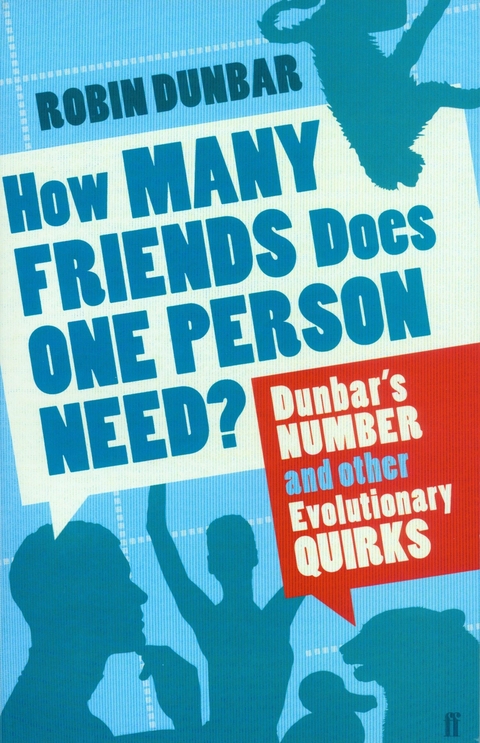
How Many Friends Does One Person Need? (eBook)
320 Seiten
Faber & Faber (Verlag)
978-0-571-25829-1 (ISBN)
Robin Dunbar is currently Professor of Evolutionary Anthropology at Oxford University and a Fellow of Magdalen College. His principal research interest is the evolution of sociality. He was elected a Fellow of the British Academy in 1998. His books include The Trouble with Science, 'an eloquent riposte to the anti-science lobby' (Sunday Times), and Grooming, Gossip and the Evolution of Language. The Human Story was described as 'fizzing with recent research and new theories' in the Sunday Times and 'punchy and provocative' by the New Scientist. How Many Friends Does One Person Need?: Dunbar's Number and Other Evolutionary Quirks was published in 2010.
We are the product of our evolutionary history and this history colours our everyday lives - from why we kiss to how religious we are. In How Many Friends Does One Person Need? Robin Dunbar explains how the distant past underpins our current behaviour, through the groundbreaking experiments that have changed the thinking of evolutionary biologists forever. He explains phenomena such as why 'Dunbar's Number' (150) is the maximum number of acquaintances you can have, why all babies are born premature and the science behind lonely hearts columns. Stimulating, provocative and highly enjoyable, this fascinating book is essential for understanding why humans behave as they do - what it is to be human.
lt;p>Robin Dunbar is currently Professor of Evolutionary Anthropology at Oxford and a Fellow of Magdalen College. His principal research interest is the evolution of sociality. He was elected a Fellow of the British Academy in 1998.
His books include The Trouble with Science (1995), 'an eloquent riposte to the anti-science lobby' (Sunday Times), and Grooming, Gossip and the Evolution of Language, praised as 'brilliantly original' and 'a delight to read' (Focus). His most recent book, The Human Story, (2004), was described as 'fizzing with recent research and new theories' in the Sunday Times and 'punchy and provocative' by the New Scientist.
We share a history, you and I. A history in which our respective stories snake back through time, edging ever closer to each other until finally they meet up in a common ancestor. Perhaps our lineages meet up only a few generations back, or maybe it was a thousand years ago. Perhaps it was so long ago that it predates history – though even that could not have been more than two hundred thousand years ago, a mere twinkle in earth time. For we modern humans all descend from a common ancestor who roamed the plains of Africa a mere ten thousand generations ago, ten thousand mothers giving birth to ten thousand daughters … no more than would fit in a town of very modest size today.
For us, that has two important implications. One is that we share most of our traits in common. From Alaska to Tasmania, and Tierra del Fuego to Spitzbergen, we are a single family, one biological species united by common ancestry. The other is that those traits we share are, nonetheless, the product of evolution, honed by the demands of the lives that our ancestors led. Sometimes, they are the product of deep evolutionary time, traits we share with the other members of our biological family, the great apes, and especially the African great apes. Sometimes, those traits are of more recent origin, wrought in the fire of the particular circumstances that our more immediate ancestors faced in the battle for life, traits that mark us out as human – not special, because we are just one of many tens of thousands of individually unique species of animals, but unique in that we alone possess them. Some of these give us the capacity for culture, that remarkable product of the human mind that has made us what we are – those traits that allowed us to break away from our biological roots, that allowed human history to be what it is.
Yet, in our enthusiasm for the wonders of human culture, we sometimes overlook just how much of our behaviour is rooted in our biological evolution. The human mind is surely one of the wonders of the natural world, yet sometimes it seems so pedestrian and constrained that it is hard to see how we differ from any of the other primates. We live in massive conurbations numbering tens of millions of individuals, a product of our cultural flexibility if ever there was one. We have lived in villages only for the last ten thousand years, and cities the size of Bombay or Rio de Janeiro only for the last century at most. These are novel innovations, a product of our capacity to invent ways of making do. Yet, at the same time, our social world is still what it was several hundred thousand years ago. The number of people we know personally, whom we can trust, whom we feel some emotional affinity for, is no more than 150, Dunbar’s Number. It has been 150 for as long as we have been a species. And it is 150 because our minds lack the capacity to make it any larger. We are as much the product of our evolutionary history as any other species is.
*
I probably owe my interest in evolution to my American grandmother. Though a fiercely God-fearing Presbyterian missionary, she was also a surgeon and sufficiently well-versed in science to be an enthusiast for the new discoveries in human evolution that were emerging from Africa during the 1950s. When I was ten or eleven, she sent me a series of Audubon Society booklets on every imaginable subject to do with the natural world, complete with sticky stamps to paste in. One was on evolution, and covered everything from dinosaurs to humans. I became hooked on the story of human evolution. Some years later, I read Darwin’s Origin of Species, having found it by chance in the school library. It was interesting, but I can’t say I got a great deal out of it at the time. I was becoming more interested in philosophy, and science wasn’t really my thing.
Then, five or six years later as a postgraduate student, I was thrust willy-nilly back into Darwin’s world. I was deeply engaged in studying the behaviour of monkeys in the wild, spending several years doing fieldwork in Africa during the early 1970s. At the time, evolutionary thinking in the behavioural sciences was apt to be somewhat loose and wayward. We returned from fieldwork in Ethiopia in late 1975 to find the world had been turned upside down. Edward O. Wilson had just published his Sociobiology: The New Synthesis and Richard Dawkins would publish The Selfish Gene the following year. It was a life-changing experience for all of us. Overnight, we were made to think about evolutionary processes in a much more rigorous way. We were being asked to return to a more strictly Darwinian view, after decades of increasingly lax, often speculative, thinking that had come to characterise much of organismic biology in mid-century. Of course, neither book invented something that was novel. What both, in their different ways, did was to lay out in stark detail the ideas that evolutionary biologists had slowly been developing over the previous decades.
The big intellectual change was a shift away from thinking that evolution was for the benefit of the species to one in which evolution was for the benefit of the genes that underpinned a trait, whether that trait was physical or behavioural. This should not be taken to imply that behaviour is hardwired, determined by the genes you inherit. Few traits are ever that simple in biology. But taking a gene’s-eye view in which the benefits of a trait are costed out in terms of the impact they have on how often a particular gene is represented in the next generation brings us closer to Darwin’s original conception of the theory of evolution by natural selection. More importantly, perhaps, it moved us away from the naïve genes-determine-all-behaviour view that has so often bedevilled thinking in this area to one in which an individual’s freely made decisions on how to behave, free of any direct genetic input, could still be understood in a Darwinian framework. The following decades saw a veritable explosion of research. We learned so much in so short a space of time. Looking back, it is difficult now to convey the excitement of the time. So much of what was then novel is now accepted as fact.
Charles Darwin did not, of course, invent the theory of evolution. It had already had a long history within European biology dating back at least a century before young Charles was even a twinkle in his mother’s eye. In fact, his own polymath of a grandfather, Erasmus Darwin, had himself made a seminal contribution to promoting the idea of evolution in one of his own best sellers. If anyone deserves the credit for inventing the theory of evolution it should probably be the great eighteenth-century French biologists – Cuvier, Buffon, Lamarck, among others. But they had been locked into a medieval mindset that had its origins in the views of Aristotle and Plato, filtered through the intellectual spectacles of the Church Fathers, a seminal group of medieval Christian theologians who established the core tenets of modern Christian theology. Building on the thinking of their Greek predecessors, they saw evolution as progressive, with each species inexorably climbing slowly but surely up the ‘Great Chain of Being’ from primitive life forms to join the angels just below God, who, at least as far as they were concerned, inevitably stood at the pinnacle of it all.
The publication of Darwin’s book On the Origin of Species in 1859 set aside the old scala natura, or Great Chain of Being, that had been the linchpin of evolutionary thinking ever since Plato. Darwin set in train a new way of thinking about the natural world, a world whose history is driven by the demands of successful biological reproduction. In the process, of course, he upset quite a few apple carts, not least because his new vision of evolution challenged Victorian beliefs about the established order. Not only were Englishmen not the high point of evolution, but there wasn’t that much room at the top for God either.
Darwin’s great genius was to recognise that natural selection is the engine that drives evolution. In doing so, he dragged the theory of evolution out of the medieval doldrums into the modern world. He provided a mechanism that could explain how life on earth could have evolved without need for a creator. And it was a mechanism that, at the same time, could explain how and why a species might have evolved particular traits, traits that enabled individual animals to reproduce more successfully.
As with all scientific ideas, Darwin’s theory underwent extensive development in the decades after the publication of the Origin. He expanded his ideas on natural selection to include sexual selection (selection for traits that enhance attractiveness to prospective mates). He applied his ideas to the nascent discipline of psychology – commenting at length on topics such as music, language, emotions and physical attractiveness – and even finally the evolution of Man.
Nor did his theory come to a halt with his death in 1882. It continued to be developed by those who came after him. We know so much more now than Darwin himself ever did, but the core of modern evolutionary theory and its many intellectual derivatives still lies firmly in Darwin’s elegantly simple idea: organisms behave in ways that tend to enhance the frequencies with which the genes they carry are passed on to future generations.
It was into this heady atmosphere that I was thrust as a young researcher in the 1970s. We were galvanised and excited by the opportunities on offer, by the heady mix of new Darwinian theories whose strong predictions could guide our research and give us new...
| Erscheint lt. Verlag | 4.3.2010 |
|---|---|
| Verlagsort | London |
| Sprache | englisch |
| Themenwelt | Sachbuch/Ratgeber ► Gesundheit / Leben / Psychologie ► Psychologie |
| Sachbuch/Ratgeber ► Natur / Technik | |
| Geisteswissenschaften ► Psychologie | |
| Naturwissenschaften | |
| Technik | |
| Schlagworte | Facebook friends • Gossip • Human Evolution • Human Evolutionary Science • Robin Dunbar • sapiens • The Righteous Mind |
| ISBN-10 | 0-571-25829-8 / 0571258298 |
| ISBN-13 | 978-0-571-25829-1 / 9780571258291 |
| Informationen gemäß Produktsicherheitsverordnung (GPSR) | |
| Haben Sie eine Frage zum Produkt? |
 EPUB (Adobe DRM)
Kopierschutz: Adobe-DRM
Adobe-DRM ist ein Kopierschutz, der das eBook vor Mißbrauch schützen soll. Dabei wird das eBook bereits beim Download auf Ihre persönliche Adobe-ID autorisiert. Lesen können Sie das eBook dann nur auf den Geräten, welche ebenfalls auf Ihre Adobe-ID registriert sind.
Details zum Adobe-DRM
Dateiformat: EPUB (Electronic Publication)
EPUB ist ein offener Standard für eBooks und eignet sich besonders zur Darstellung von Belletristik und Sachbüchern. Der Fließtext wird dynamisch an die Display- und Schriftgröße angepasst. Auch für mobile Lesegeräte ist EPUB daher gut geeignet.
Systemvoraussetzungen:
PC/Mac: Mit einem PC oder Mac können Sie dieses eBook lesen. Sie benötigen eine
eReader: Dieses eBook kann mit (fast) allen eBook-Readern gelesen werden. Mit dem amazon-Kindle ist es aber nicht kompatibel.
Smartphone/Tablet: Egal ob Apple oder Android, dieses eBook können Sie lesen. Sie benötigen eine
Geräteliste und zusätzliche Hinweise
Buying eBooks from abroad
For tax law reasons we can sell eBooks just within Germany and Switzerland. Regrettably we cannot fulfill eBook-orders from other countries.
aus dem Bereich