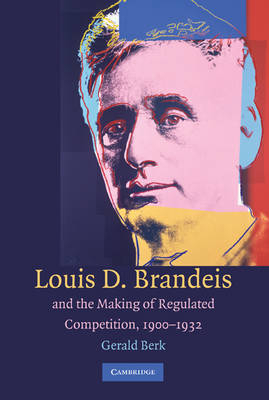
Louis D. Brandeis and the Making of Regulated Competition, 1900-1932 (eBook)
Cambridge University Press (Verlag)
978-0-511-57760-4 (ISBN)
This book provides an innovative interpretation of industrialization and statebuilding in the United States. Whereas most scholars cast the politics of industrialization in the progressive era as a narrow choice between breaking up and regulating the large corporation, Berk reveals a third way: regulated competition. In this framework, the government steered economic development away from concentrated power by channeling competition from predation to improvements in products and production processes. Louis Brandeis conceptualized regulated competition and introduced it into public debate. Political entrepreneurs in Congress enacted many of Brandeis's proposals into law. The Federal Trade Commission enlisted business and professional associations to make it workable. The commercial printing industry showed how it could succeed. And 30 percent of manufacturing industries used it to improve economic performance. In order to make sense of regulated competition, Berk provides a new theo
This book provides an innovative interpretation of industrialization and statebuilding in the United States. Whereas most scholars cast the politics of industrialization in the progressive era as a narrow choice between breaking up and regulating the large corporation, Berk reveals a third way: regulated competition. In this framework, the government steered economic development away from concentrated power by channeling competition from predation to improvements in products and production processes. Louis Brandeis conceptualized regulated competition and introduced it into public debate. Political entrepreneurs in Congress enacted many of Brandeis's proposals into law. The Federal Trade Commission enlisted business and professional associations to make it workable. The commercial printing industry showed how it could succeed. And 30 percent of manufacturing industries used it to improve economic performance. In order to make sense of regulated competition, Berk provides an original theory of institutions he calls 'creative syncretism'.
| Erscheint lt. Verlag | 4.9.2009 |
|---|---|
| Sprache | englisch |
| Themenwelt | Sachbuch/Ratgeber |
| Geisteswissenschaften ► Geschichte ► Regional- / Ländergeschichte | |
| Geschichte ► Teilgebiete der Geschichte ► Militärgeschichte | |
| Geschichte ► Teilgebiete der Geschichte ► Wirtschaftsgeschichte | |
| Recht / Steuern ► Rechtsgeschichte | |
| Sozialwissenschaften ► Politik / Verwaltung ► Staat / Verwaltung | |
| ISBN-10 | 0-511-57760-5 / 0511577605 |
| ISBN-13 | 978-0-511-57760-4 / 9780511577604 |
| Informationen gemäß Produktsicherheitsverordnung (GPSR) | |
| Haben Sie eine Frage zum Produkt? |
 PDF (Adobe DRM)
Kopierschutz: Adobe-DRM
Adobe-DRM ist ein Kopierschutz, der das eBook vor Mißbrauch schützen soll. Dabei wird das eBook bereits beim Download auf Ihre persönliche Adobe-ID autorisiert. Lesen können Sie das eBook dann nur auf den Geräten, welche ebenfalls auf Ihre Adobe-ID registriert sind.
Details zum Adobe-DRM
Dateiformat: PDF (Portable Document Format)
Mit einem festen Seitenlayout eignet sich die PDF besonders für Fachbücher mit Spalten, Tabellen und Abbildungen. Eine PDF kann auf fast allen Geräten angezeigt werden, ist aber für kleine Displays (Smartphone, eReader) nur eingeschränkt geeignet.
Systemvoraussetzungen:
PC/Mac: Mit einem PC oder Mac können Sie dieses eBook lesen. Sie benötigen eine
eReader: Dieses eBook kann mit (fast) allen eBook-Readern gelesen werden. Mit dem amazon-Kindle ist es aber nicht kompatibel.
Smartphone/Tablet: Egal ob Apple oder Android, dieses eBook können Sie lesen. Sie benötigen eine
Geräteliste und zusätzliche Hinweise
Buying eBooks from abroad
For tax law reasons we can sell eBooks just within Germany and Switzerland. Regrettably we cannot fulfill eBook-orders from other countries.
aus dem Bereich