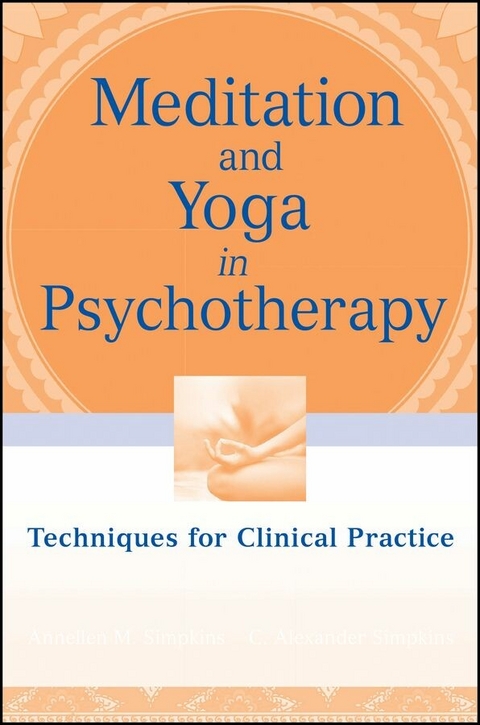
Meditation and Yoga in Psychotherapy (eBook)
John Wiley & Sons (Verlag)
978-0-470-92057-2 (ISBN)
'From the wisdom of ancient cultures to modern neuroscience, the authors skillfully create a bridge of understanding between the practice of meditation, yoga, and psychotherapy. The Simpkins are at their best in describing how everyone can learn to integrate their own brain, body, and mind to facilitate a creative synchrony of healing and well-being.'
—Kathryn Rossi, PhD Coeditor, Collected Works of Milton H. Erickson: The Nature of Therapeutic Hypnosis
'This reader-friendly text is directed toward therapists and healthcare workers who are considering incorporating yoga and meditation into their work. These technologies are time-honored and appear to have beneficial effects on contemporary clients and patients. Meditation and Yoga in Psychotherapy serves as an informative introduction to these¿practices, and explains how a therapist might integrate such practices into their work. The chapters on neuroscience research and healthy aging are unique in books of this nature, and the discussion of alleviating depression alone is worth the price of the book.'
—Stanley Krippner, PhDProfessor of Psychology, Saybrook UniversityCoauthor, Haunted by Combat: Understanding PTSD in War Veterans
A thoughtful and pragmatic guide for integrating meditation and yoga techniques into traditional psychotherapy
Meditation and Yoga in Psychotherapy is an inspiring 'how-to' guide grounded in the neuroscientific and clinical evidence that supports the use of meditation and other yoga practices to improve clients' mental health.
Drawing from the authors' decades of practice, teaching, and writing, this inspiring book is focused on applying meditation, yoga, and Zen to therapy, with discussion of:
The latest neuroscience findings, showing how the brain and larger nervous system are altered by yoga methods
Philosophical and psychological principles upon which yoga is based
The how, when, and why for use of specific techniques with common psychological problems
Fundamental stretching exercises and meditation techniques
Filled with vivid case examples and writings from renowned yoga masters, Meditation and Yoga in Psychotherapy encourages a therapeutic process in which clients move their attention from outside concerns to inner mindfulness. With a range of techniques that embrace the diversity and uniqueness of clients, this book offers methods to creatively individualize techniques for a wide variety of presenting problems.
ANNELLEN M. SIMPKINS, PhD, and C. ALEXANDER SIMPKINS, PhD, have extensive training in psychotherapy, meditation, yoga, and Zen. They have clinical, teaching, and research experience using meditation either as the primary method or in conjunction with other forms of therapy. They are the authors of several books on meditation, yoga, psychotherapy, and hypnosis, as well as books on several Eastern philosophical traditions.
Praise for Meditation and Yoga in Psychotherapy "e;From the wisdom of ancient cultures to modern neuroscience, the authors skillfully create a bridge of understanding between the practice of meditation, yoga, and psychotherapy. The Simpkins are at their best in describing how everyone can learn to integrate their own brain, body, and mind to facilitate a creative synchrony of healing and well-being."e; Kathryn Rossi, PhD Coeditor, Collected Works of Milton H. Erickson: The Nature of Therapeutic Hypnosis "e;This reader-friendly text is directed toward therapists and healthcare workers who are considering incorporating yoga and meditation into their work. These technologies are time-honored and appear to have beneficial effects on contemporary clients and patients. Meditation and Yoga in Psychotherapy serves as an informative introduction to these practices, and explains how a therapist might integrate such practices into their work. The chapters on neuroscience research and healthy aging are unique in books of this nature, and the discussion of alleviating depression alone is worth the price of the book."e; Stanley Krippner, PhDProfessor of Psychology, Saybrook UniversityCoauthor, Haunted by Combat: Understanding PTSD in War Veterans A thoughtful and pragmatic guide for integrating meditation and yoga techniques into traditional psychotherapy Meditation and Yoga in Psychotherapy is an inspiring "e;how-to"e; guide grounded in the neuroscientific and clinical evidence that supports the use of meditation and other yoga practices to improve clients' mental health. Drawing from the authors' decades of practice, teaching, and writing, this inspiring book is focused on applying meditation, yoga, and Zen to therapy, with discussion of: The latest neuroscience findings, showing how the brain and larger nervous system are altered by yoga methods Philosophical and psychological principles upon which yoga is based The how, when, and why for use of specific techniques with common psychological problems Fundamental stretching exercises and meditation techniques Filled with vivid case examples and writings from renowned yoga masters, Meditation and Yoga in Psychotherapy encourages a therapeutic process in which clients move their attention from outside concerns to inner mindfulness. With a range of techniques that embrace the diversity and uniqueness of clients, this book offers methods to creatively individualize techniques for a wide variety of presenting problems.
ANNELLEN M. SIMPKINS, PhD, and C. ALEXANDER SIMPKINS, PhD, have extensive training in psychotherapy, meditation, yoga, and Zen. They have clinical, teaching, and research experience using meditation either as the primary method or in conjunction with other forms of therapy. They are the authors of several books on meditation, yoga, psychotherapy, and hypnosis, as well as books on several Eastern philosophical traditions.
Preface xi
How Yoga Can Help the Th erapeutic Process xii
Yoga's Popularity xiv
About Th is Book xiv
Part I: Efficacy and Neuroscience Research 1
1 Efficacy 3
Efficacy Studies Overview 6
Efficacy Studies for Specific Problems 10
Factors of Healing 17
Conclusion 21
2 Yoga and the Brain 23
The Relationship Between Mind and Brain 23
Overview of How Yoga Affects the Brain 25
The Neuroanatomy of Yoga 26
From Mind to Brain: Neuroplasticity and Neurogenesis 32
Conclusion 41
Part II: What Is Yoga? 43
3 Traditions 45
Tracing Yoga's Roots in Ancient Texts 46
Different Forms of Yoga 49
Introduction to the West Th rough Great Teachers 58
Conclusion 71
4 Philosophy 73
From Samkhya to Yoga: Integration of Mind and Matter 74
The Eight Limbs of Yoga 75
Integration 85
Conclusion 86
5 Practices 87
Integrating Yamas and Niyamas as a Therapeutic Tool 88
Asana Postures 89
Pranayama Breathing 100
Meditation 105
Conclusion 111
Part III: Applications 113
6 Overcoming Stress With the Eight Limbs of Therapy
115
Background and Theory 115
Taking Yoga From Theory to Practice 120
Using the Yamas and Niyamas 121
Pratyahara: Withdrawing 123
Dharana: Narrowing the Focus 124
Dhyana: Opening the Focus 129
Fostering Relaxation 129
Conclusion 132
7 Transcending Anxiety 133
The Anxious Mind, Brain, Body, and Spirit 133
Categories of Anxiety 135
Yoga Treatments 136
Overcoming Anxiety Actively 139
Dynamic Work on the Anxious Mind-Body-Brain System 148
Working With Panic Disorder 149
Treatments for PTSD 151
Treatment for OCD: Trading Rituals 154
Conclusion 155
8 Freedom From Depression's Grip 157
Theories of Depression and Their Integration 157
Working With Depression Integratively 160
Altering the Neurochemical Balance 162
Fostering Cognitive Change 170
Improving Social Interactions 174
Conclusion 178
9 Addiction: Five Steps to Lasting Release 179
Definitions 180
Neurobiology of Addiction 181
A Five-Step Method for Treating Addiction 182
Conclusion 194
10 Adapting Yoga for Children 195
ADHD: Discovering Steady Attention 196
Overcoming Anxiety and Stress 203
Aggressive Behavior 207
Some Special Variations for Children 210
Learning and Memory: Using Wisdom to Gain Knowledge 211
Conclusion 216
11 Healthy Aging 217
The Aging Mind, Brain, and Body 217
Uncovering the Value of Aging 222
Enhancing Vitality, Flexibility, and Strength: Chair-Sitting
Yoga 223
Working With Memory 231
Pain Control 236
Conclusion 239
12 Freedom: Living From the Soul for Clients and
Therapists 241
What Is the Soul? 241
Soul of the Client: Fostering the Best 244
Drawing on the Soul of the Th erapist 248
Attainment of Freedom 250
Appendix I: Warming Up for Supplemental Practice 253
Appendix II: A Quick Tour Th rough the Brain 257
References 269
Index 285
"The Simpkins are at their best in describing how everyone can learn to integrate their own brain, body, and mind to facilitate a creative synchrony of healing and well-being." (The Milton H. Erickson Foundation Newsletter, Spring 2011)
"This reader-friendly text is directed toward therapists and health
care workers who are considering incorporating yoga and meditation
into their work. These technologies are time-honored and appear to
have beneficial effects on contemporary clients and patients.
Meditation and Yoga for Psychotherapy serves as an
informative introduction to these practices, and explains how a
therapist might integrate such practices into their work,
especially those who are receptive to Eastern thought and practice.
The chapters on neuroscience research and healthy aging are unique
in books of this nature, and the discussion of alleviating
depression alone is worth the price of the book."
--Stanley Krippner, Ph.D., Professor of Psychology,
Saybrook University, Co-author, Haunted by Combat: Understanding
PTSD in War Veterans
| Erscheint lt. Verlag | 29.11.2010 |
|---|---|
| Sprache | englisch |
| Themenwelt | Geisteswissenschaften ► Psychologie |
| Medizin / Pharmazie ► Gesundheitsfachberufe | |
| Medizin / Pharmazie ► Medizinische Fachgebiete ► Psychiatrie / Psychotherapie | |
| Schlagworte | Clinical psychology • Health & Behavioral Clinical Psychology • Klinische Psychologie • Klinische Psychologie / Verhalten • Psychologie • Psychology • Psychotherapie • Psychotherapie u. Beratung • Psychotherapy & Counseling • Yoga for therapy, Annellen Simpkins, C. Alexander Simpkins, psychotherapy, meditation, yoga, zen, yoga basics, the dao of neuroscience, meditation for therapists and clients, mindfulness and the therapeutic relationship, Segal, Hick, Bein, Brilliant Sanity, Francis Kaklauskas, Learning ACT, Luoma, Hayes, Walser, mindful therapy, therapeutic presence, mindful listening, cultivating empathy, cultivating mindfulness, mindfulness practice, cultivate empathy |
| ISBN-10 | 0-470-92057-2 / 0470920572 |
| ISBN-13 | 978-0-470-92057-2 / 9780470920572 |
| Informationen gemäß Produktsicherheitsverordnung (GPSR) | |
| Haben Sie eine Frage zum Produkt? |
 EPUB (Adobe DRM)
Kopierschutz: Adobe-DRM
Adobe-DRM ist ein Kopierschutz, der das eBook vor Mißbrauch schützen soll. Dabei wird das eBook bereits beim Download auf Ihre persönliche Adobe-ID autorisiert. Lesen können Sie das eBook dann nur auf den Geräten, welche ebenfalls auf Ihre Adobe-ID registriert sind.
Details zum Adobe-DRM
Dateiformat: EPUB (Electronic Publication)
EPUB ist ein offener Standard für eBooks und eignet sich besonders zur Darstellung von Belletristik und Sachbüchern. Der Fließtext wird dynamisch an die Display- und Schriftgröße angepasst. Auch für mobile Lesegeräte ist EPUB daher gut geeignet.
Systemvoraussetzungen:
PC/Mac: Mit einem PC oder Mac können Sie dieses eBook lesen. Sie benötigen eine
eReader: Dieses eBook kann mit (fast) allen eBook-Readern gelesen werden. Mit dem amazon-Kindle ist es aber nicht kompatibel.
Smartphone/Tablet: Egal ob Apple oder Android, dieses eBook können Sie lesen. Sie benötigen eine
Geräteliste und zusätzliche Hinweise
Buying eBooks from abroad
For tax law reasons we can sell eBooks just within Germany and Switzerland. Regrettably we cannot fulfill eBook-orders from other countries.
aus dem Bereich