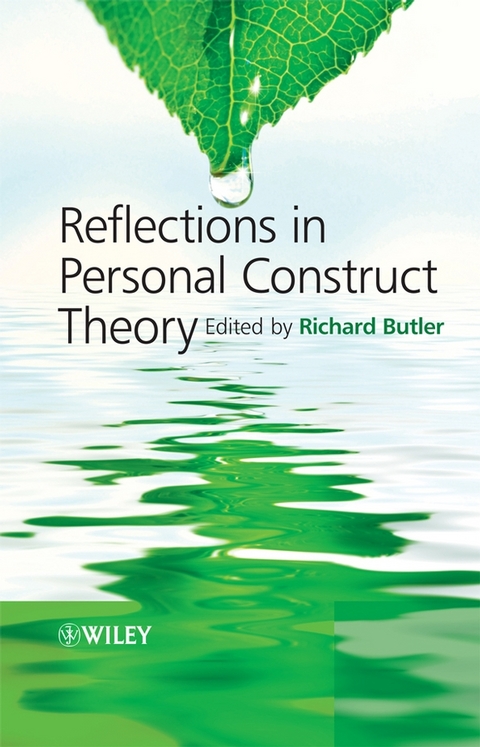
- Reflexivity is a key methodological issue in psychological theory and practice, and is an area of growing interest
- International contributors include prominent constructivist psychologists such as Richard Bell and David Winter
- Will help constructivist therapists to gain a better understanding of the nature of personal constructs from the perspective of both client and therapist
Dr. Richard J. Butler is a Consultant Clinical Psychologist formerly with Leeds Primary care Trust in the UK. He is an Associate Fellow of the British Psychological Society and has published extensively in the areas of both clinical psychology and sport psychology.
Internationally-renowned practitioners discuss the impact of reflexivity on their work, giving those new to personal construct psychology valuable insights and guidance on managing the therapeutic relationship. Reflexivity is a key methodological issue in psychological theory and practice, and is an area of growing interest International contributors include prominent constructivist psychologists such as Richard Bell and David Winter Will help constructivist therapists to gain a better understanding of the nature of personal constructs from the perspective of both client and therapist
Dr. Richard J. Butler is a Consultant Clinical Psychologist formerly with Leeds Primary care Trust in the UK. He is an Associate Fellow of the British Psychological Society and has published extensively in the areas of both clinical psychology and sport psychology.
List of contributors.
Preface.
Acknowledgements.
Section I Exploring Personal Construct Theory.
Chapter 1 Coming to terms with personal construct theory
(Richard Butler).
Chapter 2 The construct (Harry Procter).
Section II The Men behind the Theory.
Chapter 3 The George Kelly I knew (Jay S. Efran).
Chapter 4 Don Bannister through the looking glass (Fay
Fransella).
Section III Construct Theory as a Meaningful
Alternative.
Chapter 5 Individuality, community and criminal behaviour
(James Horley).
Chapter 6 Shaking hands with a serial killer (David A.
Winter).
Chapter 7 Encounters of the puzzling kind: the organisational
corollary in relation to self-construing (Richard
Butler).
Chapter 8 Sauce for the gander (Sally Robbins).
Chapter 9 Griddled with angst: a roller-coaster ride on the
repertory grid (Richard Bell).
Section IV Construct Theory as an Elaborative Choice.
Chapter 10 Living aggressively (Jonathan D. Raskin).
Chapter 11 The guilty choice: reflections on dislodgement,
extension and definition (Peter Cummins).
Chapter 12 Different readings of personal construct theory
(Trevor Butt).
Chapter 13 The teacher, the singer and the personal construct
theorist: an unlikely but fruitful dialogue (Vivien
Burr).
Chapter 14 Refl exivity: what in the 'GAK' is that? (Desley
Hennessy).
Section V No One Need be a Victim of Their Biography.
Chapter 15 Differentiating the I from the ME
(Jerald R. Forster).
Chapter 16 Mirror man (David Green).
Chapter 17 Landmarks on a personal odyssey (Finn
Tschudi).
Chapter 18 Reconstruing after a change in health status
(örn Scheer).
Chapter 19 Constructions of death and loss: a personal and
professional evolution (Robert A. Neimeyer).
Chapter 20 Reflections on the creation of a dissertation
(Dennis Hinkle).
Section VI The Client as an Active Participant.
Chapter 21 Enculturing reflexivity across cultures: non-PC
lessons from study abroad (Naoimh O'Connor).
Chapter 22 The icing on the sausage: The emancipation of
constructive alternativism (Dina Pekkala).
Chapter 23 Theory, therapy and life: experiential personal
construct psychology and the 'desert places' of a therapist
(Larry M. Leitner).
Chapter 24 Reflexivity, research and practice: explorations in
experiential personal construct psychology (Alexandra L. Adame,
Anthony J. Pavlo, Brendon M. Smith, Hugo J. Schielke & Larry M.
Leitner).
Chapter 25 The joint experiment of research supervision
(Beverly M. Walker).
Section VII And Finally . . . Reflections on
Reflexivity.
Chapter 26 Critical consciousness in action: reflections on
reflection in, from and beyond personal construct psychology
(Bill Warren).
Index.
| Erscheint lt. Verlag | 18.3.2009 |
|---|---|
| Sprache | englisch |
| Themenwelt | Geisteswissenschaften ► Psychologie ► Allgemeine Psychologie |
| Geisteswissenschaften ► Psychologie ► Klinische Psychologie | |
| Schlagworte | Aspects • Chapters • Clinical psychology • Concept • Different • Explores • Impact • important • internationally • Klinische Psychologie • Personal • personal construct theory • Perspectives • Practices • Practitioners • Psychologie • Psychology • Reflections • reflexivity • series • Several • thoughtprovoking • various • Work |
| ISBN-13 | 9780470743584 / 9780470743584 |
| Informationen gemäß Produktsicherheitsverordnung (GPSR) | |
| Haben Sie eine Frage zum Produkt? |
 PDF (Adobe DRM)
Kopierschutz: Adobe-DRM
Adobe-DRM ist ein Kopierschutz, der das eBook vor Mißbrauch schützen soll. Dabei wird das eBook bereits beim Download auf Ihre persönliche Adobe-ID autorisiert. Lesen können Sie das eBook dann nur auf den Geräten, welche ebenfalls auf Ihre Adobe-ID registriert sind.
Details zum Adobe-DRM
Dateiformat: PDF (Portable Document Format)
Mit einem festen Seitenlayout eignet sich die PDF besonders für Fachbücher mit Spalten, Tabellen und Abbildungen. Eine PDF kann auf fast allen Geräten angezeigt werden, ist aber für kleine Displays (Smartphone, eReader) nur eingeschränkt geeignet.
Systemvoraussetzungen:
PC/Mac: Mit einem PC oder Mac können Sie dieses eBook lesen. Sie benötigen eine
eReader: Dieses eBook kann mit (fast) allen eBook-Readern gelesen werden. Mit dem amazon-Kindle ist es aber nicht kompatibel.
Smartphone/Tablet: Egal ob Apple oder Android, dieses eBook können Sie lesen. Sie benötigen eine
Geräteliste und zusätzliche Hinweise
Buying eBooks from abroad
For tax law reasons we can sell eBooks just within Germany and Switzerland. Regrettably we cannot fulfill eBook-orders from other countries.
aus dem Bereich