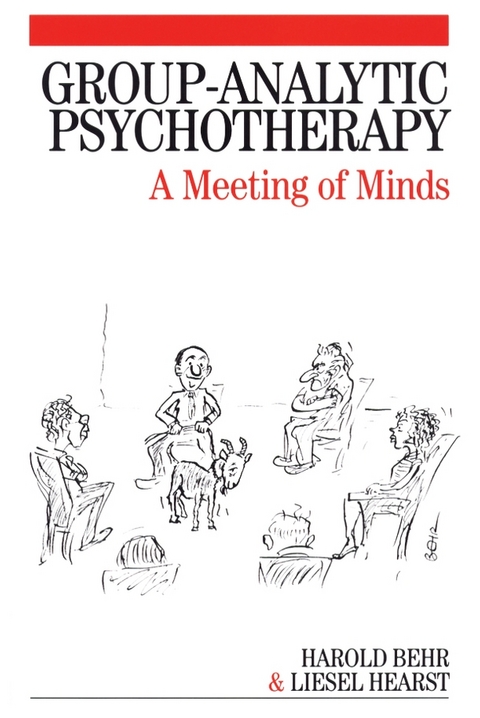
Group-Analytic Psychotherapy (eBook)
John Wiley & Sons (Verlag)
978-0-470-71369-3 (ISBN)

A chapter on psychopathology gives a picture of the main psychiatric conditions which the group therapist is likely to encounter, and offers clear guidelines on how to manage them in a group context. An exposition on the group in full flow provides an unusual insight into the processes which constitute the analytic culture, including the analysis of dreams, the art of interpreting, use of the transference and countertransference, and the place of play, humour and metaphor.
Difficult and challenging scenarios, such as dropping out, scapegoating, the silent group member, and monopolisation of the group are treated in depth, as are Large Groups, homogeneous groups, groups for children and adolescents, family therapy, groups in non-clinical settings, and the supervision of group therapy. The impingement of the therapist' s own personal issues is also given attention.
The authors have flanked their narrative with accounts of the historical, social and cultural origins of group analysis, and a vision of the future provided by the newer strands of thinking in the field. The text is enlivened by colourful vignettes drawn from the authors' own experiences, and by sharply focused dialogues between the two authors, designed to illustrate their contrasting and complementary perspectives.
The book represents a distillation of the authors' long experience in the field of group analytic practice and training in the United Kingdom and internationally.
Harold Behr is the author of Group-Analytic Psychotherapy: A Meeting of Minds, published by Wiley.
Liesel Hearst is the author of Group-Analytic Psychotherapy: A Meeting of Minds, published by Wiley.
This book offers practitioners, teachers and students of psychotherapy a detailed and comprehensive account of group analysis. It demystifies the workings of analytic groups and looks at the great stretch of issues and tasks confronting the therapist in the practice of group analytic psychotherapy. Each stage in the process is fully discussed: the assessment and preparation of patients for groups, dynamic administration, beginning and ending a group, and the introduction of new members into an established group. A chapter on psychopathology gives a picture of the main psychiatric conditions which the group therapist is likely to encounter, and offers clear guidelines on how to manage them in a group context. An exposition on the group in full flow provides an unusual insight into the processes which constitute the analytic culture, including the analysis of dreams, the art of interpreting, use of the transference and countertransference, and the place of play, humour and metaphor. Difficult and challenging scenarios, such as dropping out, scapegoating, the silent group member, and monopolisation of the group are treated in depth, as are Large Groups, homogeneous groups, groups for children and adolescents, family therapy, groups in non-clinical settings, and the supervision of group therapy. The impingement of the therapist' s own personal issues is also given attention. The authors have flanked their narrative with accounts of the historical, social and cultural origins of group analysis, and a vision of the future provided by the newer strands of thinking in the field. The text is enlivened by colourful vignettes drawn from the authors' own experiences, and by sharply focused dialogues between the two authors, designed to illustrate their contrasting and complementary perspectives. The book represents a distillation of the authors' long experience in the field of group analytic practice and training in the United Kingdom and internationally.
Harold Behr is the author of Group-Analytic Psychotherapy: A Meeting of Minds, published by Wiley. Liesel Hearst is the author of Group-Analytic Psychotherapy: A Meeting of Minds, published by Wiley.
Foreword vii
Acknowledgements ix
Introduction x
The Authors xv
Chapter 1 The Social And Cultural Basis Of Group Analysis 1
Chapter 2 A Century Of Group Therapy 12
Chapter 3 Planning An Analytic Group 28
Chapter 4 Dynamic Administration 42
Chapter 5 The Assessment Interview 55
Chapter 6 The Symptom In Its Group Context 66
Chapter 7 The Start Of A New Group 81
Chapter 8 A Newcomer To The Group 92
Chapter 9 The Group In Action 102
Chapter 10 Life Events In The Group 121
Chapter 11 Bringing Therapy To An End 133
Chapter 12 Therapeutic Pitfalls 144
Chapter 13 Challenging Scenarios 150
Chapter 14 The Group Analyst In Trouble 164
Chapter 15 The Large Group 175
Chapter 16 All In The Same Boat: The Value Of Homogeneous Groups 189
Chapter 17 Groups For Children And Adolescents 203
Chapter 18 Family Therapy: A Group-Analytic Perspective 220
Chapter 19 The Application Of Group Analysis To Non-Clinical Settings 231
Chapter 20 The Supervision Of Group Therapy 237
Chapter 21 The Group Analyst As A Professional 247
Chapter 22 The Changing Landscape Of Group Analysis 255
Glossary 269
Bibliography 271
Index 295
" ...I expect it will become a key reference text in group
therapy and I heartily recommend it to trainees and experienced
therapists alike..." (British Journal of Psychiatry, May
2006)
"I recommend this book wholeheartedly to students-to-be and
experts alike. Buy it, borrow it, read it... a user-friendly
book in the sense of jargon-free language, a rich vocabulary and
felicity of expression.." (Group analysis: The Journal of Group
Analytic Psychotherapy, May 2006)
"This is the best book I have read to date in the field of group
analysis." (Israel Journal of Group Psychotherapy, May
2006)
"...thorough and detailed...providing a good overview it is well
written... entertaining..." (Journal of the Norwegian
Psychological Association, June 2006)
| Erscheint lt. Verlag | 15.9.2008 |
|---|---|
| Sprache | englisch |
| Themenwelt | Geisteswissenschaften ► Psychologie |
| Medizin / Pharmazie ► Gesundheitsfachberufe | |
| Medizin / Pharmazie ► Medizinische Fachgebiete ► Psychiatrie / Psychotherapie | |
| Schlagworte | Account • Analytic • established group • Fully • Great • Group • Group Analysis • groups • Introduction • Issues • Main • New • patients • Preparation • Process • Psychiatric • Psychologie • Psychology • psychopathology • Psychotherapie u. Beratung • Psychotherapy & Counseling • stage • Stretch • Tasks • Teachers • Therapist • workings |
| ISBN-10 | 0-470-71369-0 / 0470713690 |
| ISBN-13 | 978-0-470-71369-3 / 9780470713693 |
| Informationen gemäß Produktsicherheitsverordnung (GPSR) | |
| Haben Sie eine Frage zum Produkt? |
 PDF (Adobe DRM)
Kopierschutz: Adobe-DRM
Adobe-DRM ist ein Kopierschutz, der das eBook vor Mißbrauch schützen soll. Dabei wird das eBook bereits beim Download auf Ihre persönliche Adobe-ID autorisiert. Lesen können Sie das eBook dann nur auf den Geräten, welche ebenfalls auf Ihre Adobe-ID registriert sind.
Details zum Adobe-DRM
Dateiformat: PDF (Portable Document Format)
Mit einem festen Seitenlayout eignet sich die PDF besonders für Fachbücher mit Spalten, Tabellen und Abbildungen. Eine PDF kann auf fast allen Geräten angezeigt werden, ist aber für kleine Displays (Smartphone, eReader) nur eingeschränkt geeignet.
Systemvoraussetzungen:
PC/Mac: Mit einem PC oder Mac können Sie dieses eBook lesen. Sie benötigen eine
eReader: Dieses eBook kann mit (fast) allen eBook-Readern gelesen werden. Mit dem amazon-Kindle ist es aber nicht kompatibel.
Smartphone/Tablet: Egal ob Apple oder Android, dieses eBook können Sie lesen. Sie benötigen eine
Geräteliste und zusätzliche Hinweise
Buying eBooks from abroad
For tax law reasons we can sell eBooks just within Germany and Switzerland. Regrettably we cannot fulfill eBook-orders from other countries.
aus dem Bereich