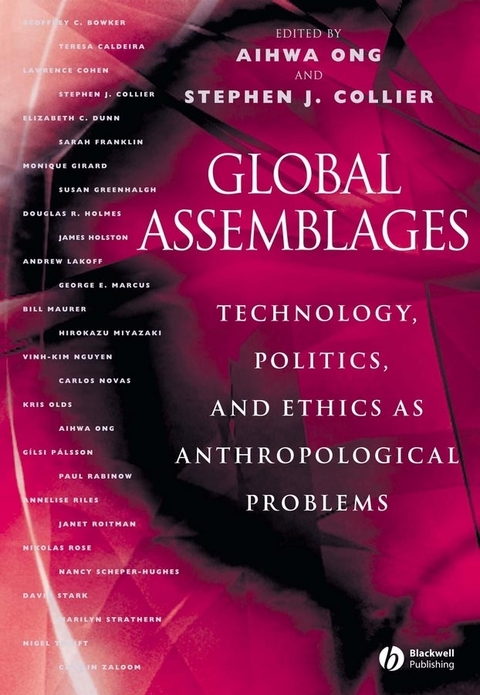
Global Assemblages (eBook)
John Wiley & Sons (Verlag)
978-0-470-69581-4 (ISBN)
- Offers a ground-breaking approach to central debates about globalization with chapters written by leading scholars from across the social sciences.
- Examines a range of phenomena that articulate broad structural transformations: technoscience, circuits of exchange, systems of governance, and regimes of ethics or values.
- Investigates these phenomena from the perspective of the 'anthropological' problems they pose.
- Covers a broad range of geographical areas: Africa, the Middle East, East and South Asia, North America, South America, and Europe.
- Grapples with a number of empirical problems of popular and academic interest - from the organ trade, to accountancy, to pharmaceutical research, to neoliberal reform.
Aihwa Ong is Professor of Anthropology and Southeast Asian Studies at the University of California, Berkeley.
Stephen J. Collier is a faculty member at the Graduate Program in International Affairs, The New School University.
Provides an exciting approach to some of the most contentious issues in discussions around globalization bioscientific research, neoliberalism, governance from the perspective of the "e;anthropological"e; problems they pose; in other words, in terms of their implications for how individual and collective life is subject to technological, political, and ethical reflection and intervention. Offers a ground-breaking approach to central debates about globalization with chapters written by leading scholars from across the social sciences. Examines a range of phenomena that articulate broad structural transformations: technoscience, circuits of exchange, systems of governance, and regimes of ethics or values. Investigates these phenomena from the perspective of the anthropological problems they pose. Covers a broad range of geographical areas: Africa, the Middle East, East and South Asia, North America, South America, and Europe. Grapples with a number of empirical problems of popular and academic interest from the organ trade, to accountancy, to pharmaceutical research, to neoliberal reform.
Aihwa Ong is Professor of Anthropology and Southeast Asian Studies at the University of California, Berkeley. Stephen J. Collier is a faculty member at the Graduate Program in International Affairs, The New School University.
Notes on Contributors viii
Acknowledgments xiii
Part I Introduction 1
1 Global Assemblages, Anthropological Problems 3
Stephen J. Collier and Aihwa Ong
2 On Regimes of Living 22
Stephen J. Collier and Andrew Lakoff
3 Midst Anthropology's Problems 40
Paul Rabinow
Part II Bioscience and Biological Life 55
Ethics of Technoscientific Objects 57
4 Stem Cells R Us: Emergent Life Forms and the Global Biological 59
Sarah Franklin
5 Operability, Bioavailability, and Exception 79
Lawrence Cohen
6 The Iceland Controversy: Reflections on the Transnational Market of Civic Virtue 91
Gísli Pálsson and Paul Rabinow
Value and Values 105
7 Time, Money, and Biodiversity 107
Geoffrey C. Bowker
8 Antiretroviral Globalism, Biopolitics, and Therapeutic Citizenship 124
Vinh-kim Nguyen
9 The Last Commodity: Post-Human Ethics and the Global Traffic in ''Fresh'' Organs 145
Nancy Scheper-Hughes
Part III Social Technologies and Disciplines 169
Standards 171
10 Standards and Person-Making in East Central Europe 173
Elizabeth C. Dunn
11 The Private Life of Numbers: Pharmaceutical Marketing in Post-Welfare Argentina 194
Andrew Lakoff
12 Implementing Empirical Knowledge in Anthropology and Islamic Accountancy 214
Bill Maurer
Practices of Calculating Selves 233
13 Cultures of Expertise and the Management of Globalization: Toward the Re-Functioning of Ethnography 235
Douglas R. Holmes and George E. Marcus
14 The Discipline of Speculators 253
Caitlin Zaloom
15 Cultures on the Brink: Reengineering the Soul of Capitalism - On a Global Scale 270
Kris Olds and Nigel Thrift
Managing Uncertainty 291
16 Heterarchies of Value: Distributing Intelligence and Organizing Diversity in a New Media Startup 293
Monique Girard and David Stark
17 Failure as an Endpoint 320
Hirokazu Miyazaki and Annelise Riles
Part IV Governmentality and Politics 333
Governing Populations 335
18 Ecologies of Expertise: Assembling Flows, Managing Citizenship 337
Aihwa Ong
19 Globalization and Population Governance in China 354
Susan Greenhalgh
20 Budgets and Biopolitics 373
Stephen J. Collier
Security, Legitimacy, Justice 391
21 State and Urban Space in Brazil: From Modernist Planning to Democratic Interventions 393
Teresa Caldeira and James Holston
22 The Garrison-Entrepôt: A Mode of Governing in the Chad Basin 417
Janet Roitman
Citizenship and Ethics 437
23 Biological Citizenship 439
Nikolas Rose and Carlos Novas
24 Robust Knowledge and Fragile Futures 464
Marilyn Strathern
Index 482
"This compelling book demonstrates how a very sophisticated
anthropological perspective can transform
'globalization' into a useful tool for investigating
emerging social forms and ways of ruling and living. Certainly this
non-structural approach is needed--one that attends to the
specificity of combinations, interactions, sites, and effects
associated with the spread of technology and risk."
Ulrich Beck, Ludwig-Maximilians-Universität
München
"Global Assemblages provides excellent and rich
insight into a developing anthropology of the contemporary world.
The intertwining of violence, capital flows, political
fragmentation, and regimes of social and moral control are
investigated here in what must be recognized as a major
contribution to anthropological scholarship."
Jonathan Friedman, L' École des Hautes Études
en Sciences Sociales, Paris and Lund University,
Sweden
"This volume will give assemblages of many types a good
name--the authors are astute, varied, and at the top of their
game; the geographies do justice to the notion of global; and the
book has a core intellectual inquiry about reflexive practices that
holds together its wide-ranging essays. From transplanted kidneys
to research audit protocols, the uneasy interrelationships of
global assemblages emerge in the fleshy details of a knotted
world."
Donna Haraway, University of California, Santa Cruz
| Erscheint lt. Verlag | 30.4.2008 |
|---|---|
| Sprache | englisch |
| Themenwelt | Geisteswissenschaften ► Archäologie |
| Geschichte ► Allgemeine Geschichte ► Vor- und Frühgeschichte | |
| Sozialwissenschaften ► Ethnologie | |
| Sozialwissenschaften ► Soziologie | |
| Technik | |
| Schlagworte | administrative • Anthropologie • Anthropology • Articulate • assemblages • broad • contemporary transformations • Cultural Studies • Current • debates • epoch • Global • Globalization • Kulturwissenschaften • Marker • New • Perspective • Social & Cultural Anthropology • Soziale u. kulturelle Anthropologie • structural transformation • Study • Unique • volume examines specific |
| ISBN-10 | 0-470-69581-1 / 0470695811 |
| ISBN-13 | 978-0-470-69581-4 / 9780470695814 |
| Informationen gemäß Produktsicherheitsverordnung (GPSR) | |
| Haben Sie eine Frage zum Produkt? |
 PDF (Adobe DRM)
Kopierschutz: Adobe-DRM
Adobe-DRM ist ein Kopierschutz, der das eBook vor Mißbrauch schützen soll. Dabei wird das eBook bereits beim Download auf Ihre persönliche Adobe-ID autorisiert. Lesen können Sie das eBook dann nur auf den Geräten, welche ebenfalls auf Ihre Adobe-ID registriert sind.
Details zum Adobe-DRM
Dateiformat: PDF (Portable Document Format)
Mit einem festen Seitenlayout eignet sich die PDF besonders für Fachbücher mit Spalten, Tabellen und Abbildungen. Eine PDF kann auf fast allen Geräten angezeigt werden, ist aber für kleine Displays (Smartphone, eReader) nur eingeschränkt geeignet.
Systemvoraussetzungen:
PC/Mac: Mit einem PC oder Mac können Sie dieses eBook lesen. Sie benötigen eine
eReader: Dieses eBook kann mit (fast) allen eBook-Readern gelesen werden. Mit dem amazon-Kindle ist es aber nicht kompatibel.
Smartphone/Tablet: Egal ob Apple oder Android, dieses eBook können Sie lesen. Sie benötigen eine
Geräteliste und zusätzliche Hinweise
Buying eBooks from abroad
For tax law reasons we can sell eBooks just within Germany and Switzerland. Regrettably we cannot fulfill eBook-orders from other countries.
aus dem Bereich