


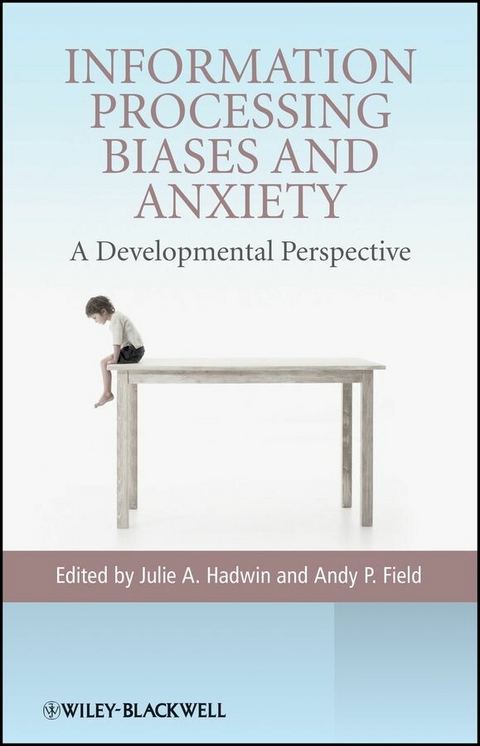
- The first book to provide readers with an understanding of anxiety and the role of information processing biases more broadly in the context of developmental psychopathology
- Demonstrates how researchers have explored diverse aspects of information processing in anxious children and adolescents
- Draws on the microparadigms used in the study of development and psychopathology to consider issues related to heritability, temperament, learning and parenting
- Considers preventative methods and treatment protocols
Julie A. Hadwin is Senior Lecturer in Psychology at the University of Southampton. She has used cognitive models to study emotional disorders in childhood and has written several seminal papers to understand attention to threat in childhood anxiety. Her publications include Teaching Children with Autism to Mind-Read (with Patricia Howlin and Simon Baron-Cohen, Wiley, 1999).
Andy Field is Reader in Experimental Psychopathology at the University of Sussex. He has published over 50 research papers, mostly on child anxiety and human conditioning, and has written/edited 10 books including the award-winning textbook Discovering Statistics using SPSS (3rd Edition, 2009). He has received teaching awards from the University of Sussex and the British Psychological Society.
With contributions from a global team of experts this book provides a comprehensive overview of information processing biases in children and adolescents. The first book to provide readers with an understanding of anxiety and the role of information processing biases more broadly in the context of developmental psychopathology Demonstrates how researchers have explored diverse aspects of information processing in anxious children and adolescents Draws on the microparadigms used in the study of development and psychopathology to consider issues related to heritability, temperament, learning and parenting Considers preventative methods and treatment protocols
Julie A. Hadwin is Senior Lecturer in Psychology at the University of Southampton. She has used cognitive models to study emotional disorders in childhood and has written several seminal papers to understand attention to threat in childhood anxiety. Her publications include Teaching Children with Autism to Mind-Read (with Patricia Howlin and Simon Baron-Cohen, Wiley, 1999). Andy Field is Reader in Experimental Psychopathology at the University of Sussex. He has published over 50 research papers, mostly on child anxiety and human conditioning, and has written/edited 10 books including the award-winning textbook Discovering Statistics using SPSS (3rd Edition, 2009). He has received teaching awards from the University of Sussex and the British Psychological Society.
List of Contributors.
Preface.
1. An Introduction to the Study of Information Processing Biases
in Childhood Anxiety: Theoretical and Methodological
Issues (Julie A. Hadwin and Andy P. Field).
Theoretical and Research Issues.
2. Anxiety-Related Reasoning Biases in Children and Adolescents
(Peter Muris).
3. The Emotional Stroop Task in Anxious Children (Zoë C.
Nightingale, Andy P. Field and Merel Kindt).
4. Selective Attention to Threat in Childhood Anxiety: Evidence
from Visual Probe Paradigms (Matthew Garner).
5. The Use of Visual Search Paradigms to Understand Attentional
Biases in Childhood Anxiety (Nick Donnelly, Julie A. Hadwin,
Tamaryn Menneer and Helen J. Richards).
6. Using Eye Tracking Methodology in Children with Anxiety
Disorders (Tina In-Albon and Silvia Schneider).
7. The Assessment of Fear-Related Automatic Associations in
Children and Adolescents (Jorg Huijding, Reinout W. Wiers and
Andy P. Field).
8. Application of Cognitive Neuroscience Techniques to the Study
of Anxiety-Related Processing Biases in Children (Koraly
Pérez-Edgar and Yair Bar-Haim).
The Origin and Treatment of Information Processing Biases in
Child Anxiety.
9. Genetics (Thalia C. Eley and Helena M.S. Zavos)
10. Temperamental Factors Associated with the Acquisition of
Information Processing Biases and Anxiety (Lauren K. White,
Sarah M. Helfinstein and Nathan A. Fox).
11. Learning of Information Processing Biases in Anxious
Children and Adolescents (Andy P. Field and Kathryn J.
Lester).
12. Intergenerational Transmission of Anxious Information
Processing Biases (Cathy Creswell, Peter Cooper and Lynne
Murray).
13. Attentional Biases in Children: Implications for Treatment
(Maria J.W. Cowart and Thomas H. Ollendick)
Index.
| Erscheint lt. Verlag | 19.2.2010 |
|---|---|
| Sprache | englisch |
| Themenwelt | Geisteswissenschaften ► Psychologie ► Entwicklungspsychologie |
| Geisteswissenschaften ► Psychologie ► Klinische Psychologie | |
| Schlagworte | Anxiety • appears • Aspects • biases • Book • Child & Adolescent Clinical Psychology • Childhood • Comprehensive • Course • Developmental • Different • Diverse • Emotion • Highlights • Information • Information Processing • Klinische Psychologie / Kinder u. Jugendliche • Origins • Overview • Psychologie • Psychology • relevant • Research • Researchers • theory • typical |
| ISBN-13 | 9780470661451 / 9780470661451 |
| Informationen gemäß Produktsicherheitsverordnung (GPSR) | |
| Haben Sie eine Frage zum Produkt? |
 PDF (Adobe DRM)
Kopierschutz: Adobe-DRM
Adobe-DRM ist ein Kopierschutz, der das eBook vor Mißbrauch schützen soll. Dabei wird das eBook bereits beim Download auf Ihre persönliche Adobe-ID autorisiert. Lesen können Sie das eBook dann nur auf den Geräten, welche ebenfalls auf Ihre Adobe-ID registriert sind.
Details zum Adobe-DRM
Dateiformat: PDF (Portable Document Format)
Mit einem festen Seitenlayout eignet sich die PDF besonders für Fachbücher mit Spalten, Tabellen und Abbildungen. Eine PDF kann auf fast allen Geräten angezeigt werden, ist aber für kleine Displays (Smartphone, eReader) nur eingeschränkt geeignet.
Systemvoraussetzungen:
PC/Mac: Mit einem PC oder Mac können Sie dieses eBook lesen. Sie benötigen eine
eReader: Dieses eBook kann mit (fast) allen eBook-Readern gelesen werden. Mit dem amazon-Kindle ist es aber nicht kompatibel.
Smartphone/Tablet: Egal ob Apple oder Android, dieses eBook können Sie lesen. Sie benötigen eine
Geräteliste und zusätzliche Hinweise
Buying eBooks from abroad
For tax law reasons we can sell eBooks just within Germany and Switzerland. Regrettably we cannot fulfill eBook-orders from other countries.
aus dem Bereich


