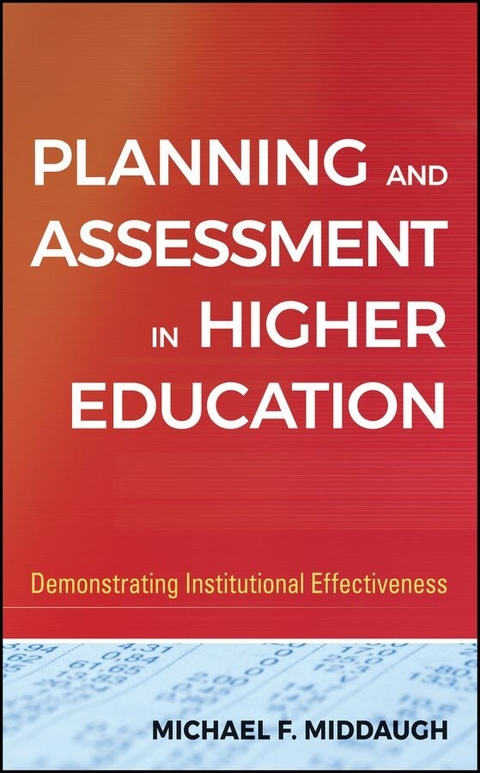
Planning and Assessment in Higher Education (eBook)
256 Seiten
John Wiley & Sons (Verlag)
978-0-470-60544-8 (ISBN)
Demonstrating Institutional Effectiveness
In this era of increasing pressure on higher education institutions for accountability, Planning and Assessment in Higher Education is an essential resource for college and university leaders and staff charged with the task of providing evidence of institutional effectiveness. Michael F. Middaugh, a noted expert in the field, shows how colleges and universities can successfully measure student learning and institutional effectiveness and use these results to create more efficient communications with both internal and external constituencies as well as promote institutional effectiveness to support student learning.
"How can the assessment of institutional effectiveness be used to provide a solid foundation for planning? Middaugh has crafted a comprehensive, practical guide that also explains what accrediting agencies really want and need to know about these topics."
--Elizabeth H. Sibolski, executive vice president, Middle States Commission on Higher Education
"Only Michael Middaugh, the unquestioned national leader in this field, could write such a lucid overview of how to make institutional assessment and planning really work as a tool rather than as a tedious requirement. He helped invent and shape the focus of national assessment rubrics and now offers his insights into how to make them work for your institution."
--John C. Cavanaugh, chancellor, Pennsylvania State System of Higher Education
"Middaugh provides extremely helpful and practical guidance and insights on how colleges and universities can use assessment tools and frameworks to improve both academic programs and administrative operations. A valuable and timely book for all higher education leaders."
--James P. Honan, senior lecturer on education, Harvard Graduate School of Education
Michael F. Middaugh is associate provost for institutional effectiveness at the University of Delaware, and commissioner and vice chair of the Middle States Commission on Higher Education. He is a past president of the Association for Institutional Research and the Society for College and University Planning and the author of Understanding Faculty Productivity from Jossey-Bass.
Preface ix
About the Author xiii
1. The National Context for Assessment 1
2. Starting at the Beginning: Mission-Driven Planning and Assessment 23
3. Assessing Institutional Effectiveness: Student Issues 47
4. A Core Issue in Institutional Effectiveness: Developing Sensible Measures of Student Learning 89
5. Maximizing Human and Fiscal Resources in Support of the Teaching/Learning Process 109
6. A Comparative Context for Examining Data on Teaching Loads and Instructional Costs 133
7. Measuring Administrative Effectiveness 157
8. Communicating Assessment Results 173
9. Where Do We Go From Here? 193
Appendix A: University of Delaware College Selection Survey 207
Appendix B: University of Delaware 2007 Study of Instruction Costs and Productivity, By Academic Discipline 215
References 227
Web-Based References 231
Resources for Further Reading 233
Index 235
"The primary purpose of the book is to provide a tool box that will
assist in the effective and efficient management of institutions of
higher learning. Toward that end, [Middaugh] proposes a variety of
methods and strategies for assessing institutional effectiveness
and discusses the interpretation, communication, and use of data
gained from assessment processes.
Middaugh highlights the usefulness of assessment as a management
tool. He tackles the better known and understood areas of
assessment such as student engagement and learning and
instructional costs and productivity, and he also highlights
methods and strategies in administrative areas where assessment is
more difficult.
Middaugh?s books and articles are notable for readability and
for the thoroughness of his approach. He begins by offering a
historical perspective that explains the national context for
assessment and planning in higher education. Moving beyond the
conceptual/theoretical, Middaugh makes a strong case for systematic
and sustainable assessment directly tied to mission-based planning.
In this volume he offers practical advice about what should be
done, why it should be done, and how best to go about doing it." ?
Planning for Higher Education; reviewer: Elizabeth Sibolski,
interim president of the Middle States Commission on Higher
Education
"Planning and Assessment in Higher Education is a
guidebook that should be on the shelf in offices of planning and
institutional research, as well as in offices charged with
responsibility for institutional assessment. In addition, the book
can serve a wider purpose as an introduction and orientation or as
a review of interconnected mission-based planning and assessment.
In this context, I recommend it to senior-level administrators who
might find it particularly useful in developing specific
institutional approaches to management, to department heads and
deans who stand at the front lines of institutional operations and
who must plan and evaluate programs and services, and to new
college and university trustees who might find it helpful as a
frame of reference for institutional oversight responsibilities." ?
Planning for Higher Education; reviewer: Elizabeth Sibolski,
interim president of the Middle States Commission on Higher
Education
| Erscheint lt. Verlag | 3.11.2009 |
|---|---|
| Sprache | englisch |
| Themenwelt | Geisteswissenschaften |
| Sozialwissenschaften ► Pädagogik ► Bildungstheorie | |
| Sozialwissenschaften ► Pädagogik ► Erwachsenenbildung | |
| Schlagworte | Assessment, Evaluation & Research (Higher Education) • Bildungswesen • Education • Hochschulen / Qualitätskontrolle, Evaluierung • Hochschulen / Qualitätskontrolle, Evaluierung |
| ISBN-10 | 0-470-60544-8 / 0470605448 |
| ISBN-13 | 978-0-470-60544-8 / 9780470605448 |
| Informationen gemäß Produktsicherheitsverordnung (GPSR) | |
| Haben Sie eine Frage zum Produkt? |
 PDF (Adobe DRM)
Kopierschutz: Adobe-DRM
Adobe-DRM ist ein Kopierschutz, der das eBook vor Mißbrauch schützen soll. Dabei wird das eBook bereits beim Download auf Ihre persönliche Adobe-ID autorisiert. Lesen können Sie das eBook dann nur auf den Geräten, welche ebenfalls auf Ihre Adobe-ID registriert sind.
Details zum Adobe-DRM
Dateiformat: PDF (Portable Document Format)
Mit einem festen Seitenlayout eignet sich die PDF besonders für Fachbücher mit Spalten, Tabellen und Abbildungen. Eine PDF kann auf fast allen Geräten angezeigt werden, ist aber für kleine Displays (Smartphone, eReader) nur eingeschränkt geeignet.
Systemvoraussetzungen:
PC/Mac: Mit einem PC oder Mac können Sie dieses eBook lesen. Sie benötigen eine
eReader: Dieses eBook kann mit (fast) allen eBook-Readern gelesen werden. Mit dem amazon-Kindle ist es aber nicht kompatibel.
Smartphone/Tablet: Egal ob Apple oder Android, dieses eBook können Sie lesen. Sie benötigen eine
Geräteliste und zusätzliche Hinweise
Buying eBooks from abroad
For tax law reasons we can sell eBooks just within Germany and Switzerland. Regrettably we cannot fulfill eBook-orders from other countries.
aus dem Bereich