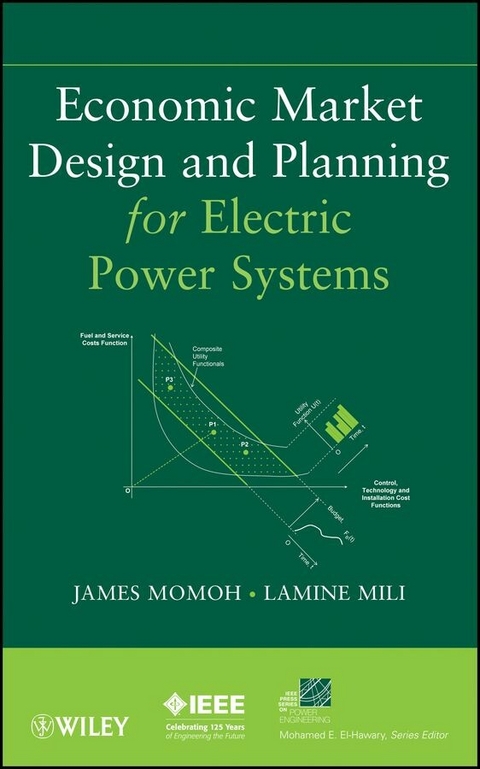
Economic Market Design and Planning for Electric Power Systems (eBook)
John Wiley & Sons (Verlag)
978-0-470-52915-7 (ISBN)
Stemming from cutting-edge research and education activities in the field of electric power systems, this book brings together the knowledge of a panel of experts in economics, the social sciences, and electric power systems. In ten concise and comprehensible chapters, the book provides unprecedented coverage of the operation, control, planning, and design of electric power systems. It also discusses:
-
A framework for interdisciplinary research and education
-
Modeling electricity markets
-
Alternative economic criteria and proactive planning for transmission investment in deregulated power systems
-
Payment cost minimization with demand bids and partial capacity cost compensations for day-ahead electricity auctions
-
Dynamic oligopolistic competition in an electric power network and impacts of infrastructure disruptions
-
Reliability in monopolies and duopolies
-
Building an efficient, reliable, and sustainable power system
-
Risk-based power system planning integrating social and economic direct and indirect costs
-
Models for transmission expansion planning based on reconfiguration capacitor switching
-
Next-generation optimization for electric power systems
Most chapters end with a bibliography, closing remarks, conclusions, or future work. Economic Market Design and Planning for Electric Power Systems is an indispensable reference for policy-makers, executives and engineers of electric utilities, university faculty members, and graduate students and researchers in control theory, electric power systems, economics, and the social sciences.
James Momoh was chair of the Electrical Engineering Department at Howard University and director of the Center for Energy Systems and Control. In 1987, Momoh received a National Science Foundation (NSF) Presidential Young Investigator Award. He is a Fellow of the IEEE, a Distinguished Fellow of the Nigerian Society of Engineers (NSE), and a Fellow of the Nigerian Academy of Engineering (NAE). His current research activities for utility firms and government agencies span several areas in systems engineering, optimization, and energy systems' control of terrestrial, space, and naval complex and dynamic networks. He has authored more than 225 technical papers in refereed journals, transactions, or proceedings, as well as several textbooks.
LAMINE MILI is Professor of Electrical and Computer Engineering at Virginia Tech. An IEEE Senior Member, Dr. Mili is also a member of the Institute of Mathematical Statistics and the American Statistical Association. He is a recipient of a 1990 NSF Research Initiation Award and a 1992 NSF Young Investigator Award. His research interests include risk assessment and management of critical infrastructures, cascading failure modeling, power system planning, power system analysis and control, electric load forecasting, bifurcation theory and chaos, nonlinear optimization, and robust statistics as applied to engineering problems. Dr. Mili is the cofounder and coeditor of the International Journal of Critical Infrastructures.
Discover cutting-edge developments in electric power systems Stemming from cutting-edge research and education activities in the field of electric power systems, this book brings together the knowledge of a panel of experts in economics, the social sciences, and electric power systems. In ten concise and comprehensible chapters, the book provides unprecedented coverage of the operation, control, planning, and design of electric power systems. It also discusses: A framework for interdisciplinary research and education Modeling electricity markets Alternative economic criteria and proactive planning for transmission investment in deregulated power systems Payment cost minimization with demand bids and partial capacity cost compensations for day-ahead electricity auctions Dynamic oligopolistic competition in an electric power network and impacts of infrastructure disruptions Reliability in monopolies and duopolies Building an efficient, reliable, and sustainable power system Risk-based power system planning integrating social and economic direct and indirect costs Models for transmission expansion planning based on reconfiguration capacitor switching Next-generation optimization for electric power systems Most chapters end with a bibliography, closing remarks, conclusions, or future work. Economic Market Design and Planning for Electric Power Systems is an indispensable reference for policy-makers, executives and engineers of electric utilities, university faculty members, and graduate students and researchers in control theory, electric power systems, economics, and the social sciences.
James Momoh was chair of the Electrical Engineering Department at Howard University and director of the Center for Energy Systems and Control. In 1987, Momoh received a National Science Foundation (NSF) Presidential Young Investigator Award. He is a Fellow of the IEEE, a Distinguished Fellow of the Nigerian Society of Engineers (NSE), and a Fellow of the Nigerian Academy of Engineering (NAE). His current research activities for utility firms and government agencies span several areas in systems engineering, optimization, and energy systems' control of terrestrial, space, and naval complex and dynamic networks. He has authored more than 225 technical papers in refereed journals, transactions, or proceedings, as well as several textbooks. LAMINE MILI is Professor of Electrical and Computer Engineering at Virginia Tech. An IEEE Senior Member, Dr. Mili is also a member of the Institute of Mathematical Statistics and the American Statistical Association. He is a recipient of a 1990 NSF Research Initiation Award and a 1992 NSF Young Investigator Award. His research interests include risk assessment and management of critical infrastructures, cascading failure modeling, power system planning, power system analysis and control, electric load forecasting, bifurcation theory and chaos, nonlinear optimization, and robust statistics as applied to engineering problems. Dr. Mili is the cofounder and coeditor of the International Journal of Critical Infrastructures.
| Erscheint lt. Verlag | 19.11.2009 |
|---|---|
| Reihe/Serie | IEEE Press Series on Power and Energy Systems |
| IEEE Press Series on Power Engineering | IEEE Press Series on Power Engineering |
| Zusatzinfo | Charts: 55 B&W, 0 Color; Graphs: 15 B&W, 0 Color |
| Sprache | englisch |
| Themenwelt | Geisteswissenschaften ► Geschichte |
| Technik ► Elektrotechnik / Energietechnik | |
| Wirtschaft | |
| Schlagworte | effect of economy on power system • Electrical & Electronics Engineering • electric power systems • electric utility economics • electric utility economy • electric utility engineers • electric utility policy • Elektrotechnik u. Elektronik • Energie • Energiewirtschaft u. -politik • Energy • Energy Economics & Policy • epnes • IEEE • ieee book • ieee series • modeling electricity markets • power grid economy • power grid policy • power system economy • power system policy • Program & Project Management • Programm- u. Projektmanagement • Systems Engineering & Management • Systemtechnik u. -management |
| ISBN-10 | 0-470-52915-6 / 0470529156 |
| ISBN-13 | 978-0-470-52915-7 / 9780470529157 |
| Informationen gemäß Produktsicherheitsverordnung (GPSR) | |
| Haben Sie eine Frage zum Produkt? |
 PDF (Adobe DRM)
Kopierschutz: Adobe-DRM
Adobe-DRM ist ein Kopierschutz, der das eBook vor Mißbrauch schützen soll. Dabei wird das eBook bereits beim Download auf Ihre persönliche Adobe-ID autorisiert. Lesen können Sie das eBook dann nur auf den Geräten, welche ebenfalls auf Ihre Adobe-ID registriert sind.
Details zum Adobe-DRM
Dateiformat: PDF (Portable Document Format)
Mit einem festen Seitenlayout eignet sich die PDF besonders für Fachbücher mit Spalten, Tabellen und Abbildungen. Eine PDF kann auf fast allen Geräten angezeigt werden, ist aber für kleine Displays (Smartphone, eReader) nur eingeschränkt geeignet.
Systemvoraussetzungen:
PC/Mac: Mit einem PC oder Mac können Sie dieses eBook lesen. Sie benötigen eine
eReader: Dieses eBook kann mit (fast) allen eBook-Readern gelesen werden. Mit dem amazon-Kindle ist es aber nicht kompatibel.
Smartphone/Tablet: Egal ob Apple oder Android, dieses eBook können Sie lesen. Sie benötigen eine
Geräteliste und zusätzliche Hinweise
Buying eBooks from abroad
For tax law reasons we can sell eBooks just within Germany and Switzerland. Regrettably we cannot fulfill eBook-orders from other countries.
aus dem Bereich