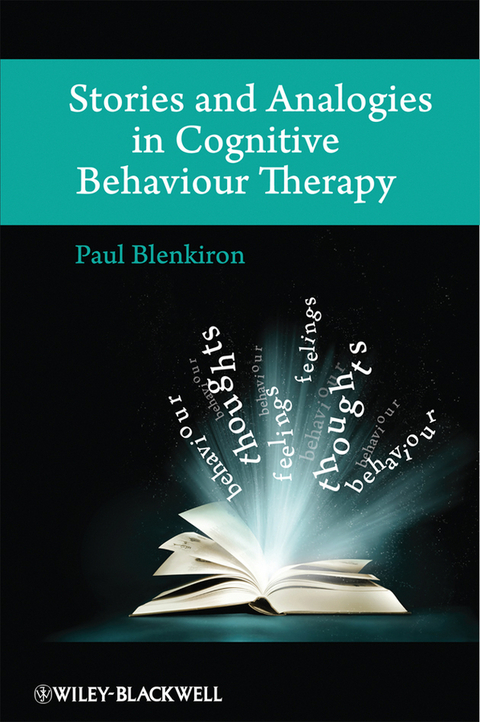
Stories and Analogies in Cognitive Behaviour Therapy (eBook)
John Wiley & Sons (Verlag)
978-0-470-06000-1 (ISBN)
- Provides therapists with a range of metaphors that can be employed as a tool to enable clients to gain a new perspective on their problem, and reinforce their clients' motivation for change
- CBT (Cognitive Behaviour Therapy) continues to grow in popularity, and is strongly recommended as an effective intervention by the National Institute of Clinical Excellence
- Written in an engaging style that is accessible to both established practitioners and trainees in clinical psychology
Paul Blenkiron is a Consultant Psychiatrist based at Bootham Park Hospital in York, UK, and is an accredited member of the British Association for Behavioural and Cognitive Psychotherapies. He is also Honorary Senior Lecturer in Psychiatry and Behavioural Sciences at Leeds University, and a CBT course facilitator at York University's Department of Health Sciences. He has authored more than 60 original research and clinical publications in the areas of CBT, depression, self harm and chronic fatigue.
An accessible guide to employing stories and metaphors within cognitive behaviour therapy, which will aid clinicians in providing effective treatment for their clients Provides therapists with a range of metaphors that can be employed as a tool to enable clients to gain a new perspective on their problem, and reinforce their clients motivation for change CBT (Cognitive Behaviour Therapy) continues to grow in popularity, and is strongly recommended as an effective intervention by the National Institute of Clinical Excellence Written in an engaging style that is accessible to both established practitioners and trainees in clinical psychology
Paul Blenkiron is a Consultant Psychiatrist based at Bootham Park Hospital in York, UK, and is an accredited member of the British Association for Behavioural and Cognitive Psychotherapies. He is also Honorary Senior Lecturer in Psychiatry and Behavioural Sciences at Leeds University, and a CBT course facilitator at York University's Department of Health Sciences. He has authored more than 60 original research and clinical publications in the areas of CBT, depression, self harm and chronic fatigue.
List of Tables, Figures and Boxes.
About the Author.
Foreword by Chris Williams.
Preface.
Acknowledgments.
PART ONE: ONCE UPON A TIME: GETTING STARTED.
Chapter 1: What is Cognitive Behaviour Therapy?
Introduction.
What Is Psychotherapy?
What Is Cognitive Behaviour Therapy?
CBT: Ten Essential Ingredients.
Ten Common Myths About CBT.
Summary.
Chapter 2: Stories, Analogies & Metaphors.
Introduction.
Tools for Communication.
Stories from the Wider World.
Story-Telling across the Psychotherapies.
Summary.
Chapter 3: Using Stories in CBT.
Introduction.
Uses for Stories and Metaphors.
Abuses and Limitations.
The Evidence Base.
Drawing it All Together.
Summary.
PART TWO: DEVELOPING THE PLOT: STORIES FOR SPECIFICDISORDERS.
Chapter 4: Depression.
Introduction.
Definition.
Stories and Analogies.
Step 1: Putting it into Words.
Step 2: Accepting Help.
CBT for Depression.
Step 3: Doing More - Activities and Goals.
Three Layers of Thinking.
Step 4: Removing the Critical Voice.
Step 5: Develop a Kinder Self-Talk.
Step 6: Preparing for the Future.
Summary.
Chapter 5: Anxiety, Panic and Phobias.
Introduction.
What Is Anxiety?
How Do We Learn?
Assessing Anxiety.
Generalised Anxiety Disorder.
Panic Disorder.
Catastrophic Misinterpretation.
Selective Attention.
Hypervigilence.
Safety Behaviours.
Phobias.
Graded Exposure.
Social Anxiety.
Summary
Chapter 6: Obsessions, Compulsions and Post TraumaticStress.
Introduction.
Obsessive Compulsive Disorder.
Definition.
Behaviour Therapy for OCD.
Cognitive Therapy for OCD.
Post Traumatic Stress Disorder.
Definition.
Stories and Analogies for PTSD.
CBT for PTSD.
Exposure Therapy for PTSD.
Cognitive Therapy for PTSD.
Childhood Trauma.
Summary.
Chapter 7: Physical Health.
Introduction.
Health Anxiety.
Medically Unexplained Symptoms.
Chronic Fatigue Syndrome.
Eating Disorders.
Adjusting to Serious Illness.
When Illness Threatens Life.
Summary.
Chapter 8: Personality, Beliefs And Behaviours.
Introduction.
Anger.
Assertiveness.
Low Self-Esteem.
Relationship Problems.
Self-Harm.
Perfectionism.
Changing Core Beliefs.
Summary.
PART THREE: HAPPILY EVER AFTER? STORY-TELLING IN THE REALWORLD.
Chapter 9: CBT In Practice.
Introduction.
Practical Tips For Therapists.
Creating Personalised Stories and Analogies.
Problem Solving.
Schizophrenia and Psychosis.
Teamwork, Training and CBT Supervision.
Summary.
Chapter 10: The Next Generation.
Introduction.
Third-Generation CBT.
Behavioural Activation.
Mindfulness.
Acceptance and Commitment Therapy.
CBT for Enduring Problems.
Compassionate Mind Training.
Building Resilience.
The New You.
The Future of CBT.
Summary.
Epilogue: The End - An Unfolding Story...
Appendices.
Appendix 1: Sources of Information for this Book.
Appendix 2: Literature Search.
Appendix 3: List of Therapy Conversations.
Appendix 4: List of Stories and Analogies.
Author's Note.
References.
Index.
"Story telling is one of our most ancient ways of communicating. Paul Blenkiron has vividly described how stories can be used for therapeutic purposes." (CBT Today, March 2015)
"An excellent, stimulating book. Offers all therapists an invaluable toolkit for many years to come. I recommend savouring every word." (Royal College of Psychiatrists, 2 February 2011)
"This is a real treat and worth an investment - not only for 'the shelf', but also for the 'self'" (British Association for Behavioural & Cognitive Psychotherapies, 15 December 2010 )
"What makes this book such a coherent piece of work is its structured presentation of useful content paired with the well-thought-out narrative in which these ideas are communicated." (Psychologist, 1 October 2010)
"The usefulness of this book to therapeutic practice is vast." (Therapeutic Recreation, 1 July, 2010)
| Erscheint lt. Verlag | 23.9.2011 |
|---|---|
| Sprache | englisch |
| Themenwelt | Geisteswissenschaften ► Psychologie ► Klinische Psychologie |
| Medizin / Pharmazie ► Gesundheitsfachberufe | |
| Medizin / Pharmazie ► Medizinische Fachgebiete ► Psychiatrie / Psychotherapie | |
| Schlagworte | CBT • Clinical psychology • Clinician • Cognitive behavioral therapy (CBT) • Cognitive Behaviour Therapy • Klinische Psychologie • Kognitive Verhaltenstherapie • Mental Health • Psychologie • Psychology • Therapist |
| ISBN-10 | 0-470-06000-X / 047006000X |
| ISBN-13 | 978-0-470-06000-1 / 9780470060001 |
| Informationen gemäß Produktsicherheitsverordnung (GPSR) | |
| Haben Sie eine Frage zum Produkt? |
 PDF (Adobe DRM)
Kopierschutz: Adobe-DRM
Adobe-DRM ist ein Kopierschutz, der das eBook vor Mißbrauch schützen soll. Dabei wird das eBook bereits beim Download auf Ihre persönliche Adobe-ID autorisiert. Lesen können Sie das eBook dann nur auf den Geräten, welche ebenfalls auf Ihre Adobe-ID registriert sind.
Details zum Adobe-DRM
Dateiformat: PDF (Portable Document Format)
Mit einem festen Seitenlayout eignet sich die PDF besonders für Fachbücher mit Spalten, Tabellen und Abbildungen. Eine PDF kann auf fast allen Geräten angezeigt werden, ist aber für kleine Displays (Smartphone, eReader) nur eingeschränkt geeignet.
Systemvoraussetzungen:
PC/Mac: Mit einem PC oder Mac können Sie dieses eBook lesen. Sie benötigen eine
eReader: Dieses eBook kann mit (fast) allen eBook-Readern gelesen werden. Mit dem amazon-Kindle ist es aber nicht kompatibel.
Smartphone/Tablet: Egal ob Apple oder Android, dieses eBook können Sie lesen. Sie benötigen eine
Geräteliste und zusätzliche Hinweise
Buying eBooks from abroad
For tax law reasons we can sell eBooks just within Germany and Switzerland. Regrettably we cannot fulfill eBook-orders from other countries.
aus dem Bereich