


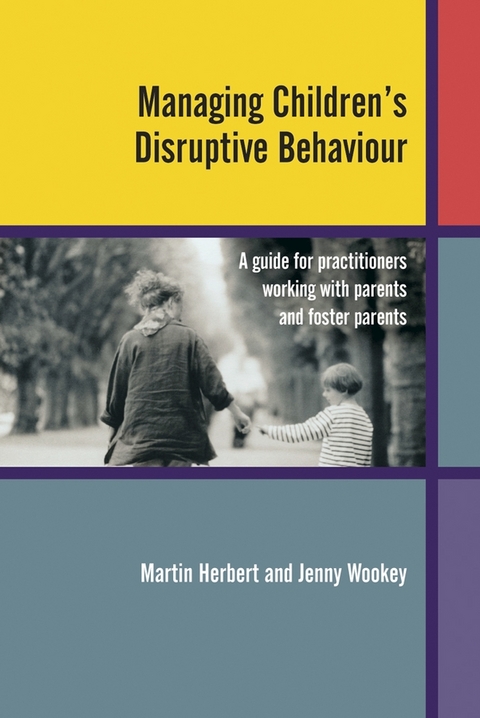
Managing Children's Disruptive Behaviour (eBook)
This flexible set of resources has been designed for use with children aged between 2 and 10 years and includes versions for use: in group settings; at home; in the classroom; with typical and special needs children. Devised for use by a wide range of professionals, the programmes reduce fraught interactions and restore mutually enjoyable relationships between the carer/parent and the child. There are also further resources available to download from a supporting website.
Managing Children's Disruptive Behaviour is an invaluab le tool for psychologists, health visitors, social workers, teachers, and all those whose work involves children and their carers.
Martin Herbert is Emeritus Professor at Exeter University. He was previously Director of the School of Social Work and Professor of Psychology at the University of Leicester. He later joined the National Health Service full time and was in charge of the mental health service for children in Plymouth. This post was succeeded by a move to Exeter where he directed the doctoral course in clinical psychology as Professor of Clinical and Community Psychology. He was appointed to the Consultant Clinical Psychologist post in the Child and Adolescent Department at the Royal Devon and Exeter NHS Healthcare Trust. He now specialises in personal injury psycho-legal work. He has published books and journal articles on various topics dealing with the psychological problems of children, adolescents and adults. His latest is Typical and Atypical Development: From Conception to Adolescence (2003). Many of his books have been translated into European and Asian languages. He is a Fellow of the British Psychological Society.
Jenny Wookey is a consultant clinical psychologist at the Plymouth Hospitals NHS Trust and also honorary tutor and supervisor on the Clinical Doctoral Course at Exeter University. She has had many years of working with adults in GP surgeries and with parents and children at the Plymouth Child Development Centre. She previously worked in an adultmental health and primary care setting. Her special interests include developmental disability and young children with behaviour problems. In recent years she has worked with Professor Martin Herbert researching and conducting parent training programmes.
Managing Children's Disruptive Behavior is a comprehensive guide designed for professionals and parents who care for children whose behavior problems are beyond those encountered normally. Arranged in three parts, the book opens by setting out the theoretical background to conduct disorders in a range of settings. Part Two discusses issues in assessment and treatment and explains the background to the 'Child-Wise' programs devised by the authors. Four versions of the Child-Wise program follow, complete with useful materials for evaluation and homework purposes. This flexible set of resources has been designed for use with children aged between 2 and 10 years and includes versions for use: in group settings; at home; in the classroom; with typical and special needs children. Devised for use by a wide range of professionals, the programmes reduce fraught interactions and restore mutually enjoyable relationships between the carer/parent and the child. There are also further resources available to download from a supporting website. Managing Children's Disruptive Behaviour is an invaluab le tool for psychologists, health visitors, social workers, teachers, and all those whose work involves children and their carers.
Martin Herbert is Emeritus Professor at Exeter University. He was previously Director of the School of Social Work and Professor of Psychology at the University of Leicester. He later joined the National Health Service full time and was in charge of the mental health service for children in Plymouth. This post was succeeded by a move to Exeter where he directed the doctoral course in clinical psychology as Professor of Clinical and Community Psychology. He was appointed to the Consultant Clinical Psychologist post in the Child and Adolescent Department at the Royal Devon and Exeter NHS Healthcare Trust. He now specialises in personal injury psycho-legal work. He has published books and journal articles on various topics dealing with the psychological problems of children, adolescents and adults. His latest is Typical and Atypical Development: From Conception to Adolescence (2003). Many of his books have been translated into European and Asian languages. He is a Fellow of the British Psychological Society. Jenny Wookey is a consultant clinical psychologist at the Plymouth Hospitals NHS Trust and also honorary tutor and supervisor on the Clinical Doctoral Course at Exeter University. She has had many years of working with adults in GP surgeries and with parents and children at the Plymouth Child Development Centre. She previously worked in an adultmental health and primary care setting. Her special interests include developmental disability and young children with behaviour problems. In recent years she has worked with Professor Martin Herbert researching and conducting parent training programmes.
About the authors.
Preface.
Acknowledgements.
PART I: DISRUPTION BY THE CHILD.
Introduction.
1. Disruption in the home: Children in control -
children out of control.
Definitions.
Consequences of the conduct disorders.
Risks and protective processes: the early history.
Developmental pathways and transmission of conduct
disorders.
Restoring the balance.
Select bibliography.
2. Disruption in the foster home.
Fostering.
The break-up of children's families.
The breakdown of fostering placements.
Interventions.
The concept of attachment.
Conclusion.
Select bibliography.
3. Disruption in the classroom.
Introduction.
The influence of school life.
The consultation (triadic) model.
Classroom management.
Disruptive behaviour.
Select bibliography.
PART II: FROM THEORY TO PRACTICE: PRINCIPLES OF ASSESSMENT
AND TRAINING.
4. Behavioural parent training.
Introduction.
Behavioural theory.
Assessment methods.
Behavioural methods.
Select bibliography.
5. Orientation to the Child-Wise behaviour management
programme.
Preliminaries.
Getting started.
Resistance.
Possible remedies to overcome resistance.
Notes on the courses.
Select bibliography.
PART III: COURSES.
6. The Child-Wise behaviour management course.
Objectives.
Course outline.
Session 1: Introduction to the course.
Session 2: Children's needs.
Session 3: Play as 'special' (quality) time.
Session 4: Effective praise.
Session 5: Tangible and social rewards.
Session 6: 'It's as simple as ABC!'.
Session 7: Discipline.
Session 8: Ignoring and time-out.
Session 9: Removing rewards and privileges.
Session 10: Caring for yourself.
Session 11: Booster session.
7. The individual behaviour management course.
Objectives.
The Child-Wise home-based version.
Advantages of the home-based individual approach.
Reference.
8. Using the Child-Wise course with special needs
children.
Introduction.
Guidelines.
Functional analysis.
Interventions - modifying antecedents.
Select bibliography.
9. The foster parents' behaviour management
course.
Introduction.
Session 1: Introduction.
Session 2: Behavioural change.
Session 3: The modification of behaviour.
Session 4: Rehearsing behavioural strategies.
Session 5: Booster session.
Appendix I: Issues for discussion and reminder handouts.
Appendix II: Course evaluation forms.
Appendix III: Child-Wise selection interview.
Appendix IV: Background to the Child-Wise course.
Index.
"...presents well-tested courses for the treatment and training of
staff dealing with difficult youngsters..." (Journal of Practising
Educational Psychologists, 2004)
"...sets out to provide a guide for experienced practitioners
who are working with the parents, teachers and foster carers of
young children with conduct disorders..." (Child and Adolescent
Mental Health, Vol 10 (3) Sept 05)
| Erscheint lt. Verlag | 21.4.2004 |
|---|---|
| Sprache | englisch |
| Themenwelt | Geisteswissenschaften ► Psychologie ► Entwicklungspsychologie |
| Geisteswissenschaften ► Psychologie ► Klinische Psychologie | |
| Geisteswissenschaften ► Psychologie ► Verhaltenstherapie | |
| Schlagworte | Authors • Background • Behaviour • Book • children • childrens disruptive • childwise programmes • Clinical psychology • Comprehensive • Conduct Disorders • discusses • Follow • Guide • Issues • Klinische Psychologie • Part • Problems • Professionals • Psychologie • Psychology • Range • Settings • theoretical background • Three • two |
| ISBN-13 | 9780470020067 / 9780470020067 |
| Informationen gemäß Produktsicherheitsverordnung (GPSR) | |
| Haben Sie eine Frage zum Produkt? |
 PDF (Adobe DRM)
Kopierschutz: Adobe-DRM
Adobe-DRM ist ein Kopierschutz, der das eBook vor Mißbrauch schützen soll. Dabei wird das eBook bereits beim Download auf Ihre persönliche Adobe-ID autorisiert. Lesen können Sie das eBook dann nur auf den Geräten, welche ebenfalls auf Ihre Adobe-ID registriert sind.
Details zum Adobe-DRM
Dateiformat: PDF (Portable Document Format)
Mit einem festen Seitenlayout eignet sich die PDF besonders für Fachbücher mit Spalten, Tabellen und Abbildungen. Eine PDF kann auf fast allen Geräten angezeigt werden, ist aber für kleine Displays (Smartphone, eReader) nur eingeschränkt geeignet.
Systemvoraussetzungen:
PC/Mac: Mit einem PC oder Mac können Sie dieses eBook lesen. Sie benötigen eine
eReader: Dieses eBook kann mit (fast) allen eBook-Readern gelesen werden. Mit dem amazon-Kindle ist es aber nicht kompatibel.
Smartphone/Tablet: Egal ob Apple oder Android, dieses eBook können Sie lesen. Sie benötigen eine
Geräteliste und zusätzliche Hinweise
Buying eBooks from abroad
For tax law reasons we can sell eBooks just within Germany and Switzerland. Regrettably we cannot fulfill eBook-orders from other countries.
aus dem Bereich


