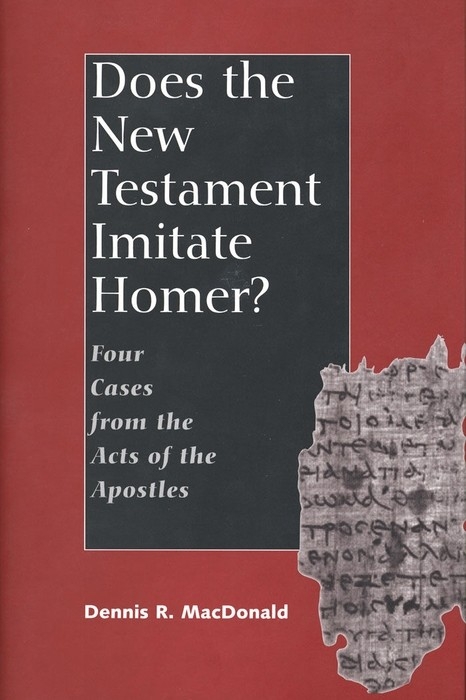
In this provocative challenge to prevailing views of New Testament sources, Dennis R. MacDonald argues that the origins of passages in the book of Acts are to be found not in early Christian legends but in the epics of Homer. MacDonald focuses on four passages in the book of Acts, examines their potential parallels in the Iliad, and concludes that the author of Acts composed them using famous scenes in Homer's work as a model.
Tracing the influence of passages from the Iliad onsubsequent ancient literature, MacDonald shows how the story generated a vibrant, mimetic literary tradition long before Luke composed the Acts. Luke could have expected educated readers to recognize his transformation of these tales and to see that the Christian God and heroes were superior to Homeric gods and heroes. Building upon and extending the analytic methods of his earlier book, The Homeric Epics and the Gospel of Mark, MacDonald opens an original and promising appreciation not only of Acts but also of the composition of early Christian narrative in general.
In this provocative challenge to prevailing views of New Testament sources, Dennis R. MacDonald argues that the origins of passages in the book of Acts are to be found not in early Christian legends but in the epics of Homer. MacDonald focuses on four passages in the book of Acts, examines their potential parallels in the Iliad, and concludes that the author of Acts composed them using famous scenes in Homer’s work as a model.Tracing the influence of passages from the Iliad on subsequent ancient literature, MacDonald shows how the story generated a vibrant, mimetic literary tradition long before Luke composed the Acts. Luke could have expected educated readers to recognize his transformation of these tales and to see that the Christian God and heroes were superior to Homeric gods and heroes. Building upon and extending the analytic methods of his earlier book, The Homeric Epics and the Gospel of Mark, MacDonald opens an original and promising appreciation not only of Acts but also of the composition of early Christian narrative in general.
| Erscheint lt. Verlag | 1.10.2008 |
|---|---|
| Sprache | englisch |
| Themenwelt | Religion / Theologie ► Christentum ► Bibelausgaben / Bibelkommentare |
| Geisteswissenschaften ► Sprach- / Literaturwissenschaft ► Anglistik / Amerikanistik | |
| Geisteswissenschaften ► Sprach- / Literaturwissenschaft ► Literaturwissenschaft | |
| ISBN-10 | 0-300-12989-0 / 0300129890 |
| ISBN-13 | 978-0-300-12989-2 / 9780300129892 |
| Informationen gemäß Produktsicherheitsverordnung (GPSR) | |
| Haben Sie eine Frage zum Produkt? |
 PDF (Wasserzeichen)
Größe: 624 KB
DRM: Digitales Wasserzeichen
Dieses eBook enthält ein digitales Wasserzeichen und ist damit für Sie personalisiert. Bei einer missbräuchlichen Weitergabe des eBooks an Dritte ist eine Rückverfolgung an die Quelle möglich.
Dateiformat: PDF (Portable Document Format)
Mit einem festen Seitenlayout eignet sich die PDF besonders für Fachbücher mit Spalten, Tabellen und Abbildungen. Eine PDF kann auf fast allen Geräten angezeigt werden, ist aber für kleine Displays (Smartphone, eReader) nur eingeschränkt geeignet.
Systemvoraussetzungen:
PC/Mac: Mit einem PC oder Mac können Sie dieses eBook lesen. Sie benötigen dafür einen PDF-Viewer - z.B. den Adobe Reader oder Adobe Digital Editions.
eReader: Dieses eBook kann mit (fast) allen eBook-Readern gelesen werden. Mit dem amazon-Kindle ist es aber nicht kompatibel.
Smartphone/Tablet: Egal ob Apple oder Android, dieses eBook können Sie lesen. Sie benötigen dafür einen PDF-Viewer - z.B. die kostenlose Adobe Digital Editions-App.
Buying eBooks from abroad
For tax law reasons we can sell eBooks just within Germany and Switzerland. Regrettably we cannot fulfill eBook-orders from other countries.
 EPUB (Adobe DRM)
Kopierschutz: Adobe-DRM
Adobe-DRM ist ein Kopierschutz, der das eBook vor Mißbrauch schützen soll. Dabei wird das eBook bereits beim Download auf Ihre persönliche Adobe-ID autorisiert. Lesen können Sie das eBook dann nur auf den Geräten, welche ebenfalls auf Ihre Adobe-ID registriert sind.
Details zum Adobe-DRM
Dateiformat: EPUB (Electronic Publication)
EPUB ist ein offener Standard für eBooks und eignet sich besonders zur Darstellung von Belletristik und Sachbüchern. Der Fließtext wird dynamisch an die Display- und Schriftgröße angepasst. Auch für mobile Lesegeräte ist EPUB daher gut geeignet.
Systemvoraussetzungen:
PC/Mac: Mit einem PC oder Mac können Sie dieses eBook lesen. Sie benötigen eine
eReader: Dieses eBook kann mit (fast) allen eBook-Readern gelesen werden. Mit dem amazon-Kindle ist es aber nicht kompatibel.
Smartphone/Tablet: Egal ob Apple oder Android, dieses eBook können Sie lesen. Sie benötigen eine
Geräteliste und zusätzliche Hinweise
Buying eBooks from abroad
For tax law reasons we can sell eBooks just within Germany and Switzerland. Regrettably we cannot fulfill eBook-orders from other countries.
aus dem Bereich