Zum Hauptinhalt springen
Nicht aus der Schweiz? Besuchen Sie lehmanns.de
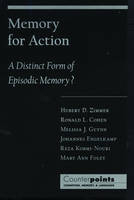
Memory for Action -  Ronald L. Cohen,  Johannes Engelkamp,  Mary Ann Foley,  Melissa J. Guynn,  Reza Kormi-Nouri,  Hubert D. Zimmer

Memory for Action (eBook)

A Distinct Form of Episodic Memory?
eBook Download: PDF
2001
224 Seiten
Oxford University Press (Verlag)
978-0-19-535397-6 (ISBN)
Systemvoraussetzungen
17,02 inkl. MwSt
(CHF 16,60)
Der eBook-Verkauf erfolgt durch die Lehmanns Media GmbH (Berlin) zum Preis in Euro inkl. MwSt.
  • Download sofort lieferbar
  • Zahlungsarten anzeigen
The book presents in eight chapters our actual knowledge on memory for actions and it gives room to the proponents of the opposing models to develop their view for explaining action memory. In Chapter one, Hubert Zimmer and Ronald Cohen summarize the results of laboratory research on action, i. e. memory for self-performed actions. In Chapter two, Melissa Guynn, Mark McDaniel and Gilles Einstein extend this field on memory for intended actions. They present their view on the prospective memory of actions, and they demonstrate the importance of automatic retrieval in prospective memory. In the following chapter, Johannes Engelkamp presents his motor oriented explanation of action memory. He claims that output processes strongly contribute to memory for performed actions, and that the information which is critical for memory is closely related to the information used in the motor control of overt performance. Reza Kormi-Nouri and Lars-Goran Nilsson (Chapter four) completely disagree with this position. They argue that performing actions may cause specific processes, but that nevertheless action memory is part of a unique episodic memory which stores all types of episodes in a similar way. In the following chapter, Mary Ann Foley and Hilary Ratner put action memory in the broader context of activity memory. Everyday actions are usually performed in social contexts and they are goal-oriented. This aspect is seldom relevant in laboratory research, but the authors show that it is of importance for everyday memory. Then two brief chapters follow in which Nilsson and Kormi-Nouri on the one hand, and Engelkamp on the other hand mutually comment on each others position. In the closing chapter, Hubert Zimmer discusses the presented different attempts in parallel. He is doing this by taking into account the different processes and brain modules which are necessary for a successful control of actions.
PDFPDF (Adobe DRM)

Kopierschutz: Adobe-DRM
Adobe-DRM ist ein Kopierschutz, der das eBook vor Mißbrauch schützen soll. Dabei wird das eBook bereits beim Download auf Ihre persönliche Adobe-ID autorisiert. Lesen können Sie das eBook dann nur auf den Geräten, welche ebenfalls auf Ihre Adobe-ID registriert sind.
Details zum Adobe-DRM

Dateiformat: PDF (Portable Document Format)
Mit einem festen Seiten­layout eignet sich die PDF besonders für Fach­bücher mit Spalten, Tabellen und Abbild­ungen. Eine PDF kann auf fast allen Geräten ange­zeigt werden, ist aber für kleine Displays (Smart­phone, eReader) nur einge­schränkt geeignet.

Systemvoraussetzungen:
PC/Mac: Mit einem PC oder Mac können Sie dieses eBook lesen. Sie benötigen eine Adobe-ID und die Software Adobe Digital Editions (kostenlos). Von der Benutzung der OverDrive Media Console raten wir Ihnen ab. Erfahrungsgemäß treten hier gehäuft Probleme mit dem Adobe DRM auf.
eReader: Dieses eBook kann mit (fast) allen eBook-Readern gelesen werden. Mit dem amazon-Kindle ist es aber nicht kompatibel.
Smartphone/Tablet: Egal ob Apple oder Android, dieses eBook können Sie lesen. Sie benötigen eine Adobe-ID sowie eine kostenlose App.
Geräteliste und zusätzliche Hinweise

Buying eBooks from abroad
For tax law reasons we can sell eBooks just within Germany and Switzerland. Regrettably we cannot fulfill eBook-orders from other countries.

Mehr entdecken
aus dem Bereich