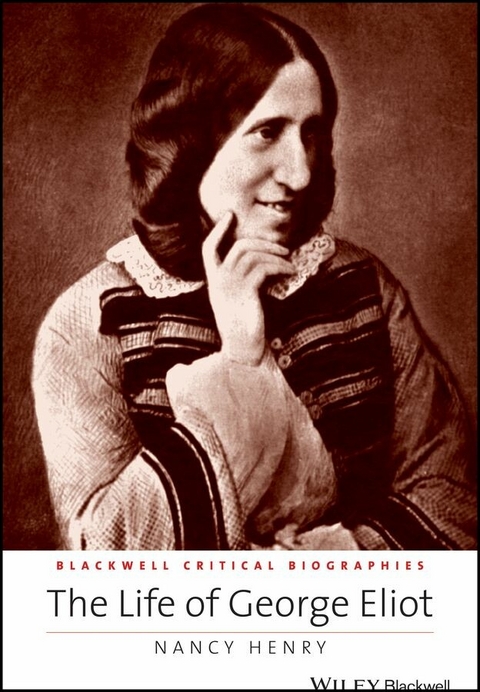
The Life of George Eliot (eBook)
John Wiley & Sons (Verlag)
978-1-118-27467-5 (ISBN)
- A fresh look at George Eliot's captivating life story
- Includes original new analysis of her writing
- Deploys the latest biographical research
- Combines literary criticism with biographical narrative to offer a rounded perspective
Nancy Henry is Professor of English at the University of Tennessee at Knoxville. She is the author of George Eliot and the British Empire (2002), and The Cambridge Introduction to George Eliot (2008), and co-editor of Victorian Investments: New Perspectives on Finance and Culture (2009). She is also the recipient of a 2014/15 NEH Fellowship.
The life story of the Victorian novelist George Eliot is as dramatic and complex as her best plots. This new assessment of her life and work combines recent biographical research with penetrating literary criticism, resulting in revealing new interpretations of her literary work. A fresh look at George Eliot's captivating life story Includes original new analysis of her writing Deploys the latest biographical research Combines literary criticism with biographical narrative to offer a rounded perspective
Nancy Henry is Professor of English at the University of Tennessee at Knoxville. She is the author of George Eliot and the British Empire (2002), and The Cambridge Introduction to George Eliot (2008), and co-editor of Victorian Investments: New Perspectives on Finance and Culture (2009). She is also the recipient of a 2014/15 NEH Fellowship.
List of Illustrations ix
Acknowledgments xi
List of Abbreviations xiii
1 The History of a Writer: George Eliot and Biographies 1
2 Early Years: 1819-50 22
3 London and Lewes: 1850-4 64
4 Marian Lewes and George Eliot: 1855-60 95
5 Silas Marner and Romola: 1860-4 120
6 Felix Holt and The Spanish Gypsy: 1865-9 153
7 Middlemarch: 1870-2 181
8 Daniel Deronda: 1873-6 207
9 Impressions of Theophrastus Such: 1877-9 235
10 The Final Years: 1879 to Cross's Life 255
Bibliography 271
Index 287
"It is no surprise that this book is now available in paperback: compact and hugely suggestive, bringing us new things to think about, showing us old myths to discard; in its productive disruption of commonplace fact/fiction approaches to the life and works mode, it enriches and enlarges our understanding of the writer and her writings." (Cercles, 1 June 2015)
"...this learned, adventurous new biographer has
changed the landscape of George Eliot studies." (The
George Eliot Review, 1 November 2012)
"Driven neither by hero-worship or spite, Henry's
"critical biography" demonstrates what treasure there is still to
be found in even the most worked-over subjects. The trick is to ask
the questions that everyone else assumed had been answered years
ago." (The Guardian, 2 June 2012)
"Henry provides a useful reminder that that old-fashioned
pejorative, adulteress, might have been applied to Eliot as well as
to Agnes, and she provides a sensitive analysis of the novels in
the light of that insight." (The New Yorker, 6
August 2012)
Chapter 1
The History of a Writer
George Eliot and Biographies
She believed that her husband was one of those men whose memoirs should be written when they died.
(Middlemarch 326; ch. 36)
Toward the end of her life, George Eliot wrote: “The best history of a writer is contained in his writings – these are his chief actions.” In the same 1879 letter to Mrs Thomas Adolphus Trollope, she further and more emphatically declared that biographies “generally are a disease of English literature” (GEL 7:230). These assertions were prompted by the death in 1878 of her companion of twenty-four years, George Henry Lewes, himself a writer of biographies including The Life and Works of Goethe (1855). She declined to write her autobiography, or to cooperate with would-be biographers of herself or Lewes. She did not want details of her personal life to affect evaluations of her writing or to overshadow her own and Lewes's posthumous reputations. The care of those reputations was centrally important to her in a way that is consistent with questions about history and individual lives that her novels raise. All of her novels implicitly ask how the past influences the present, and how the present, as she put it in the Finale to Middlemarch (1871–2), “prepares” the future: “we insignificant people with our daily words and acts are preparing the lives of many Dorotheas . . .” (785; Finale). But George Eliot was not an insignificant person. She was someone whose memoirs would be written. As far as she could, she wanted to prepare the conditions of how she would be remembered after her death.
Eliot's preoccupation with the writings that survive the writer is evident from her first published fiction, “Poetry and Prose from the Notebook of an Eccentric” (1846–7). Borrowing a convention used by Sir Walter Scott and others, she introduces a narrator who has decided to publish the notebooks of his recently deceased friend Macarthy. In her last book, Impressions of Theophrastus Such (1879), her narrator Theophrastus introduces his character sketches by imagining that he will leave his manuscripts to a friend, whom he asks “to use his judgment in insuring me against posthumous mistake” (13; ch. 1). She had originally thought of titling that work “Characters and Characteristics by Theophrastus Such, edited by George Eliot” (GEL 7:119). In between Macarthy and Theophrastus, Latimer in her short story, “The Lifted Veil” (1859), writes the story of his life as he approaches what he preternaturally knows will be the moment of his death. Edward Casaubon in Middlemarch asks his wife Dorothea to labor on with his “Key to All Mythologies,” and Eliot herself completed and published the last two volumes of Lewes's Problems of Life and Mind (1879) after his death. With the combination of hindsight and foresight characteristic of her fictional narrators, she was deeply interested in the “history of a writer” – whether looking back to the origins of the writing, as in her journal entry, “How I Came to Write Fiction” (1857) – or looking forward to the inevitability of posterity's judgment in an age when biographies were popular enough to merit being called a disease of literature. Her condemnation of biographies seems to have been a reflex of her anxiety about the representation of her own history as it would be written and live on – along with her published writings – after her death. As it happened (or as she designed), her widower John Walter Cross was the first to “edit” her papers, including her letters and journals, to produce his George Eliot's Life as Related in her Letters and Journals (1885).
I will be drawing on Eliot's own views about telling life stories because her novels, essays, poetry, and letters provide insights into the possibilities for constructing such narratives with a self-consciousness associated with later, post-modernist assumptions about the fluid boundaries between fact and fiction. Her insights are particularly relevant for a biography that seeks to explore connections between the author's life and writings. In a section on “Story-Telling” in her posthumously published “Leaves from a Notebook” (1884) she writes:
The only stories life presents to us in an orderly way are those of our autobiography, or the career of our companions from our childhood upwards, or perhaps of our own children. But it is a great art to make a connected strictly relevant narrative of such careers as we can recount from the beginning. (Poetry 2:203)
She made this statement about the art of ordering narratives in the 1870s when she was experimenting with narrative structure – first in Middlemarch and then more radically in Daniel Deronda (1876) – and it has implications for the biographer as well as the novelist. She chose to narrate the “careers” of her characters in Daniel Deronda out of sequence, questioning the notion that beginnings are inevitable, and intentionally altering the established bildungsroman formula epitomized in the first chapter of David Copperfield (1849–50), “I am Born.” In contrast, the first chapter of Daniel Deronda begins with an epigraph (written by Eliot): “Men can do nothing without the make-believe of a beginning.” The story proceeds in medias res before flashing back to illustrative anecdotes from the childhoods of its major characters, Daniel Deronda and Gwendolen Harleth. The form of story-telling in her last novel initiated a transformation in narrative that would be adopted and developed by Henry James, Joseph Conrad, James Joyce, Virginia Woolf and others.
A biography may seem to have a natural beginning – the birth of its subject – but how we choose to select and relate the sequence of events that follows, especially with the benefit of hindsight and an abundance of factual material pre-ordered by past biographies, must be determined by narrative interest. In her novel of Renaissance Florence, Romola (1862–3), the narrator observes, “as in the tree that bears a myriad of blossoms, each single bud with its fruit is dependent on the primary circulation of the sap, so the fortunes of Tito and Romola were dependent on certain grand political and social conditions which made an epoch in the history of Italy” (21; ch. 2). The goal of biography is to provide the most accurate account possible of the author's history, including not only a chronology of what she wrote but the circumstances and events that are contexts for those writings.
Biographical facts about the author may not be discoverable in fiction, but the author's “character” is there to be read. Eliot was intensely aware of the sense in which “the history of a writer is contained in his writings.” In committing his words to paper and publishing them, the writer reveals himself and his life in intimate if not always ordered ways. This is why her most self-conscious reflections on the relationship between life and writing in Impressions of Theophrastus Such take the form of chapters entitled “Looking Inward,” and more temporally, “Looking Backward.” Theophrastus takes the example of Jean-Jacques Rousseau (1712–78) when observing that “half our impressions of his character come not from what he means to convey, but from what he unconsciously enables us to discern” (5; ch.1), and applying this observation to himself. The biographer of a writer must look backward to the historical record and inward to the character or persona of the author that is “contained,” as Eliot said, in her writings. Through such a reconstruction of the author using the historical record and the writings, we have at least as good a chance of knowing Mary Anne Evans/Marian Lewes/George Eliot/Mary Ann Cross today as those who knew her only in childhood, or those who knew her only as admiring visitors at her Sunday afternoons at the Priory.1
It is tempting to take Eliot's criticism of biographies as a “disease” of English literature – made after she had become one of England's most famous novelists and therefore the object of biographical speculation and invasive inquiries – as her definitive opinion on the subject. Her views about biographies, however, were not always so negative. In 1839, after reading J. G. Lockhart's Memoirs of the Life of Sir Walter Scott (1837–8), she commented to her friend Maria Lewis: “All biography is interesting and instructive” (GEL 1:24). Her first major publication was the translation of a work that is an interrogation of biographical sources, David Strauss's Life of Jesus, Critically Examined (1846). She was devoted to the truth exposed in the biblical scholar's account, but she lamented the harsh light of historical inquiry that seemed to spoil the poetry in the life of Jesus. The story of a life (miracles and all) is more satisfying than the dissection of that story. At the beginning of her authorial career, Eliot defended Elizabeth Gaskell's Life of Charlotte Brontë (1857) against the objections of her publisher, John Blackwood, who referred to it disdainfully as “this bookmaking out...
| Erscheint lt. Verlag | 2.3.2012 |
|---|---|
| Reihe/Serie | Blackwell Critical Biographies |
| Blackwell Critical Biographies | Wiley Blackwell Critical Biographies |
| Sprache | englisch |
| Themenwelt | Literatur ► Biografien / Erfahrungsberichte |
| Literatur ► Romane / Erzählungen | |
| Geisteswissenschaften ► Sprach- / Literaturwissenschaft ► Anglistik / Amerikanistik | |
| Geisteswissenschaften ► Sprach- / Literaturwissenschaft ► Literaturgeschichte | |
| Geisteswissenschaften ► Sprach- / Literaturwissenschaft ► Literaturwissenschaft | |
| Schlagworte | 19th Century English Literature • Eliot, George • Englische Literatur / 19. Jhd. • Literature • Literaturgeschichte • Literaturwissenschaft • Romane • The novel • Victorian novel, fiction, poetry, realism, biography, Mary Ann Evans |
| ISBN-10 | 1-118-27467-9 / 1118274679 |
| ISBN-13 | 978-1-118-27467-5 / 9781118274675 |
| Informationen gemäß Produktsicherheitsverordnung (GPSR) | |
| Haben Sie eine Frage zum Produkt? |
 EPUB (Adobe DRM)
Kopierschutz: Adobe-DRM
Adobe-DRM ist ein Kopierschutz, der das eBook vor Mißbrauch schützen soll. Dabei wird das eBook bereits beim Download auf Ihre persönliche Adobe-ID autorisiert. Lesen können Sie das eBook dann nur auf den Geräten, welche ebenfalls auf Ihre Adobe-ID registriert sind.
Details zum Adobe-DRM
Dateiformat: EPUB (Electronic Publication)
EPUB ist ein offener Standard für eBooks und eignet sich besonders zur Darstellung von Belletristik und Sachbüchern. Der Fließtext wird dynamisch an die Display- und Schriftgröße angepasst. Auch für mobile Lesegeräte ist EPUB daher gut geeignet.
Systemvoraussetzungen:
PC/Mac: Mit einem PC oder Mac können Sie dieses eBook lesen. Sie benötigen eine
eReader: Dieses eBook kann mit (fast) allen eBook-Readern gelesen werden. Mit dem amazon-Kindle ist es aber nicht kompatibel.
Smartphone/Tablet: Egal ob Apple oder Android, dieses eBook können Sie lesen. Sie benötigen eine
Geräteliste und zusätzliche Hinweise
Buying eBooks from abroad
For tax law reasons we can sell eBooks just within Germany and Switzerland. Regrettably we cannot fulfill eBook-orders from other countries.
aus dem Bereich