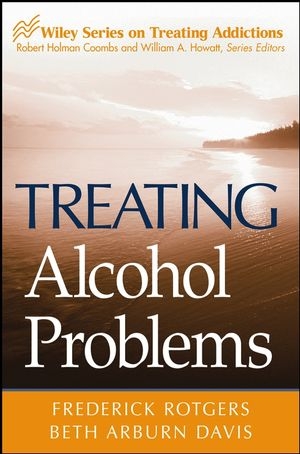
Part of the Wiley Series on Treating Addictions, Treating Alcohol Problems offers the latest evidence-based guidance on effectively diagnosing and treating the full spectrum of problems related to drinking. Whether you are an addictions counselor, mental health professional, or physician, you can use this all-in-one guide as a stepping-stone to seek out and develop better treatment options for your clients.
Bringing treatment approaches into harmony with scientific findings, Treating Alcohol Problems summarizes methods proven to be successful. Written in a clear and accessible style, the text focuses on presenting the information most directly useful for helping clients. This handy guide is ideal for training and continuing education, as a refresher for seasoned professionals, and as a useful primer for all who come into contact with individuals suffering from alcohol abuse.
Coverage includes:
- Conceptual foundations-defining alcohol problems
- Identifying alcohol problems
- Assessment and treatment planning
- Treatment tools, programs, and theories
- When and how clients should be discharged to aftercare
- Increasing recovery success
- Culture, coaching, and change-moving beyond alcohol problems
- Finding and getting the best out of professional resources
Supporting this expert coverage, the reader-friendly series format features quizzes, checklists, diagrams, 'Research Frontier' boxes, problem-solving scenarios, 'Dos and Don'ts' lists, 'Test Yourself' questions, suggested resources, and more. These tools help you reinforce your understanding and integrate this knowledge into your practice. In addition, a thorough bibliography and appendix provide lists of contacts for self-help groups, residential and outpatient treatment programs, support groups, Web sites, and reading material.
Treating Alcohol Problems is an essential resource for mental health professionals, as well as an indispensable study guide for students in psychology and social services courses.
Frederick Rotgers, PsyD, is Associate Professor in the Department of Psychology at the Philadelphia College of Osteopathic Medicine. He is the Senior Editor of Treating Substance Abuse: Theory and Technique and Senior Author of Responsible Drinking: A Moderation Management Approach for Problem Drinkers. He is on the editorial boards of several journals and is active in promoting harm reduction treatment approaches.
Beth Arburn Davis, PsyD, completed her doctorate in clinical psychology at the Philadelphia College of Osteopathic Medicine and works as a behavioral health therapist for a large health care organization. Prior to entering graduate school, she was a journalist for more than fifteen years.
This handy guide provides a single source of evidence-based methods for assessing and treating alcohol problems Part of the Wiley Series on Treating Addictions, Treating Alcohol Problems offers the latest evidence-based guidance on effectively diagnosing and treating the full spectrum of problems related to drinking. Whether you are an addictions counselor, mental health professional, or physician, you can use this all-in-one guide as a stepping-stone to seek out and develop better treatment options for your clients. Bringing treatment approaches into harmony with scientific findings, Treating Alcohol Problems summarizes methods proven to be successful. Written in a clear and accessible style, the text focuses on presenting the information most directly useful for helping clients. This handy guide is ideal for training and continuing education, as a refresher for seasoned professionals, and as a useful primer for all who come into contact with individuals suffering from alcohol abuse. Coverage includes: Conceptual foundations-defining alcohol problems Identifying alcohol problems Assessment and treatment planning Treatment tools, programs, and theories When and how clients should be discharged to aftercare Increasing recovery success Culture, coaching, and change-moving beyond alcohol problems Finding and getting the best out of professional resources Supporting this expert coverage, the reader-friendly series format features quizzes, checklists, diagrams, "e;Research Frontier"e; boxes, problem-solving scenarios, "e;Dos and Don'ts"e; lists, "e;Test Yourself"e; questions, suggested resources, and more. These tools help you reinforce your understanding and integrate this knowledge into your practice. In addition, a thorough bibliography and appendix provide lists of contacts for self-help groups, residential and outpatient treatment programs, support groups, Web sites, and reading material. Treating Alcohol Problems is an essential resource for mental health professionals, as well as an indispensable study guide for students in psychology and social services courses.
Frederick Rotgers, PsyD, is Associate Professor in the Department of Psychology at the Philadelphia College of Osteopathic Medicine. He is the Senior Editor of Treating Substance Abuse: Theory and Technique and Senior Author of Responsible Drinking: A Moderation Management Approach for Problem Drinkers. He is on the editorial boards of several journals and is active in promoting harm reduction treatment approaches. Beth Arburn Davis, PsyD, completed her doctorate in clinical psychology at the Philadelphia College of Osteopathic Medicine and works as a behavioral health therapist for a large health care organization. Prior to entering graduate school, she was a journalist for more than fifteen years.
| Erscheint lt. Verlag | 27.4.2006 |
|---|---|
| Reihe/Serie | Wiley Treating Addictions series |
| Wiley Treating Addictions Series | Wiley Treating Addictions Series |
| Sprache | englisch |
| Themenwelt | Geisteswissenschaften ► Psychologie ► Sucht / Drogen |
| Schlagworte | Addictions • Alcohol • allinone • Better • Clients • Counselor • Develop • effectively • evidencebased methods • full • Guide • Handy • latest evidencebased guidance • Part • Problems • Psychologie • Psychology • Single • source • spectrum • steppingstone • Sucht • Treatment |
| ISBN-13 | 9780471786801 / 9780471786801 |
| Informationen gemäß Produktsicherheitsverordnung (GPSR) | |
| Haben Sie eine Frage zum Produkt? |
 PDF (Adobe DRM)
Kopierschutz: Adobe-DRM
Adobe-DRM ist ein Kopierschutz, der das eBook vor Mißbrauch schützen soll. Dabei wird das eBook bereits beim Download auf Ihre persönliche Adobe-ID autorisiert. Lesen können Sie das eBook dann nur auf den Geräten, welche ebenfalls auf Ihre Adobe-ID registriert sind.
Details zum Adobe-DRM
Dateiformat: PDF (Portable Document Format)
Mit einem festen Seitenlayout eignet sich die PDF besonders für Fachbücher mit Spalten, Tabellen und Abbildungen. Eine PDF kann auf fast allen Geräten angezeigt werden, ist aber für kleine Displays (Smartphone, eReader) nur eingeschränkt geeignet.
Systemvoraussetzungen:
PC/Mac: Mit einem PC oder Mac können Sie dieses eBook lesen. Sie benötigen eine
eReader: Dieses eBook kann mit (fast) allen eBook-Readern gelesen werden. Mit dem amazon-Kindle ist es aber nicht kompatibel.
Smartphone/Tablet: Egal ob Apple oder Android, dieses eBook können Sie lesen. Sie benötigen eine
Geräteliste und zusätzliche Hinweise
Buying eBooks from abroad
For tax law reasons we can sell eBooks just within Germany and Switzerland. Regrettably we cannot fulfill eBook-orders from other countries.
aus dem Bereich