


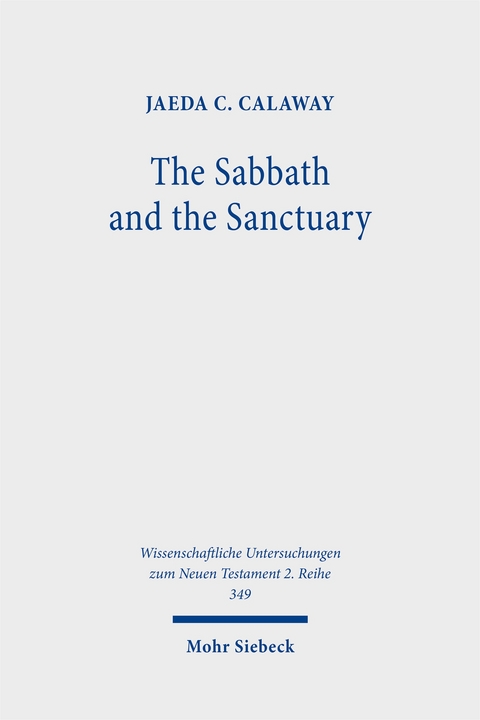
The Sabbath and the Sanctuary
Access to God in the Letter to the Hebrews and its Priestly Context
Seiten
Wer erhält Zutritt zur heiligen und himmlischen Gegenwart Gottes? Und wie? Verschiedene antike jüdische und aufstrebende christliche Gruppierungen diskutierten diese Fragen im ersten Jahrhundert n. Chr. Jaeda C. Calaway stellt fest, dass der Hebräerbrief sich der Diskussion um diese Fragen anschloss, indem er das priesterliche, dezidiert sakrale Bezugssystem, das den Sabbat auf das Heiligtum ausrichtete, in Anspruch nahm.
Who can enter the sacred and heavenly presence of God? And how? Various ancient Jewish and emergent Christian groups disputed these questions in the first century CE. Jared C. Calaway states that the Letter to the Hebrews joined this debate by engaging and countering priestly frameworks of sacred access that aligned the Sabbath with the sanctuary. From the Hebrew Bible through late Second Temple Judaism, the sanctity of the sanctuary could be experienced through the Sabbath, sacred space through sacred time. In its sweeping vistas of Sabbath rest and the heavenly homeland, the heavenly sanctuary and the coming age, and the heavenly priesthood, Hebrews reworked this priestly framework, showing familiarity with its traditional and contemporary forms, such as the "Songs of the Sabbath Sacrifice". In a manner resembling postwar layers of the emergent Christian tradition, instead of entering God's sacred and heavenly Presence through the weekly Sabbath, one could only experience the heavenly realities of the Sabbath and the sanctuary through faithfulness and obedience to Jesus, the faithful and obedient heavenly high priest who purifies, sanctifies, and perfects.
Who can enter the sacred and heavenly presence of God? And how? Various ancient Jewish and emergent Christian groups disputed these questions in the first century CE. Jared C. Calaway states that the Letter to the Hebrews joined this debate by engaging and countering priestly frameworks of sacred access that aligned the Sabbath with the sanctuary. From the Hebrew Bible through late Second Temple Judaism, the sanctity of the sanctuary could be experienced through the Sabbath, sacred space through sacred time. In its sweeping vistas of Sabbath rest and the heavenly homeland, the heavenly sanctuary and the coming age, and the heavenly priesthood, Hebrews reworked this priestly framework, showing familiarity with its traditional and contemporary forms, such as the "Songs of the Sabbath Sacrifice". In a manner resembling postwar layers of the emergent Christian tradition, instead of entering God's sacred and heavenly Presence through the weekly Sabbath, one could only experience the heavenly realities of the Sabbath and the sanctuary through faithfulness and obedience to Jesus, the faithful and obedient heavenly high priest who purifies, sanctifies, and perfects.
Born 1980; 2003 BA from Illinois Wesleyan University; 2005 MA, 2007 M.Phil. and 2010 PhD from Columbia University in New York City; currently at Illinois College, Jacksonville, Illinois.
| Erscheint lt. Verlag | 2.8.2013 |
|---|---|
| Reihe/Serie | Wissenschaftliche Untersuchungen zum Neuen Testament 2. Reihe |
| Verlagsort | Tübingen |
| Sprache | englisch |
| Maße | 154 x 240 mm |
| Gewicht | 425 g |
| Themenwelt | Religion / Theologie ► Christentum ► Bibelausgaben / Bibelkommentare |
| Geisteswissenschaften ► Religion / Theologie ► Judentum | |
| Geisteswissenschaften ► Sprach- / Literaturwissenschaft ► Literaturwissenschaft | |
| Schlagworte | Angelic • Angelic Liturgy • Epistle • Epistle to Hebrews • Hebräerbrief • Hebrews • Jewish • Jewish Priesthood • Liturgy • priesthood • Sabbat • Tabernacle • to |
| ISBN-13 | 9783161523656 / 9783161523656 |
| Zustand | Neuware |
| Informationen gemäß Produktsicherheitsverordnung (GPSR) | |
| Haben Sie eine Frage zum Produkt? |
Mehr entdecken
aus dem Bereich


aus dem Bereich
Buch | Softcover (2021)
De Gruyter (Verlag)
CHF 44,90


