


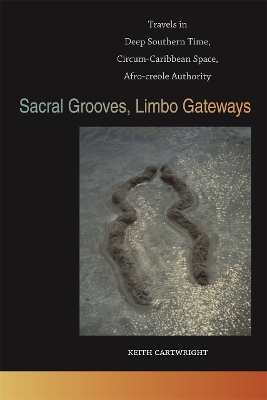
Sacral Grooves, Limbo Gateways
Travels in Deep Southern Time, Circum-Caribbean Space, Afro-creole Authority
Seiten
2013
University of Georgia Press (Verlag)
978-0-8203-4536-9 (ISBN)
University of Georgia Press (Verlag)
978-0-8203-4536-9 (ISBN)
Drawing from Haitian and New Orleanian Vodou, Cuban and South Floridian Santeria, as well as from Afro-Baptist (Caribbean, Geechee, and Bahamian) models of encounter with otherness, Sacral Grooves, Limbo Gateways places deep southern texts within the context of Afro-Atlantic modernity.
“We’re seeing people that we didn’t know exist,” the director of FEMA acknowledged in the wake of Hurricane Katrina. Sacral Grooves, Limbo Gateways offers a corrective to some of America’s institutionalized invisibilities by delving into the submerged networks of ritual performance, writing, intercultural history, and migration that have linked the coastal U.S. South with the Caribbean and the wider Atlantic world. This interdisciplinary study slips beneath the bar of rigid national and literary periods, embarking upon deeper—more rhythmic and embodied—signatures of time. It swings low through ecologies and symbolic orders of creolized space. And it reappraises pluralistic modes of knowledge, kinship, and authority that have sustained vital forms of agency (such as jazz) amid abysses of racialized trauma.
Drawing from Haitian Vodou and New Orleanian Voudou and from Cuban and South Floridian Santería, as well as from Afro-Baptist (Caribbean, Geechee, and Bahamian) models of encounters with otherness, this book reemplaces deep-southern texts within the counterclockwise ring-stepping of a long Afro-Atlantic modernity. Turning to an orphan girl’s West African initiation tale to follow a remarkably traveled body of feminine rites and writing (in works by Paule Marshall, Zora Neale Hurston, Lydia Cabrera, William Faulkner, James Weldon Johnson, and LeAnne Howe, among others), Cartwright argues that only in holistic form, emergent from gulfs of cross-cultural witness, can literary and humanistic authority find legitimacy. Without such grounding, he contends, our educational institutions blind and even poison students, bringing them to “swallow lye,” like the grandson of Phoenix Jackson in Eudora Welty’s “A Worn Path.” Here, literary study may open pathways to alternative medicines—fetched by tenacious avatars like Phoenix (or an orphan Kumba or a shell-shaking Turtle)—to remedy the lies our partial histories have made us swallow.
“We’re seeing people that we didn’t know exist,” the director of FEMA acknowledged in the wake of Hurricane Katrina. Sacral Grooves, Limbo Gateways offers a corrective to some of America’s institutionalized invisibilities by delving into the submerged networks of ritual performance, writing, intercultural history, and migration that have linked the coastal U.S. South with the Caribbean and the wider Atlantic world. This interdisciplinary study slips beneath the bar of rigid national and literary periods, embarking upon deeper—more rhythmic and embodied—signatures of time. It swings low through ecologies and symbolic orders of creolized space. And it reappraises pluralistic modes of knowledge, kinship, and authority that have sustained vital forms of agency (such as jazz) amid abysses of racialized trauma.
Drawing from Haitian Vodou and New Orleanian Voudou and from Cuban and South Floridian Santería, as well as from Afro-Baptist (Caribbean, Geechee, and Bahamian) models of encounters with otherness, this book reemplaces deep-southern texts within the counterclockwise ring-stepping of a long Afro-Atlantic modernity. Turning to an orphan girl’s West African initiation tale to follow a remarkably traveled body of feminine rites and writing (in works by Paule Marshall, Zora Neale Hurston, Lydia Cabrera, William Faulkner, James Weldon Johnson, and LeAnne Howe, among others), Cartwright argues that only in holistic form, emergent from gulfs of cross-cultural witness, can literary and humanistic authority find legitimacy. Without such grounding, he contends, our educational institutions blind and even poison students, bringing them to “swallow lye,” like the grandson of Phoenix Jackson in Eudora Welty’s “A Worn Path.” Here, literary study may open pathways to alternative medicines—fetched by tenacious avatars like Phoenix (or an orphan Kumba or a shell-shaking Turtle)—to remedy the lies our partial histories have made us swallow.
KEITH CARTWRIGHT is an associate professor of English at the University of North Florida. He is the author of Reading Africa into American Literature: Epics, Fables, and Gothic Tales; Junkanoo: A Christmas Pageant; and Saint-Louis: A Wool Strip-Cloth for Sekou Dabo.
| Reihe/Serie | The New Southern Studies |
|---|---|
| Zusatzinfo | 4 b&w illus. |
| Verlagsort | Georgia |
| Sprache | englisch |
| Maße | 152 x 229 mm |
| Gewicht | 612 g |
| Themenwelt | Literatur ► Biografien / Erfahrungsberichte |
| Geisteswissenschaften ► Sprach- / Literaturwissenschaft ► Anglistik / Amerikanistik | |
| Geisteswissenschaften ► Sprach- / Literaturwissenschaft ► Literaturwissenschaft | |
| Sozialwissenschaften ► Ethnologie ► Volkskunde | |
| Sozialwissenschaften ► Soziologie | |
| ISBN-10 | 0-8203-4536-9 / 0820345369 |
| ISBN-13 | 978-0-8203-4536-9 / 9780820345369 |
| Zustand | Neuware |
| Informationen gemäß Produktsicherheitsverordnung (GPSR) | |
| Haben Sie eine Frage zum Produkt? |
Mehr entdecken
aus dem Bereich

aus dem Bereich
Poetik eines sozialen Urteils
Buch | Hardcover (2023)
De Gruyter (Verlag)
CHF 83,90


