


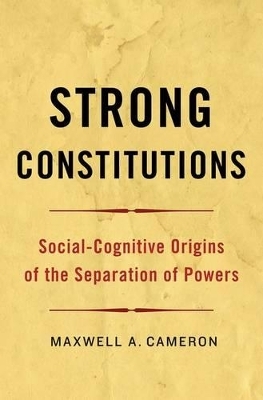
Strong Constitutions
Social-Cognitive Origins of the Separation of Powers
Seiten
2013
Oxford University Press Inc (Verlag)
978-0-19-998744-3 (ISBN)
Oxford University Press Inc (Verlag)
978-0-19-998744-3 (ISBN)
A bold argument that constitutional states are not weaker because their powers are divided -- they are often stronger because they solve collective action problems rooted in speech and communication.
The separation of powers is an idea with ancient origins, but nowadays it is often relegated to legal doctrine, public philosophy, or the history of ideas. Yet the concept is often evoked in debates on the "war " on terrorism, the use of emergency powers, or constitutional reform. So it is surprising that there have been few attempts to place the study of the separation of powers on a social scientific footing. To that end, this book makes a bold conjecture. It argues that the separation of powers emerged with the spread of literacy, became a central part of constitutional thought in the context of the Gutenberg revolution, and faces unprecedented challenges in our current era of electronic communication. The separation of powers is linked to social-cognitive changes associated with evolving media of communication.
The essence of the argument is that constitutional states use texts to coordinate collective action, and they do so by creating governmental agencies with specific jurisdiction and competence over distinct types of power. The first, and most familiar to students of political science since Max Weber, is the power to make decisions backed by legally sanctioned coercion. Cameron highlights two other forms of power: the deliberative power to make procedurally legitimate laws, and the judicial power to interpret and apply laws in particular circumstances. The division of government into three such branches enables state officials and citizens to use written texts-legal codes and documents, including constitutions-along with unwritten rules and conventions to coordinate their activities on larger scales and over longer time horizons.
Cameron argues that constitutional states are not weaker because their powers are divided. They are often stronger because they solve collective action problems rooted in speech and communication. The book is a must read for anyone interested in the separation of powers, its origin, evolution, and consequences.
The separation of powers is an idea with ancient origins, but nowadays it is often relegated to legal doctrine, public philosophy, or the history of ideas. Yet the concept is often evoked in debates on the "war " on terrorism, the use of emergency powers, or constitutional reform. So it is surprising that there have been few attempts to place the study of the separation of powers on a social scientific footing. To that end, this book makes a bold conjecture. It argues that the separation of powers emerged with the spread of literacy, became a central part of constitutional thought in the context of the Gutenberg revolution, and faces unprecedented challenges in our current era of electronic communication. The separation of powers is linked to social-cognitive changes associated with evolving media of communication.
The essence of the argument is that constitutional states use texts to coordinate collective action, and they do so by creating governmental agencies with specific jurisdiction and competence over distinct types of power. The first, and most familiar to students of political science since Max Weber, is the power to make decisions backed by legally sanctioned coercion. Cameron highlights two other forms of power: the deliberative power to make procedurally legitimate laws, and the judicial power to interpret and apply laws in particular circumstances. The division of government into three such branches enables state officials and citizens to use written texts-legal codes and documents, including constitutions-along with unwritten rules and conventions to coordinate their activities on larger scales and over longer time horizons.
Cameron argues that constitutional states are not weaker because their powers are divided. They are often stronger because they solve collective action problems rooted in speech and communication. The book is a must read for anyone interested in the separation of powers, its origin, evolution, and consequences.
Associate Professor of Political Science, University of British Columbia
List of Figures ; Acknowledgements ; Chapter 1. Introduction: Strong Constitutions ; Chapter 2. Social-Cognitive Origins of the Separation of Powers ; Chapter 3. Literacy and the Invention of Constitutions ; Chapter 4. The Printing Press and Constitutional Revolutions ; Chapter 5. Electronic Media, Mass Politics, and Electoral Democracy ; Chapter 6. Beyond Liberalism: Language, Law, and Deliberation ; Chapter 7. Democracy Without the Separation of Powers? ; Chapter 8. Conclusion: Writing, Power, and Democracy ; Bibliography
| Erscheint lt. Verlag | 29.8.2013 |
|---|---|
| Verlagsort | New York |
| Sprache | englisch |
| Maße | 236 x 160 mm |
| Gewicht | 550 g |
| Themenwelt | Geisteswissenschaften ► Philosophie |
| Recht / Steuern ► EU / Internationales Recht | |
| Recht / Steuern ► Öffentliches Recht | |
| Sozialwissenschaften ► Politik / Verwaltung ► Politische Theorie | |
| Sozialwissenschaften ► Politik / Verwaltung ► Staat / Verwaltung | |
| ISBN-10 | 0-19-998744-0 / 0199987440 |
| ISBN-13 | 978-0-19-998744-3 / 9780199987443 |
| Zustand | Neuware |
| Informationen gemäß Produktsicherheitsverordnung (GPSR) | |
| Haben Sie eine Frage zum Produkt? |
Mehr entdecken
aus dem Bereich


aus dem Bereich
Weltherrschaft und Menschheitsethos
Buch | Hardcover (2025)
Suhrkamp (Verlag)
CHF 67,20
Leben und letzte Reise eines Revolutionärs
Buch | Hardcover (2025)
C.H.Beck (Verlag)
CHF 36,40


