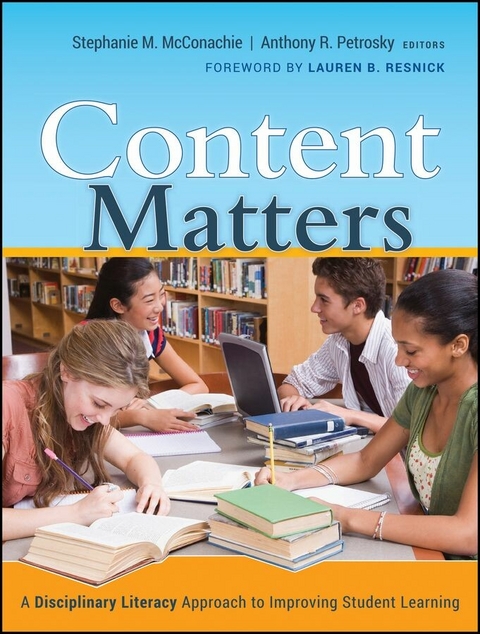
Content Matters (eBook)
John Wiley & Sons (Verlag)
978-0-470-54981-0 (ISBN)
This book introduces teachers to the Disciplinary Literacy instructional framework developed by the Institute for Learning, University of Pittsburgh. Grounded in the Principles of Learning developed by acclaimed educator Lauren Resnick, the framework is designed to prepare students, grades 6 and up, to master the rigorous academic content learning required for college success. Unlike 'generic' teaching models, the framework is specifically tailored for each of the content disciplines. Highly practical, the book shows teachers how to integrate literacy development and thinking practices into their routine content instruction, with separate chapters devoted to math, science, history, and English/language arts. The book also shows how school instructional leaders can support teachers in learning and using this instructional approach.
- Offers an innovative approach for improving literacy, thinking, and content learning in secondary students
- Includes detailed instructional guidance plus numerous classroom examples of lessons, dialogs, and teaching routines
- Features chapters on each of the content areas-math, science, language arts, and social sciences
- Provides leadership guidance in implementing the method
- Foreword written by internationally acclaimed educator and cognitive scientist Lauren Resnick
Stephanie M. McConachie is a fellow at the Institute for Learning at the Learning Research and Development Center of the University of Pittsburgh.
Anthony R. Petrosky is professor and associate dean at the School of Education at the University of Pittsburgh.
Headed by distinguished scholar, Lauren B. Resnick, the Institute for Learning (IFL) provides consultation, coaching, and professional development services to schools and districts in areas of leadership and instructional practice.
An authoritative guide for improving teaching, learning, and literacy in content area classrooms This book introduces teachers to the Disciplinary Literacy instructional framework developed by the Institute for Learning, University of Pittsburgh. Grounded in the Principles of Learning developed by acclaimed educator Lauren Resnick, the framework is designed to prepare students, grades 6 and up, to master the rigorous academic content learning required for college success. Unlike 'generic' teaching models, the framework is specifically tailored for each of the content disciplines. Highly practical, the book shows teachers how to integrate literacy development and thinking practices into their routine content instruction, with separate chapters devoted to math, science, history, and English/language arts. The book also shows how school instructional leaders can support teachers in learning and using this instructional approach. Offers an innovative approach for improving literacy, thinking, and content learning in secondary students Includes detailed instructional guidance plus numerous classroom examples of lessons, dialogs, and teaching routines Features chapters on each of the content areas-math, science, language arts, and social sciences Provides leadership guidance in implementing the method Foreword written by internationally acclaimed educator and cognitive scientist Lauren Resnick
Stephanie M. McConachie is a fellow at the Institute for Learning at the Learning Research and Development Center of the University of Pittsburgh. Anthony R. Petrosky is professor and associate dean at the School of Education at the University of Pittsburgh. Headed by distinguished scholar, Lauren B. Resnick, the Institute for Learning (IFL) provides consultation, coaching, and professional development services to schools and districts in areas of leadership and instructional practice.
Foreword by Lauren B. Resnick vii
Preface ix
Acknowledgments xiii
The Editors xvii
The Authors xix
ONE Engaging Content Teachers in Literacy Development 1
Stephanie M. McConachie, Anthony R. Petrosky
TWO Disciplinary Literacy: A Principle-Based Framework 15
Stephanie M. McConachie
THREE Disciplinary Literacy in the History Classroom 33
Anita K. Ravi
FOUR Disciplinary Literacy in the Mathematics Classroom 63
Victoria L. Bill, Idorenyin Jamar
FIVE Disciplinary Literacy in the Science Classroom 87
Samuel A. Spiegel, Jody Bintz, Joseph A. Taylor, Nancy M. Landes, Deborah L. Jordan
SIX Disciplinary Literacy in the English Language Arts Classroom 129
Anthony R. Petrosky, Stephanie M. McConachie, Vivian Mihalakis
SEVEN Embedding Disciplinary Literacy: Leadership and Professional Learning 163/
Stephanie M. McConachie, Rosita E. Apodaca
Appendix A: Disciplinary Literacy Design Principles by Core Academic Area 197
Appendix B: Disciplinary Literacy Observation Protocol 215
Appendix C: Selected Disciplinary Literacy Tools 219
References 223
Index 241
| Erscheint lt. Verlag | 4.11.2009 |
|---|---|
| Vorwort | Lauren B. Resnick |
| Sprache | englisch |
| Themenwelt | Geisteswissenschaften |
| Sozialwissenschaften ► Pädagogik ► Bildungstheorie | |
| Sozialwissenschaften ► Pädagogik ► Schulpädagogik / Sekundarstufe I+II | |
| Schlagworte | Bildungswesen • Education • Guide for improving adolescent literacy, guide for improving middle school literacy, guide for improving high school literacy, suggestions for improving middle school literacy, suggestions for improving high school literacy, ideas for improving middle school literacy, ideas for improving high school literacy • K-12 / Lehren u. Lernen • K-12 / Lehrerbildung • K-12 / Leitung u. Verwaltung • Leadership & Administration (K-12) • Lehrerbildung • Lernen • Schule • Teacher Education (K-12) • Teaching & Learning (K-12) |
| ISBN-10 | 0-470-54981-5 / 0470549815 |
| ISBN-13 | 978-0-470-54981-0 / 9780470549810 |
| Informationen gemäß Produktsicherheitsverordnung (GPSR) | |
| Haben Sie eine Frage zum Produkt? |
 EPUB (Adobe DRM)
Größe: 2,8 MB
Kopierschutz: Adobe-DRM
Adobe-DRM ist ein Kopierschutz, der das eBook vor Mißbrauch schützen soll. Dabei wird das eBook bereits beim Download auf Ihre persönliche Adobe-ID autorisiert. Lesen können Sie das eBook dann nur auf den Geräten, welche ebenfalls auf Ihre Adobe-ID registriert sind.
Details zum Adobe-DRM
Dateiformat: EPUB (Electronic Publication)
EPUB ist ein offener Standard für eBooks und eignet sich besonders zur Darstellung von Belletristik und Sachbüchern. Der Fließtext wird dynamisch an die Display- und Schriftgröße angepasst. Auch für mobile Lesegeräte ist EPUB daher gut geeignet.
Systemvoraussetzungen:
PC/Mac: Mit einem PC oder Mac können Sie dieses eBook lesen. Sie benötigen eine
eReader: Dieses eBook kann mit (fast) allen eBook-Readern gelesen werden. Mit dem amazon-Kindle ist es aber nicht kompatibel.
Smartphone/Tablet: Egal ob Apple oder Android, dieses eBook können Sie lesen. Sie benötigen eine
Geräteliste und zusätzliche Hinweise
Buying eBooks from abroad
For tax law reasons we can sell eBooks just within Germany and Switzerland. Regrettably we cannot fulfill eBook-orders from other countries.
 PDF (Adobe DRM)
Kopierschutz: Adobe-DRM
Adobe-DRM ist ein Kopierschutz, der das eBook vor Mißbrauch schützen soll. Dabei wird das eBook bereits beim Download auf Ihre persönliche Adobe-ID autorisiert. Lesen können Sie das eBook dann nur auf den Geräten, welche ebenfalls auf Ihre Adobe-ID registriert sind.
Details zum Adobe-DRM
Dateiformat: PDF (Portable Document Format)
Mit einem festen Seitenlayout eignet sich die PDF besonders für Fachbücher mit Spalten, Tabellen und Abbildungen. Eine PDF kann auf fast allen Geräten angezeigt werden, ist aber für kleine Displays (Smartphone, eReader) nur eingeschränkt geeignet.
Systemvoraussetzungen:
PC/Mac: Mit einem PC oder Mac können Sie dieses eBook lesen. Sie benötigen eine
eReader: Dieses eBook kann mit (fast) allen eBook-Readern gelesen werden. Mit dem amazon-Kindle ist es aber nicht kompatibel.
Smartphone/Tablet: Egal ob Apple oder Android, dieses eBook können Sie lesen. Sie benötigen eine
Geräteliste und zusätzliche Hinweise
Buying eBooks from abroad
For tax law reasons we can sell eBooks just within Germany and Switzerland. Regrettably we cannot fulfill eBook-orders from other countries.
aus dem Bereich