Detecting Lies and Deceit (eBook)
John Wiley & Sons (Verlag)
978-0-470-72729-4 (ISBN)
Do gender and personality differences affect how people lie?
How can lies be detected?
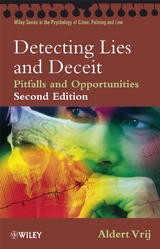
Detecting Lies and Deceit provides the most comprehensive review of deception to date. This revised edition provides an up-to-date account of deception research and discusses the working and efficacy of the most commonly used lie detection tools, including:
- Behaviour Analysis Interview
- Statement Validity Assessment
- Reality Monitoring
- Scientific Content Analysis
- Several different polygraph tests
- Voice Stress Analysis
- Thermal Imaging
- EEG-P300
- Functional Magnetic Resonance Imaging (fMRI)
All three aspects of deception are covered: nonverbal cues, speech and written statement analysis and (neuro)physiological responses. The most common errors in lie detection are discussed and practical guidelines are provided to help professionals improve their lie detection skills.
Detecting Lies and Deceit is a must-have resource for students, academics and professionals in psychology, criminology, policing and law.
Aldert Vrij is a Professor of Applied Social Psychology in the Department of Psychology at the University of Portsmouth (UK). He has published more than 300 articles and book chapters to date, mainly on the subjects of nonverbal and verbal cues to deception and lie detection. he also advises the police about conducting interviews with suspects, acts as an Expert Witness in court, and gives invited talks and workshops on lie detection to practitioners and scholars across the world. he is at present Editor of Legal and Criminological Psychology, a forensic journal published by the British Psychological Society.
Why do people lie?Do gender and personality differences affect how people lie?How can lies be detected? Detecting Lies and Deceit provides the most comprehensive review of deception to date. This revised edition provides an up-to-date account of deception research and discusses the working and efficacy of the most commonly used lie detection tools, including: Behaviour Analysis Interview Statement Validity Assessment Reality Monitoring Scientific Content Analysis Several different polygraph tests Voice Stress Analysis Thermal Imaging EEG-P300 Functional Magnetic Resonance Imaging (fMRI) All three aspects of deception are covered: nonverbal cues, speech and written statement analysis and (neuro)physiological responses. The most common errors in lie detection are discussed and practical guidelines are provided to help professionals improve their lie detection skills. Detecting Lies and Deceit is a must-have resource for students, academics and professionals in psychology, criminology, policing and law.
Aldert Vrij is a Professor of Applied Social Psychology in the Department of Psychology at the University of Portsmouth (UK). He has published more than 300 articles and book chapters to date, mainly on the subjects of nonverbal and verbal cues to deception and lie detection. he also advises the police about conducting interviews with suspects, acts as an Expert Witness in court, and gives invited talks and workshops on lie detection to practitioners and scholars across the world. he is at present Editor of Legal and Criminological Psychology, a forensic journal published by the British Psychological Society.
About the Author vii
Series Preface ix
Preface xi
Acknowledgements xiii
1 Introduction 1
2 Lying: A Selfish Act and a Social Lubricant 11
3 Nonverbal Behaviour and Deception 37
4 Individual Verbal Cues to Deception 101
5 Beliefs About Nonverbal and Verbal Cues to Deception 115
6 Lie Detection Without Using Specialised Tools 141
7 The Behaviour Analysis Interview 189
8 Statement Validity Assessment 201
9 Reality Monitoring 261
10 Scientific Content Analysis 281
11 Physiological Lie Detection: The Concern Approach 293
12 Physiological Lie Detection: The Orienting Reflex Approach 343
13 Physiological Lie Detection: functional Magnetic Resonance Imaging (fMRI) 365
14 Pitfalls: Why People Fail To Catch Liars 373
15 Opportunities: How People Can Improve Their Lie Detection Skills 389
Epilogue 419
References 421
Index 483
| Erscheint lt. Verlag | 15.4.2008 |
|---|---|
| Reihe/Serie | Wiley Series in Psychology of Crime, Policing and Law |
| Wiley Series in The Psychology of Crime, Policing and Law | Wiley Series in The Psychology of Crime, Policing and Law |
| Sprache | englisch |
| Themenwelt | Geisteswissenschaften ► Psychologie ► Allgemeine Psychologie |
| Geisteswissenschaften ► Psychologie ► Verhaltenstherapie | |
| Schlagworte | Account • Analysis • Behaviour • commonly • Content • Deception • differences • Different • Forensic Psychology • Forensische Psychologie • Interview • Lies • People • people lie • Polygraph • Psychologie • Psychology • Reality • Research • Review • Scientific • Several • Statement • Tests • thermal • uptodate • voice stress |
| ISBN-10 | 0-470-72729-2 / 0470727292 |
| ISBN-13 | 978-0-470-72729-4 / 9780470727294 |
| Informationen gemäß Produktsicherheitsverordnung (GPSR) | |
| Haben Sie eine Frage zum Produkt? |
 PDF (Adobe DRM)
Kopierschutz: Adobe-DRM
Adobe-DRM ist ein Kopierschutz, der das eBook vor Mißbrauch schützen soll. Dabei wird das eBook bereits beim Download auf Ihre persönliche Adobe-ID autorisiert. Lesen können Sie das eBook dann nur auf den Geräten, welche ebenfalls auf Ihre Adobe-ID registriert sind.
Details zum Adobe-DRM
Dateiformat: PDF (Portable Document Format)
Mit einem festen Seitenlayout eignet sich die PDF besonders für Fachbücher mit Spalten, Tabellen und Abbildungen. Eine PDF kann auf fast allen Geräten angezeigt werden, ist aber für kleine Displays (Smartphone, eReader) nur eingeschränkt geeignet.
Systemvoraussetzungen:
PC/Mac: Mit einem PC oder Mac können Sie dieses eBook lesen. Sie benötigen eine
eReader: Dieses eBook kann mit (fast) allen eBook-Readern gelesen werden. Mit dem amazon-Kindle ist es aber nicht kompatibel.
Smartphone/Tablet: Egal ob Apple oder Android, dieses eBook können Sie lesen. Sie benötigen eine
Geräteliste und zusätzliche Hinweise
Buying eBooks from abroad
For tax law reasons we can sell eBooks just within Germany and Switzerland. Regrettably we cannot fulfill eBook-orders from other countries.
aus dem Bereich